Plan your trip
First trip to Morocco: a week or ten days of medinas, mountains and dunes
A first trip to Morocco is usually a loop between two old cities with the desert in the middle. Marrakech and Fes are the two great medinas, about as far apart by road as you can get on one trip, and the dunes of Erg Chebbi at Merzouga sit between them on the far side of the High Atlas. A week covers that line; ten days adds the blue town of Chefchaouen and the Atlantic capital, Rabat. The part to book first is the desert crossing, because it fixes every other night.
In this guide
Find the location ↗ — opens in a new tabThe short answer
For a week, book six nights: two in Marrakech, two on the road to and in the Sahara at Merzouga, and two in Fes, flying into Marrakech and home from Fes. For ten days and nine nights, fly into Casablanca, sleep in Rabat and Chefchaouen, then go south through Fes and the Sahara to Marrakech. Book first the three-day desert crossing and your first riad: shared three-day tours between Fes and Marrakech are listed on TourRadar at USD 274 per person, and the CTM coach from Rabat to Chefchaouen takes about 6 hours and costs from MAD 135. On the ten-day route, allow about MAD 9,600 per person on a budget, MAD 11,200 mid-range or MAD 18,400 in comfort, for two sharing a room, before flights: about MAD 960, 1,120 or 1,840 per person a day. The seven-day route comes to about MAD 10,500 per person, about MAD 1,500 per person a day. UK, US, Canadian, Australian and EU passports enter visa-free for up to 90 days, and you may carry at most MAD 2,000 in dirham banknotes in or out.
- Key point
- 7 days / 6 nights (Marrakech 2, the desert road and Merzouga 2, Fes 2) or 10 days / 9 nights (adding Rabat and Chefchaouen)
- Where it applies
- Marrakech and Fes, joined by a three-day road crossing over the High Atlas to the Erg Chebbi dunes at Merzouga
- Timing
- March to May and September to November; summer is very hot inland and in the desert, winter evenings are cool and desert nights cold
Seven days or ten: what each length buys
Both lengths are built on the same spine: Marrakech, the road east over the Tizi n'Tichka pass to the kasbahs and gorges of the south, a night in a desert camp at Merzouga, and the long drive north to Fes. The choice is whether to add the north, with Chefchaouen in the Rif and Rabat on the Atlantic, or to keep to that spine in one week.
Fly into one city and out of the other. Marrakech and Fes are far apart, and going back the way you came costs a whole day you do not need to spend on the road.
- 7 days / 6 nights: Marrakech 2, the desert tour 2 (one night on the road at the stop the operator sets, one in a camp at Merzouga), Fes 2. The seven-day itinerary gives each day, the hotels and the tour that covers the crossing.
- 10 days / 9 nights: fly into Casablanca and spend the first night in Rabat, go north to Chefchaouen, then Fes, the Sahara and Marrakech, and fly home from Marrakech. The ten-day itinerary has the nights and the trains.
- Under a week: stay with one city and its day trips. Marrakech pairs with the High Atlas villages and Essaouira; Fes pairs with Meknes and the Roman ruins at Volubilis.
Marrakech, the Sahara and Fes in the order you meet them
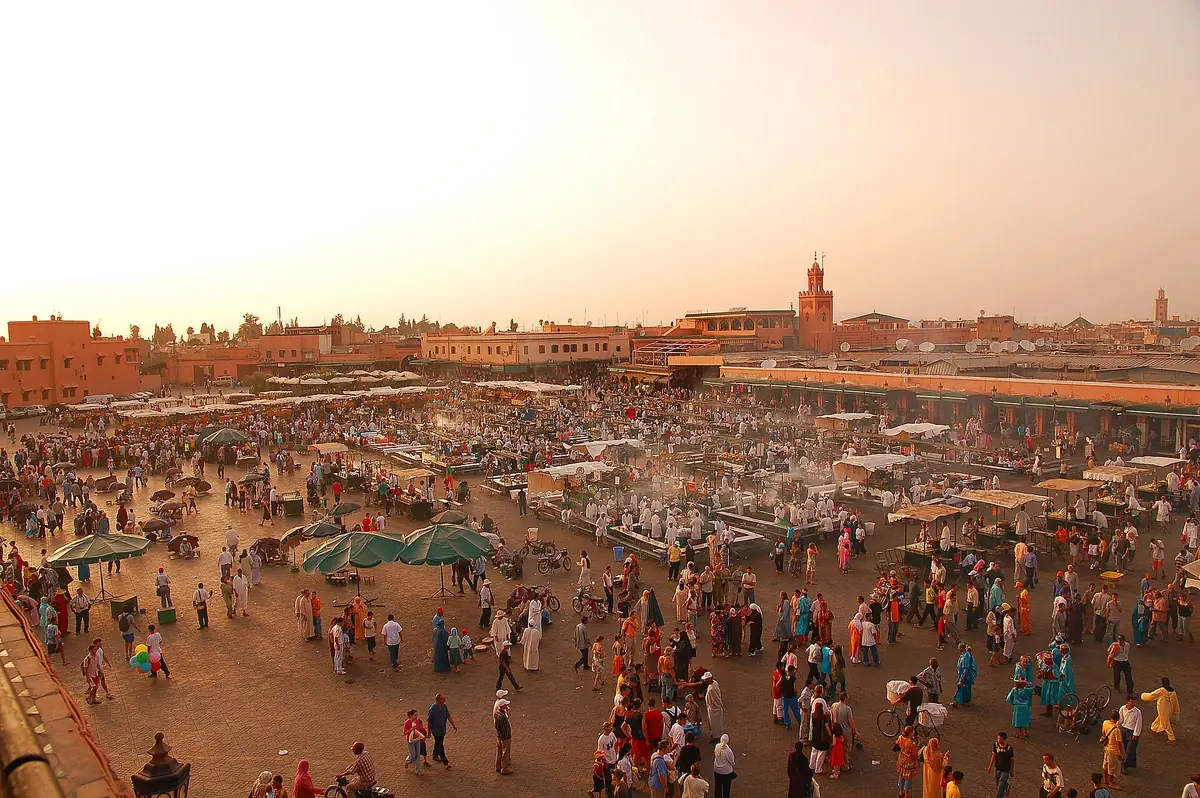
Marrakech is the busy, red-walled introduction. Jemaa el-Fnaa, the square at the heart of the medina, fills with food stalls and storytellers at dusk; the Koutoubia Mosque's minaret rises beside it, the souks run north from the square, and the Majorelle Garden, the Bahia Palace and the El Badi Palace are the visits most people add. Give it at least two nights; Visit Morocco, the national tourist office, suggests three days.
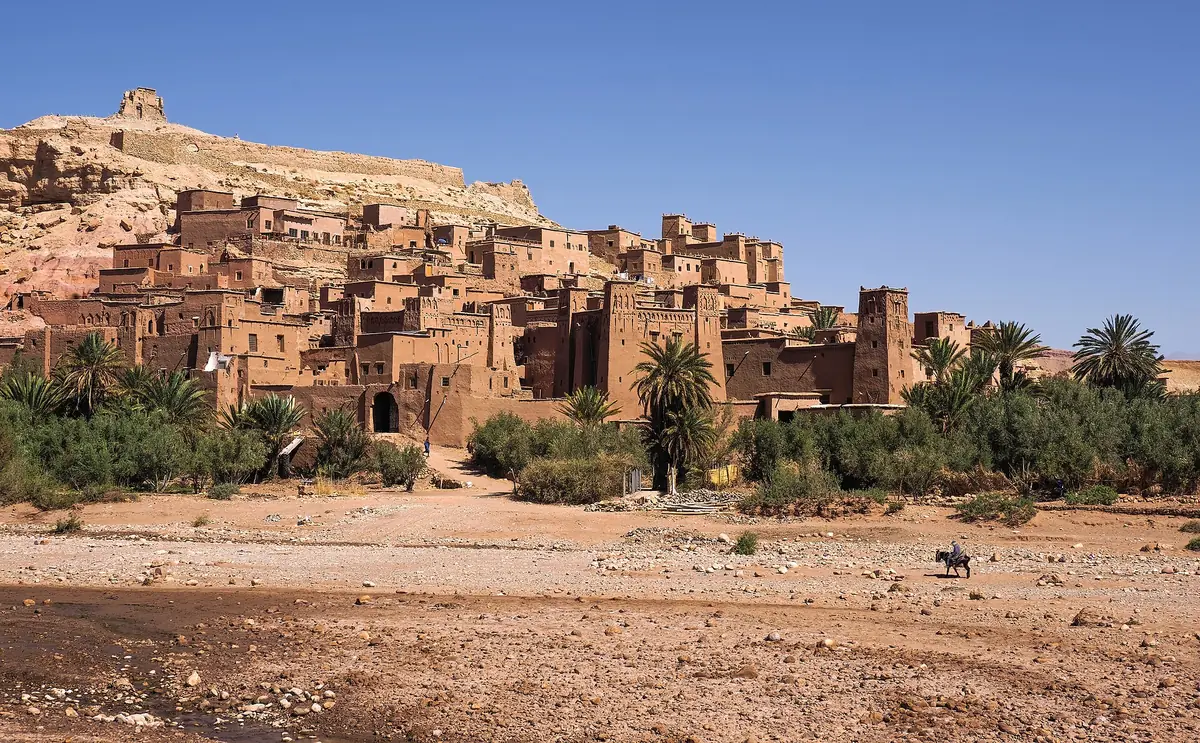
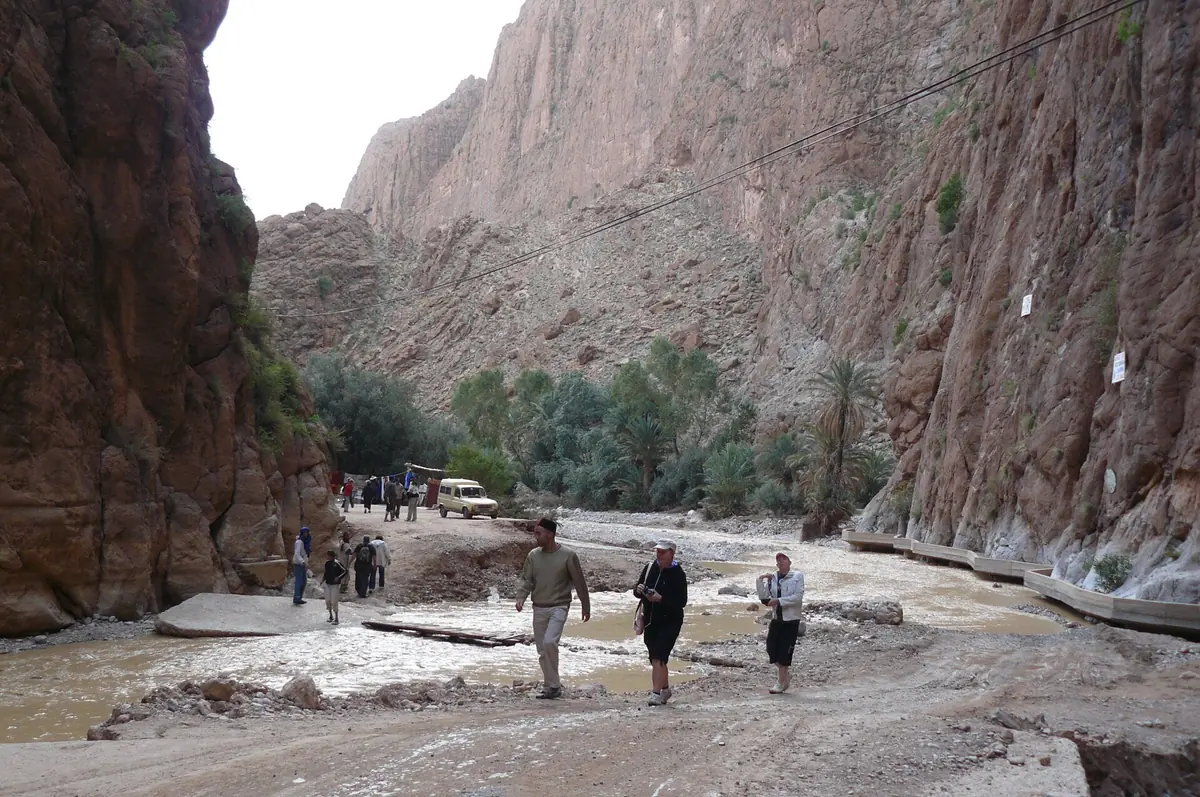
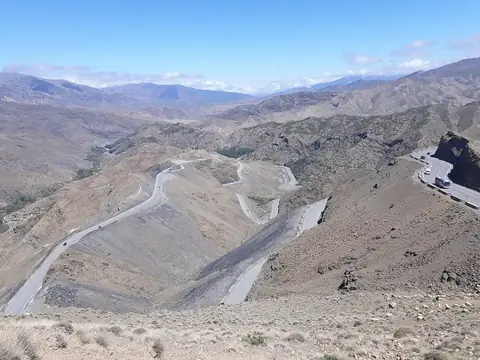
The road south-east crosses the High Atlas at the Tizi n'Tichka pass to Ouarzazate and Ait Ben Haddou. Ait Ben Haddou is one of the ksars of the south, a fortified village built of adobe, about 30 minutes from Ouarzazate. The Dades Valley is about two hours from Ouarzazate, on the long road on to Merzouga, and a desert tour breaks that drive with a night at the stop the operator sets.
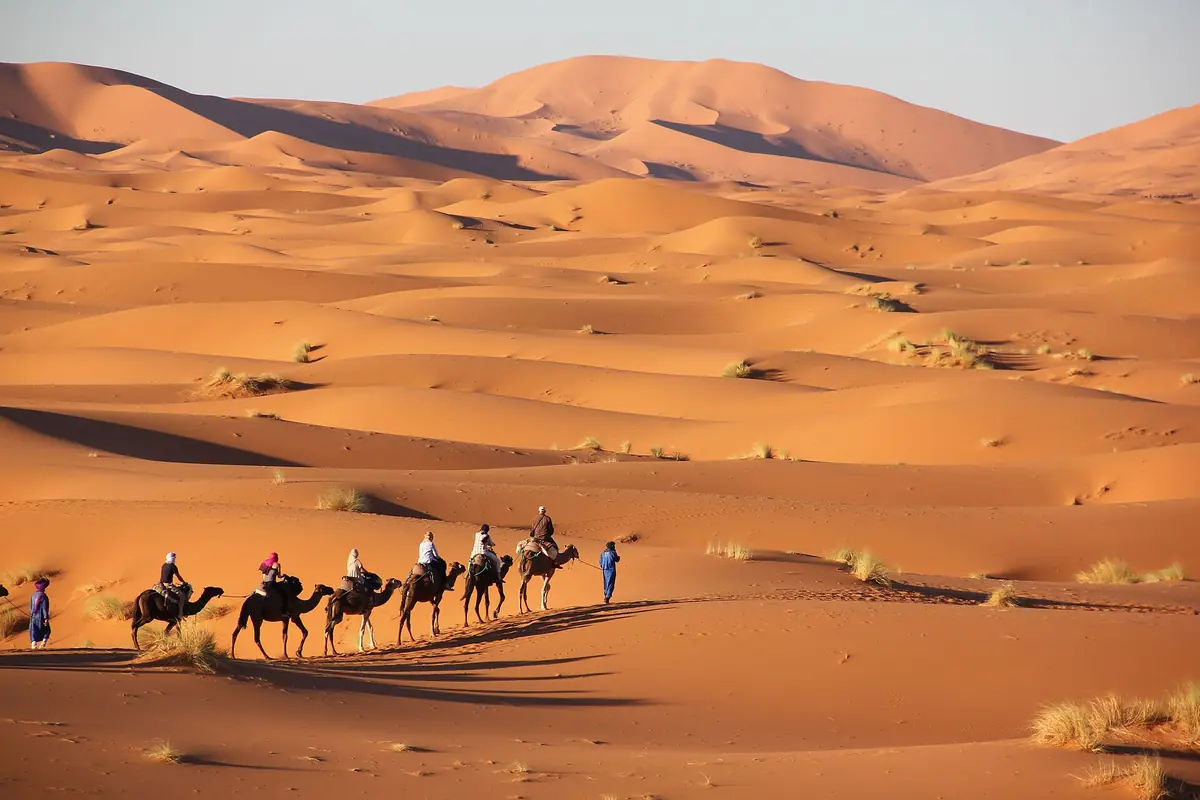
At Merzouga the Erg Chebbi dunes meet palm groves and desert tracks, and the lake of Dayet Srij lies among them. The night here is spent in a bivouac camp in the dunes, reached by dromedary caravan, and the sunrise is the reason to stay.
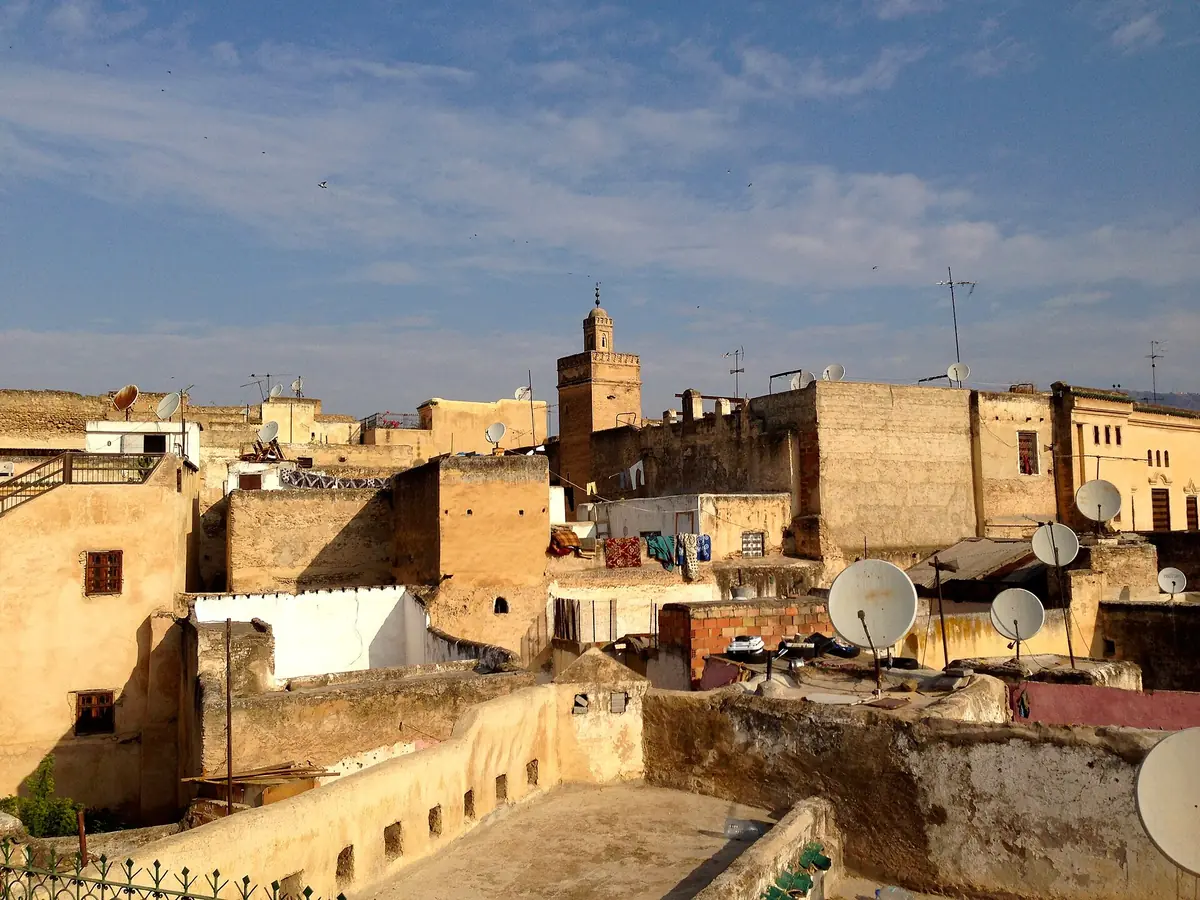
Fes is the old capital and the densest medina in the country. Enter Fes el-Bali by Bab Boujloud and walk down to the al-Qarawiyyin Mosque, the Chouara tannery and the Nejjarine Museum of woodwork; the Marinid tombs on the hill above give the view over the whole city. Two nights is the minimum, three if you want a day trip to Meknes, about an hour away, or Volubilis, about an hour and a half.
Flights, trains and the desert crossing
Morocco has 25 airports, among them Marrakech Menara (RAK). The seven-day route flies home from Fes–Saïss (FEZ), and the ten-day route arrives at Casablanca Mohammed V (CMN). An open-jaw ticket into Marrakech and home from Fes, or the reverse, saves the longest drive of the trip. At the exit of any airport you can take a taxi or a shuttle bus, or you can have your riad arrange a transfer. At Marrakech Menara, the regulated taxi fare to the city centre is MAD 70 by day and MAD 100 at night, and airport bus 19 costs MAD 30.
Trains run by ONCF link Marrakech, Casablanca, Rabat, Fes, Meknes and Tangier, and the Al Boraq high-speed line runs from Tangier to Kenitra, Rabat and Casablanca. They are the way to travel the ten-day route in the north. There is no railway to the desert: Merzouga is reached by road, on a tour, with a driver or by long-distance bus. The transport guide covers the trains, the CTM and Supratours buses and the grands taxis.
The desert crossing is the booking that shapes the week. The road is long: Visit Morocco gives Marrakech–Ouarzazate as 194.1 km and about 3 h 45, and Fes to its Errachidia-Midelt-Merzouga region as 341.8 km and 5 h 21, so the crossing takes three days. Shared tours spend two nights on the way, one in a camp at Merzouga and the other at the stop the operator sets. A shared three-day tour between Fes and Marrakech is listed on TourRadar at USD 274 per person and a private one at USD 531 per person; a private driver follows the same road at your own pace. Driving yourself is possible, but the mountain roads and the long days are tiring, and rental cars are hard to use inside the medinas.
Add days for Chefchaouen, Essaouira or the High Atlas
Chefchaouen, the blue-washed town in the Rif mountains, deserves two days for its lanes of blue houses climbing the slope and the walks above the town, and it fits a route between Fes and Tangier; Tangier is about two hours away by road. Rabat, the capital, is an easy train stop on the way north, with the Kasbah of the Udayas above the river mouth and the gardens and white lanes inside its walls.
From Marrakech, Essaouira, the walled Atlantic port, is about two and a half hours away and is better as a night than a day trip. Imlil and the High Atlas give you Berber villages and walks below Toubkal, North Africa's highest summit, as a day out or a night in a mountain guesthouse.
Choose the season
March to May and September to November are the months for a first trip: the medinas are comfortable to walk and the desert is at its best in spring and autumn. Summer is very hot inland and in the Sahara, so keep the middle of the day for the riad. Winter days are mild in Marrakech and Fes, but the evenings are cool and the desert nights are cold, and snow can close the High Atlas passes for a time.
Ramadan is expected to begin on or around 8 February 2027, and its dates move each year. Outside the tourist centres, some restaurants close in the daytime and offices keep shorter hours. The best-time guide goes month by month, and the festivals guide lists the holidays that move.
What a first trip costs
The largest costs are the riads and the desert crossing. Our trip-cost guide prices the ten-day route at about MAD 9,600 per person on a budget, MAD 11,200 mid-range or MAD 18,400 in comfort, for two people sharing a room (MAD 19,200, 22,400 or 36,800 for two): about MAD 960, 1,120 or 1,840 per person a day. That covers seven nights in riads, the three-day desert tour with its two nights, the coach to Chefchaouen, the taxi to Marrakech airport, the main monument tickets and the Jardin Majorelle, meals on every day, a local SIM card and a 10% buffer. Flights come on top. Add two fares for your own date: the ONCF train from Casablanca airport to Rabat, from oncf-voyages.ma, and the Chefchaouen–Fes leg by coach or car (the coach fare from ctm.ma, or the price your riad quotes for a car). For the seven-day route, our seven-day itinerary comes to about MAD 20,900 on the ground for two sharing, about MAD 10,500 per person or about MAD 1,500 per person a day; flights and the transfer to Fes airport are extra.
Entry and your passport
Ordinary passports from the UK, the US, Canada, Australia and the EU can enter Morocco for tourism without a visa for up to 90 days. Travel on an undamaged passport valid for six months after your departure date, and make sure the officer stamps it on arrival; the entry guide covers the rest, including identity cards and the e-visa.
Cash, cards and the closed dirham
The Moroccan dirham (MAD) is a closed currency, so take out what you need from ATMs on arrival; you may carry at most MAD 2,000 in dirham banknotes into or out of Morocco.
Cards are widely accepted in tourist areas, but small hotels, shops and remote areas often take cash only; the money guide covers ATMs, exchange and tipping.
Medinas, guides and touts
Inside the medinas, people offering to show you the way are part of the walk, and many of them are not official guides. If you want a guide in a historic quarter, choose one with an official badge, through your riad or a tourist office, and agree the price and the length of the walk before you start. A polite, firm no is enough for the rest.
Agree taxi fares in advance or check that the meter is running. Petits taxis work inside a city and often pick up other passengers on the way; grands taxis run between towns.
Mosques, dress, Ramadan and photography
Enter a mosque only where visits are offered, such as the Hassan II Mosque in Casablanca with its paid guided visits. Dress conservatively, as Canada advises. The UK suggests loose clothing that covers the arms, legs and chest for women, who may get unwanted attention, especially when travelling alone. During Ramadan, eating, drinking or smoking in public in the daytime may cause offence.
Alcohol is served in licensed hotels, restaurants and bars, and drinking it in the street is illegal. Ask before photographing people, especially children, and never take photographs near political or military sites. Same-sex relations are illegal in Morocco.
Where the advice says not to go
The land border with Algeria is closed and crossing it is illegal. Canada advises against all travel within 20 km of the Algerian border and in the border regions around the Berm, the militarised boundary in Western Sahara; the UK advises against all travel within 40 km north and west of the Berm, including Es Semara, and south and east of it. Merzouga and its desert camps lie inside the 20 km band along the Algerian border where Canada advises against all travel; other governments differ, so check your own government's advice and your travel insurance before you book. Our health and safety guide sets out each government's lines and its other advice.
The UK and Canada say terrorist attacks are likely or could occur, including in places visited by foreigners, so stay alert in crowded sights and markets.
Practical questions
Is a week enough for a first trip to Morocco?
Yes. A week covers Marrakech, the Sahara at Merzouga and Fes, as in the seven-day itinerary. The north, with Chefchaouen and Rabat, needs the ten-day route.
Do I need a visa for Morocco?
Not for tourist stays of up to 90 days with UK, US, Canadian, Australian or EU passports. The entry guide covers passport validity and the e-visa for other nationalities.
Should I fly into Marrakech or Fes?
Into one and out of the other. The two cities are on opposite sides of the desert loop, so an open-jaw ticket saves a long drive back.
Can I get to the Sahara by train?
No. No railway reaches Merzouga, so go on a tour, with a driver or by long-distance bus.
Can I buy dirhams before I travel?
Not easily, because the dirham is a closed currency. Take cash from an ATM on arrival, and carry no more than MAD 2,000 in dirham banknotes in or out of the country.
Can I visit mosques in Morocco?
Only where visits are offered. The Hassan II Mosque in Casablanca runs paid guided visits.
Keep planning your trip
Morocco in 7 days
Seven days and six nights from Marrakech over the High Atlas to a desert camp at Merzouga and on to Fes: the nights, the desert tour and the riads.
Read the guide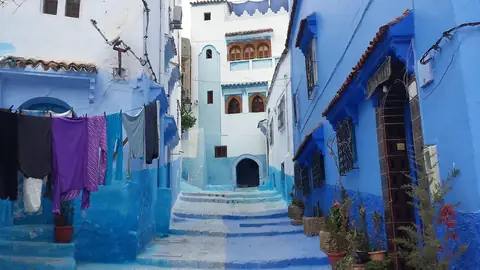
Morocco in ten days
Ten days and nine nights from Rabat through Chefchaouen and Fes to the Merzouga dunes, Ait Ben Haddou and Marrakech, with named rooms and the desert days.
Read the guide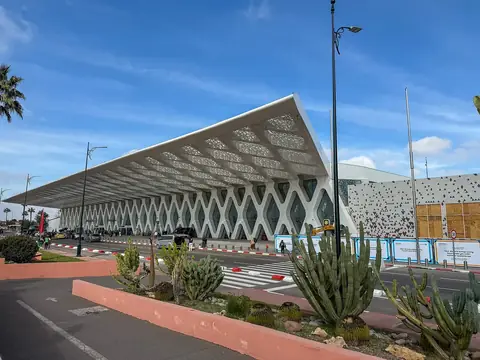
Entry to Morocco
Who enters Morocco visa-free for 90 days, passport validity, the MAD 2,000 cash limit, what to declare, drones, vaccines, and arriving by air or by ferry.
Read the guide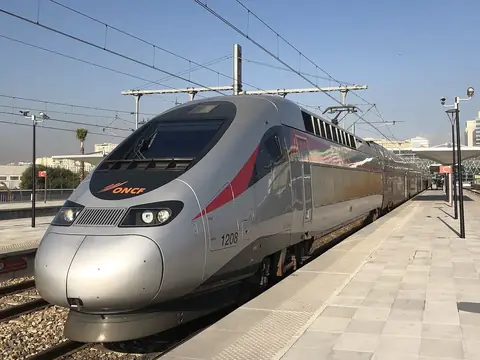
Transport in Morocco
How to get around Morocco: Al Boraq and ONCF trains, CTM coaches to Chefchaouen and the south, grands taxis, drivers, car hire, flights and city trams.
Read the guide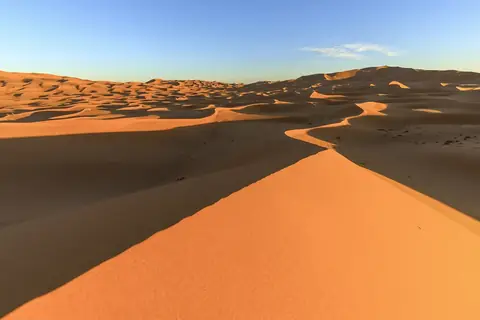
Best time to visit Morocco
When to go to Morocco: spring and autumn for Marrakech and Fes, the desert season at Merzouga, summer heat inland, cool coast, winter nights, Ramadan and holidays.
Read the guide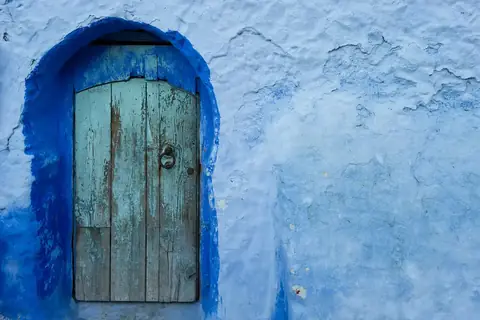
Morocco trip cost
Ten days from Rabat through Chefchaouen and Fes to the Sahara and Marrakech: about MAD 9,600 per person on a budget, 11,200 mid-range or 18,400 in comfort.
Read the guideSources and checks before you travel
(25)
- UK FCDO: Morocco entry requirements ↗ — opens in a new tab
- UK FCDO: Morocco safety and security ↗ — opens in a new tab
- UK FCDO: Morocco regional risks ↗ — opens in a new tab
- US Department of State: Morocco international travel information ↗ — opens in a new tab
- Government of Canada: Morocco travel advice ↗ — opens in a new tab
- German Federal Foreign Office: Morocco travel and safety advice ↗ — opens in a new tab
- Visit Morocco (Moroccan National Tourist Office): Marrakech ↗ — opens in a new tab
- Visit Morocco: Fez ↗ — opens in a new tab
- Visit Morocco: Errachidia-Midelt-Merzouga ↗ — opens in a new tab
- Visit Morocco: Ouarzazate-Zagora-Tinghir ↗ — opens in a new tab
- Visit Morocco: Chefchaouen ↗ — opens in a new tab
- Visit Morocco: climate and seasons ↗ — opens in a new tab
- Morocco foreign ministry consular portal: nationalities exempt from an entry visa ↗ — opens in a new tab
- Moroccan customs (ADII): foreigners visiting Morocco, questions and answers ↗ — opens in a new tab
- Fondation de la Mosquée Hassan II de Casablanca ↗ — opens in a new tab
- Visit Morocco: getting around ↗ — opens in a new tab
- Visit Morocco: historic sites ↗ — opens in a new tab
- Visit Morocco: getting to Morocco ↗ — opens in a new tab
- TourRadar: 3 Days from Fes to Marrakech through the Erg Chebbi Dunes (Desertbrise Travel) ↗ — opens in a new tab
- TourRadar: From Fes, Private 3-Day Tour Merzouga Desert to Marrakech (Morocco First Travel With Us) ↗ — opens in a new tab
- CTM: Rabat–Chefchaouen by coach ↗ — opens in a new tab
- Visit Marrakech (Marrakech-Safi Regional Tourism Council): transport ↗ — opens in a new tab
- ONCF: Al Atlas travel guide (Guide Al Atlas) ↗ — opens in a new tab
- UK Foreign Office (GOV.UK): Western Sahara travel advice ↗ — opens in a new tab
- Diyanet (Turkey): 2027 religious days ↗ — opens in a new tab
Reference sources for the version dated 29 November 2026. Confirm opening times, access, transport and conditions for your travel dates.
Photo credits
(5)
Camels in the Erg Chebbi dunes at Merzouga
Photograph: Lefidele — opens in a new tab · CC BY-SA 4.0 — opens in a new tab
Changes: Resized and converted to WebP; displayed with responsive crops. · Original photograph and licence details ↗ — opens in a new tab
Ait Ben Haddou, on the road from Marrakech to the desert
Photograph: Petar Milošević — opens in a new tab · CC BY-SA 4.0 — opens in a new tab
Changes: Resized and converted to WebP; displayed with responsive crops. · Original photograph and licence details ↗ — opens in a new tab
Rooftops of the Fes medina
Photograph: Andrew Nash from Vienna, Austria — opens in a new tab · CC BY-SA 2.0 — opens in a new tab
Changes: Resized and converted to WebP; displayed with responsive crops. · Original photograph and licence details ↗ — opens in a new tab
Jemaa el-Fnaa in Marrakech as the evening stalls set up
Photograph: Luc Viatour — opens in a new tab · CC BY-SA 3.0 — opens in a new tab
Changes: Resized and converted to WebP; displayed with responsive crops. · Original photograph and licence details ↗ — opens in a new tab
The Todra Gorge, near where desert tours often spend their first night
Photograph: Jon Lean from Bristol, United Kingdom — opens in a new tab · CC BY-SA 2.0 — opens in a new tab
Changes: Resized and converted to WebP; displayed with responsive crops. · Original photograph and licence details ↗ — opens in a new tab