Drâa-Tafilalet
Merzouga and Erg Chebbi: a night in a Sahara desert camp
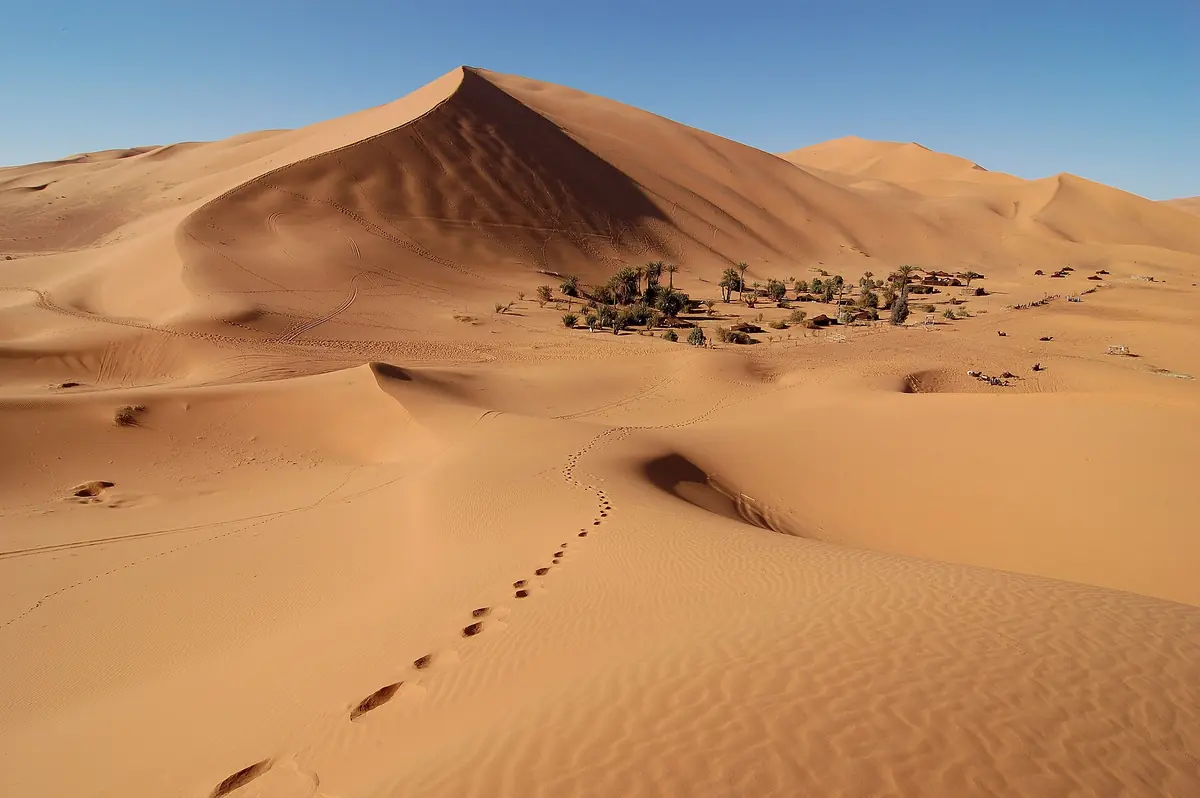
Merzouga is the village at the edge of Erg Chebbi, the great sea of sand dunes in the south-east of Morocco, and the classic place for a night in the Sahara. The dunes rise orange and rose above the stony plain and change colour with the hour. At sunset a line of camels walks into them, and the night in a camp of nomad tents ends with the sun coming up over the sand. Getting there is the real decision: Merzouga is a long drive from Marrakech or Fes, so the desert night shapes the whole route.
In this guide
Find the location ↗ — opens in a new tabThe short answer
Plan at least one night in a camp in the dunes of Erg Chebbi, reached by camel or 4x4 from Merzouga. Allow three days: the classic trip is a 3-day tour between Fes and Marrakech, in either direction, and the offers below are two of them. The shared three-day tour from Fes to Marrakech that our trip-cost guide budgets is listed on TourRadar at USD 274 per person. A camp night booked on its own runs from USD 99 a night for a tent at Madu Premium Camp to EUR 375 a night with dinner and breakfast in the main camp of Merzouga Luxury Desert Camps. Book the tour or the camp first: that booking fixes the dates of the whole route. Go between October and April: summer is extremely hot and winter nights are cold. Merzouga and its desert camps lie inside the 20 km band along the Algerian border where Canada advises against all travel; other governments differ, so check your own government's advice and your travel insurance before you book.
- Suggested time
- 1–2 nights in Merzouga, at least one of them in a desert camp
- Where to stay
- A camp in the Erg Chebbi dunes, or a kasbah hotel in Merzouga or Hassilabied
- Season and timing
- October to April is the best time for the desert; summer is extremely hot and winter nights are cold.
Which tour, and how many nights
Erg Chebbi is far from the cities. From Marrakech the road crosses the High Atlas to Ouarzazate and then runs east through the valleys of the kasbahs. From Fes it climbs over the Middle Atlas and the Talghemt pass, then follows the oases of the Tafilalet down to Rissani and the dunes. Either way it is a full day on the road. Visit Morocco gives 341.8 km and about 5 h 21 by road from Fes to its Errachidia-Midelt-Merzouga region. Merzouga Luxury Desert Camps puts its own camp about 470 km and 8 hours from Fes, and about 565 km and 9 hours from Marrakech.
Visit Morocco advises allowing three days, and the classic trip is a 3-day tour between Fes and Marrakech. From Fes, day one is the drive south over the Middle Atlas to a night in a desert camp. Day two starts with sunrise from the dunes and the camel ride back to Merzouga, then runs west by the Todra and Dades gorges towards Ouarzazate, and day three ends in Marrakech; our Ouarzazate and Ait Ben Haddou guide covers that road. From Marrakech the order is reversed: the gorges first, the camp on the second night, then the drive north to Fes. The tour's second night is at the stop the operator sets, and some tours spend both nights in the camp, so read the tour's own day plan before you book. A one-way tour saves you the drive back and links the north and the south in one trip.
Two nights at Merzouga, one in a kasbah hotel at the edge of the dunes and one in a camp, let you see the dunes at midday, visit Khamlia and Rissani, and rest after the drive. With a single night, choose the camp: the dunes at dusk and at dawn are what you come for.
Prices and times checked 28 November 2026
The camel ride, the camp and sunrise over the dunes
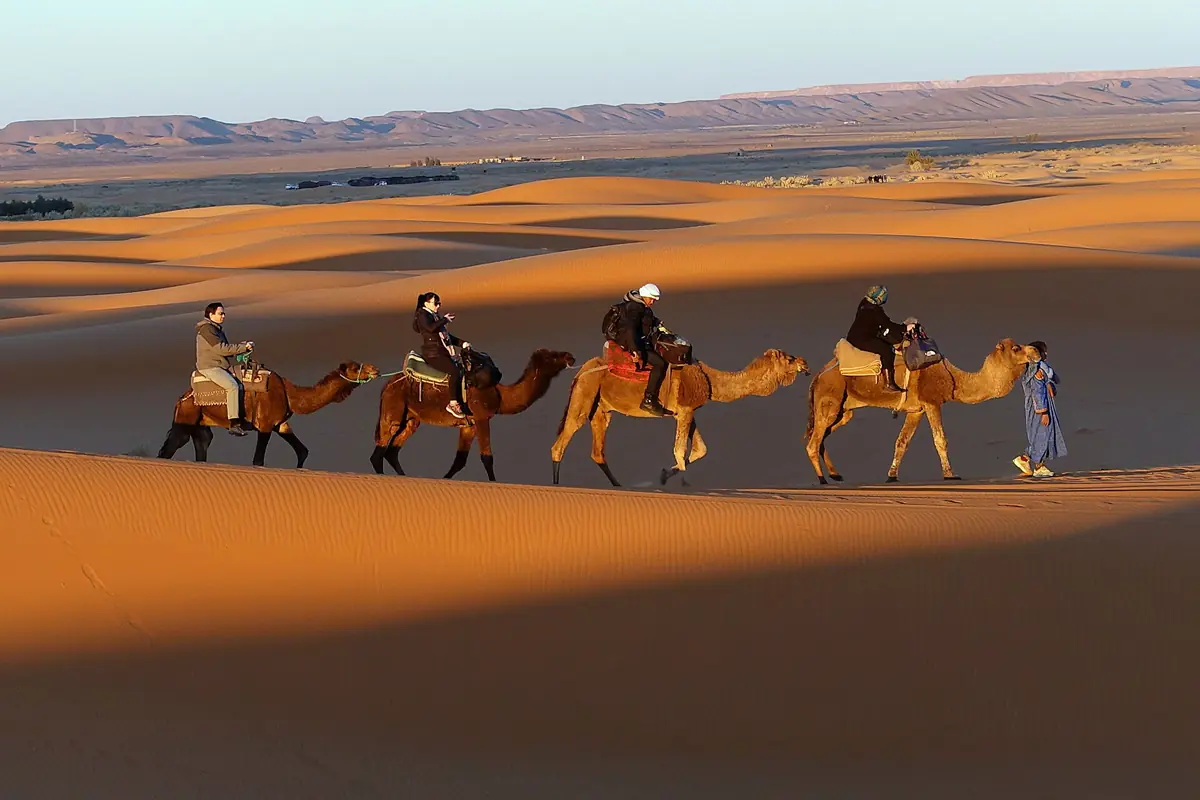
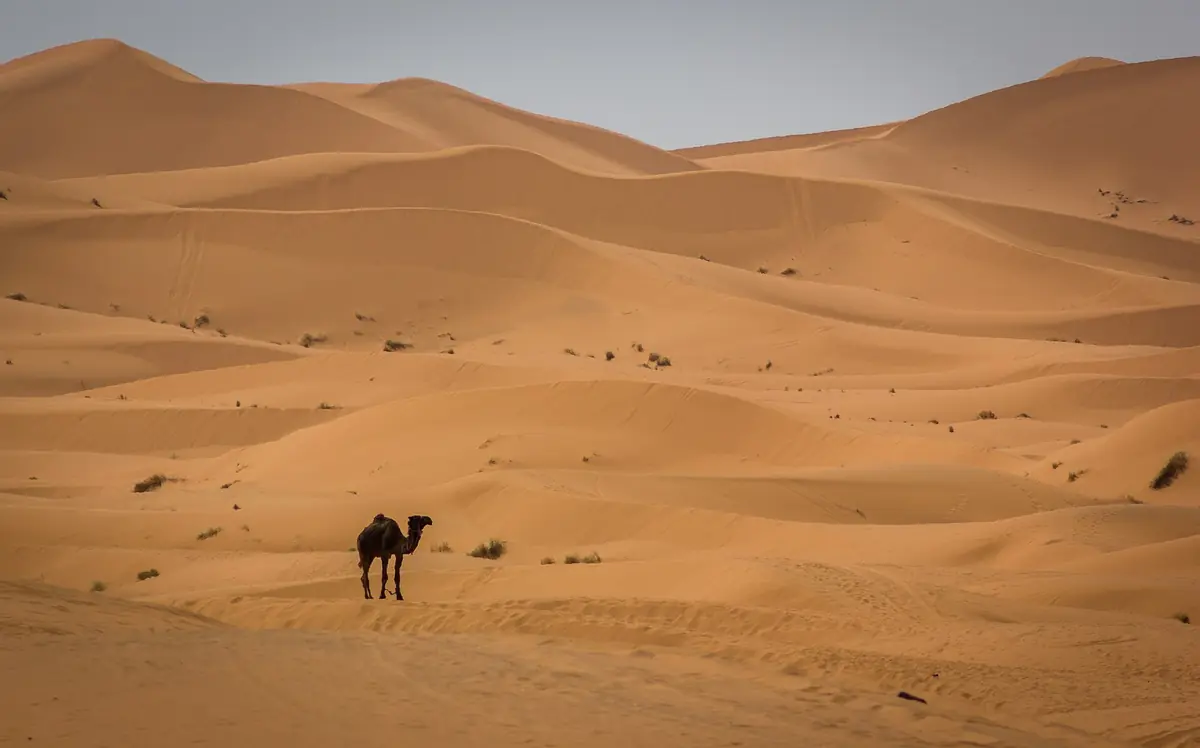
Erg Chebbi is a world of dunes, palm groves and desert tracks, its highest crests rising in soft curves shaped by the Saharan wind. In the late afternoon, camels leave from the edge of Merzouga and Hassilabied in slow lines, each led by a guide on foot, and walk into the dunes as the sand turns from gold to deep orange. At Merzouga Luxury Desert Camps, for example, the camp is 15–20 minutes from the meeting point in Merzouga by 4x4 and about 40 minutes by camel.
The camps sit in hollows between the dunes: rows of khaima tents, the traditional Berber tents of wool and canvas, around a courtyard of carpets and lanterns. Dinner is served in the camp after the sunset ride, often under the stars. Simple camps share washrooms. Premium and luxury camps give each tent a private bathroom, and some add heating and air conditioning.
Climb the dune behind the camp before dawn. The sun comes up over the sand and lights the crests one after another, and on a clear morning the shadows of the camels stretch for metres. Bring a warm layer even in spring and autumn: the desert cools fast after dark, and winter nights are cold.
Camps also offer sandboarding and quad or buggy rides; the UK Foreign Office notes that some insurance policies do not cover quad biking, so check yours first. In the dunes, stay with your camp's guide, and keep water and a hat with you on the camel ride.
Prices and times checked 28 November 2026
Khamlia, Rissani and the lake of Dayet Srij
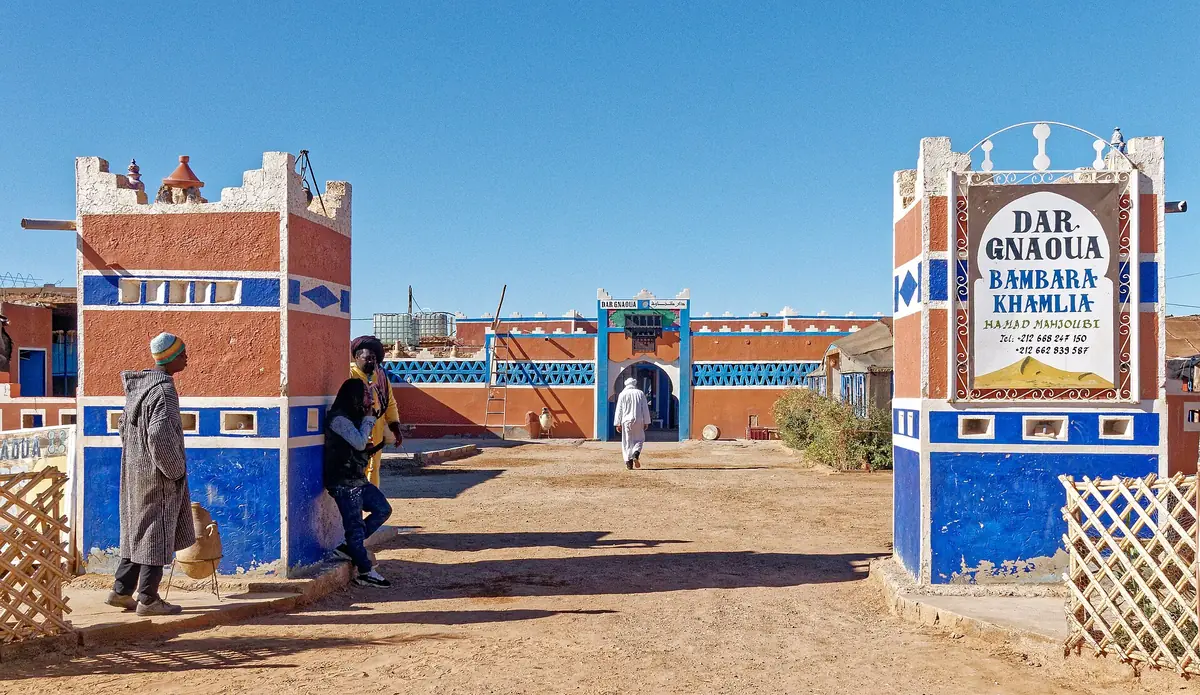
Khamlia, a village a short drive south of Merzouga, is known for its Gnawa music. Gnawa, on UNESCO's list of intangible cultural heritage, is a Sufi brotherhood music with roots in the slave trade; in the villages, musicians in white play large drums and castanets, and Gnawa groups hold festivals all year.
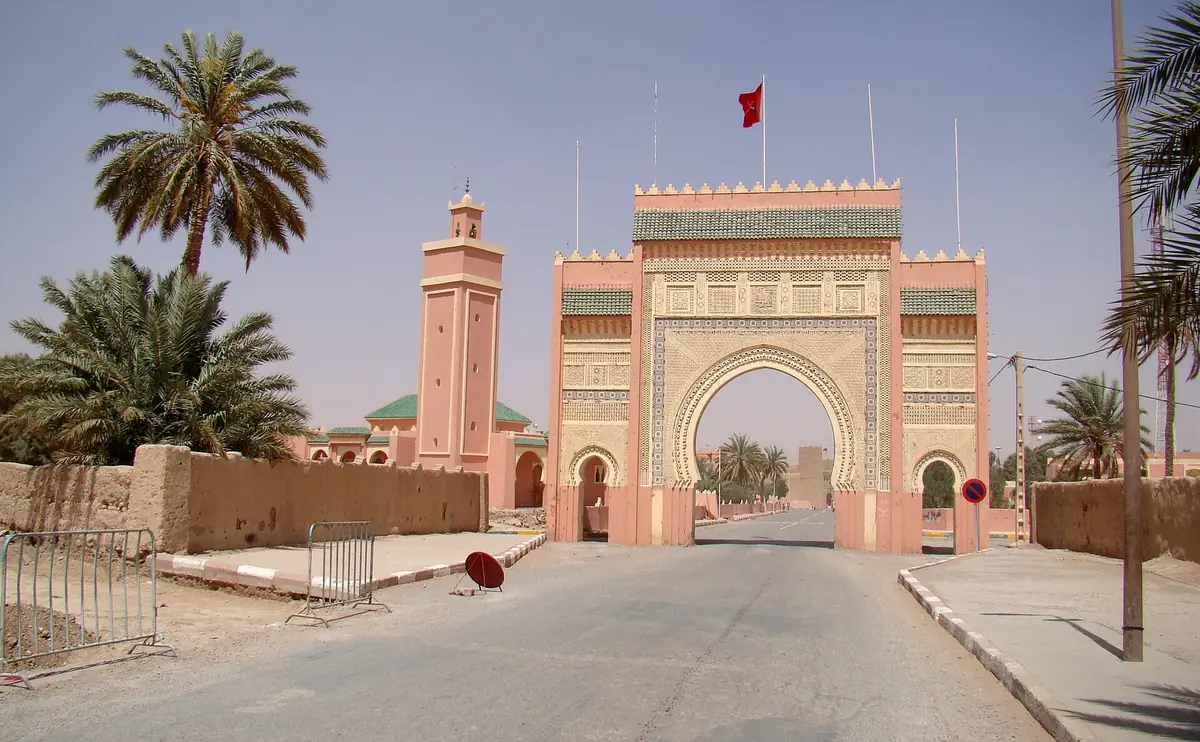
Rissani, on the road north from Merzouga, is the old market town of the Tafilalet and the cradle of the Alaouite dynasty, the family of Morocco's kings. The mausoleum of Moulay Ali Chérif, the dynasty's ancestor, is here, with the remains of Sijilmassa, a former merchant city; the Tafilalet has more than 400 ksour, the fortified villages of the oasis. Erfoud, further north, holds the International Date Fair, and a museum of fossils and minerals stands on the road to Rissani.
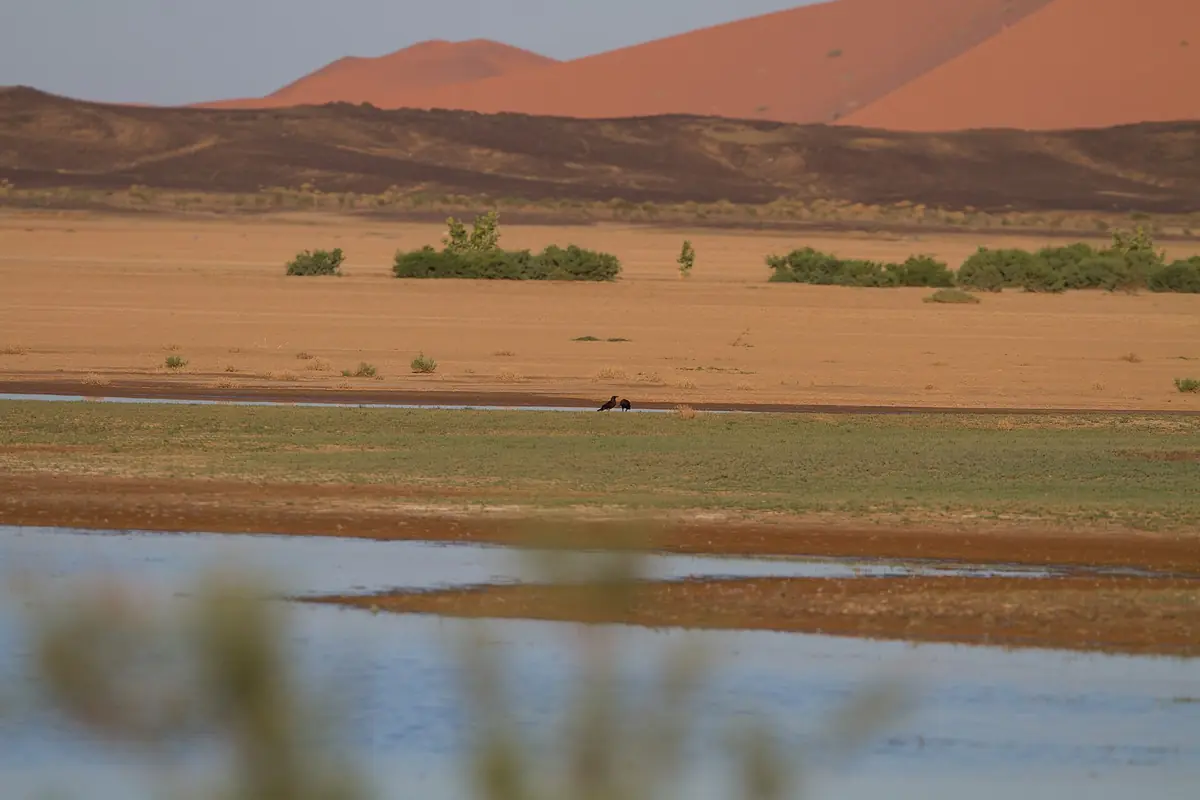
Near the dunes lies the lake of Dayet Srij, a sheet of water in the desert where stilts, doves, wagtails and storks gather. Ask your camp or driver whether the lake has water before you make the trip.
The Algerian border is close. The land and sea borders between Morocco and Algeria are closed, and the border lies east of the dunes. Measured in a straight line on a map, Merzouga village is about 17 km from it and the high dunes of Erg Chebbi about 12 to 15 km, so the village and the camps lie inside the 20 km band where Canada advises against all travel. Germany says desert tours to Erg Chebbi south of Merzouga can be done with a local tour operator, preferably in a group, and strongly advises against leaving the main roads towards Algeria. Other governments differ, so check your own government's advice and your travel insurance before you book; our health and safety guide gives each government's wording.
What to eat and where to look
Madfouna
A large flatbread stuffed with minced meat, onions, eggs and spices and baked in a clay oven, often called Berber pizza. It is the dish the Merzouga area is known for and is meant to be shared.
- Where to look
- Small restaurants in Merzouga and Rissani; ask in the morning, since it is baked to order.
- Fit it into your day
- Lunch on the day you arrive, before heading into the dunes.
Tagine
Chicken, lamb or vegetables slow-cooked in the clay pot of the same name, the dish you are most likely to meet at a camp dinner.
- Where to look
- Your camp's dinner tent and the kasbah hotels of Merzouga and Hassilabied.
- Fit it into your day
- Dinner in the camp, after the sunset ride.
Harira
A tomato, lentil and chickpea soup with herbs, often the first course of a Moroccan dinner and warming on a cold desert night.
- Where to look
- Camp dinners and roadside cafés on the drive through the Tafilalet.
- Fit it into your day
- The first course of the camp dinner.
Dates of the Tafilalet
The palm groves of the Tafilalet oases around Erfoud and Rissani grow dates, sold loose by the kilo in many varieties.
- Where to look
- The market of Rissani and stalls along the oasis road.
- Fit it into your day
- A bag for the long drive back.
Mint tea
Green tea with fresh mint and plenty of sugar, served everywhere as a welcome, including in the music houses of Khamlia.
- Where to look
- The Gnawa music houses of Khamlia and your camp at sunrise.
- Fit it into your day
- With the music in Khamlia and again at dawn on the dunes.
Getting to Merzouga by tour, car or bus
A booked tour is the simplest way to go. It includes the driver, the camel ride and the camp night with dinner and breakfast. The other night is at the stop the operator sets: a hotel on the way or a second night in the camp. Shared tours run with a minibus of fellow travellers; private tours let you set your own stops. The two offers below cover the classic routes, one from Fes and one from Marrakech, both ending at the other city.
With your own car, drive south from Fes over the Middle Atlas by Azrou and Midelt, then through Errachidia and Erfoud, or east from Ouarzazate by the Dades and Todra gorges. The camps' meeting points are in the village, and their 4x4s or camels take you on into the dunes. Our transport guide covers car hire and driving in Morocco.
Long-distance coaches are the slow alternative to a tour or a car. CTM serves Erfoud and Errachidia, north of the dunes; for coach times and fares to Erfoud, Rissani or Merzouga, search CTM on ctm.ma and Supratours on supratours.ma. If you arrive by coach, a local operator in the village can arrange the camel ride and the camp. Fes and Marrakech are the usual gateways by air, and the road trip from either city is part of the journey.
What a desert tour includes
Camp nights range from simple shared camps to luxury tents with their own bathrooms. Madu Premium Camp lists its tents from USD 99 a night, and Merzouga Luxury Desert Camps lists the Experience Tent in its main camp, for up to three adults, at EUR 375 a night with dinner and breakfast. A night in the dunes is often sold as part of a tour rather than on its own. Our where-to-stay guide compares kasbah hotels in Merzouga and Hassilabied, with their rates.
Merzouga Luxury Desert Camps' own Fes–Marrakech tour, for example, covers private transport with a driver, a night in its camp and a night in a kasbah, both with dinner and breakfast; lunches and tips are extra. For a priced example, the shared tour from Fes to Marrakech that our Morocco trip-cost guide budgets is listed on TourRadar at USD 274 per person, for groups of up to 10.
Prices and times checked 28 November 2026
Practical questions
How many nights do I need in Merzouga?
One night in a desert camp is the minimum; two nights, one in a kasbah hotel and one in a camp, let you rest after the long drive and visit Khamlia and Rissani.
Can I visit the Sahara on a day trip from Marrakech or Fes?
No. Merzouga is a full day's drive from either city: Visit Morocco gives 341.8 km and about 5 h 21 by road from Fes to its Errachidia-Midelt-Merzouga region. Allow three days: the classic trip is a 3-day tour.
When is the best time for a desert camp?
October to April. Summer is extremely hot, and winter nights are cold.
How do I get to the camp from Merzouga?
Camps meet you at a meeting point in the village and take you on by camel or 4x4; your camp gives you the meeting point and the time when you book.
Is it safe to go near the Algerian border?
Governments differ. The land and sea borders between Morocco and Algeria are closed and patrolled. Merzouga village is about 17 km from the border in a straight line on a map, and the Erg Chebbi camps lie inside the 20 km band where Canada advises against all travel. Germany says desert tours to Erg Chebbi south of Merzouga can be done with a local tour operator, preferably in a group, and strongly advises against leaving the main roads towards Algeria. Check your own government's advice and your travel insurance before you book, and stay with your camp's guide.
Keep planning your trip
Fes
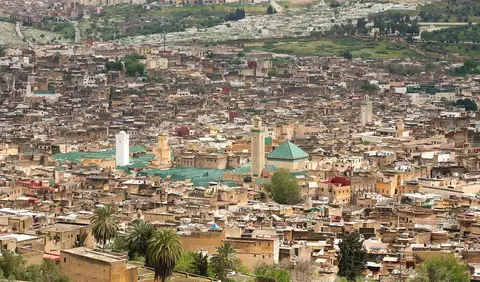
How many nights Fes needs: Fes el-Bali on foot, the madrasas and tanneries, the Batha museum, and a day trip to Meknes and Volubilis, with tickets and riads.
Read the guide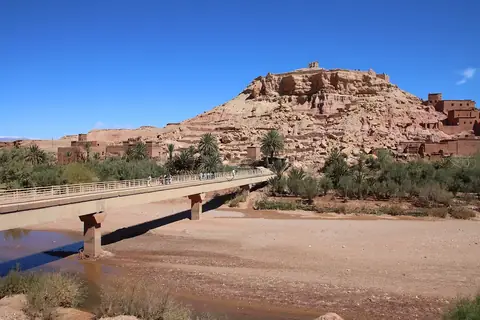
Ouarzazate and Ait Ben Haddou
Whether Ait Ben Haddou and Ouarzazate are a day trip from Marrakech or a night on the road to the Sahara: the ksar, the kasbahs, the film studios, buses and hotels.
Read the guide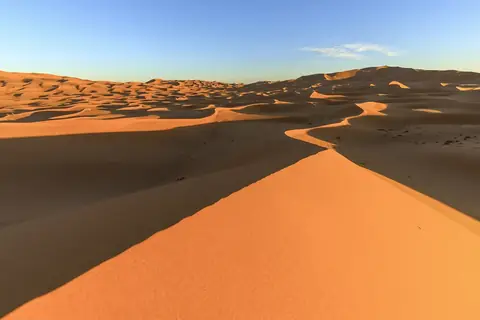
Best time to visit Morocco
When to go to Morocco: spring and autumn for Marrakech and Fes, the desert season at Merzouga, summer heat inland, cool coast, winter nights, Ramadan and holidays.
Read the guide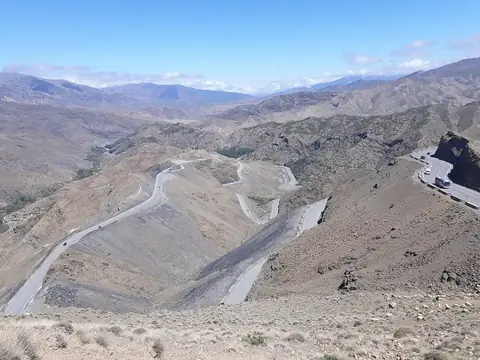
Morocco in 7 days
Seven days and six nights from Marrakech over the High Atlas to a desert camp at Merzouga and on to Fes: the nights, the desert tour and the riads.
Read the guide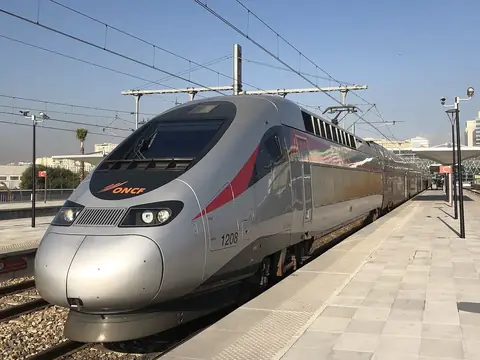
Transport in Morocco
How to get around Morocco: Al Boraq and ONCF trains, CTM coaches to Chefchaouen and the south, grands taxis, drivers, car hire, flights and city trams.
Read the guide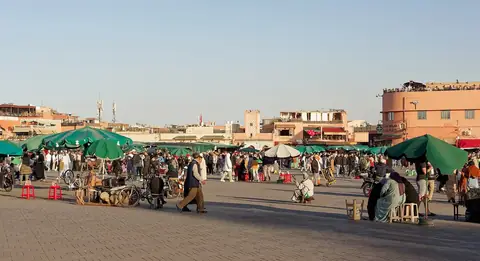
Marrakech
How many nights Marrakech needs, where to sleep in the medina, Jemaa el-Fnaa, the palaces and Majorelle, ticket prices and hours, and the day trips.
Read the guideSources and checks before you travel
(15)
- Visit Morocco (ONMT): Errachidia, Midelt and Merzouga ↗ — opens in a new tab
- Visit Morocco (ONMT): Desert break ↗ — opens in a new tab
- Merzouga Luxury Desert Camps: home page ↗ — opens in a new tab
- Merzouga Luxury Desert Camps: tents ↗ — opens in a new tab
- Riad Madu: home page ↗ — opens in a new tab
- Riad Madu: Madu Premium Camp ↗ — opens in a new tab
- UK Foreign Office: Morocco safety and security ↗ — opens in a new tab
- UK Foreign Office: Morocco regional risks ↗ — opens in a new tab
- Visit Morocco (ONMT): heritage of Errachidia, Midelt and Merzouga ↗ — opens in a new tab
- UNESCO Intangible Cultural Heritage: Gnawa ↗ — opens in a new tab
- Merzouga Luxury Desert Camps: 3-day tour from Fes to Marrakech ↗ — opens in a new tab
- TourRadar: 3 Days from Fes to Marrakech through the Erg Chebbi Dunes (Desertbrise Travel) ↗ — opens in a new tab
- CTM: tourism in Ouarzazate ↗ — opens in a new tab
- Government of Canada (travel.gc.ca): Morocco travel advice ↗ — opens in a new tab
- German Federal Foreign Office: Marokko, Reise- und Sicherheitshinweise ↗ — opens in a new tab
Reference sources for the version dated 28 November 2026. Confirm opening times, access, transport and conditions for your travel dates.
Photo credits
(7)
The dunes of Erg Chebbi around a palm-ringed hamlet
Photograph: Rosino — opens in a new tab · CC BY-SA 2.0 — opens in a new tab
Changes: Resized and converted to WebP; displayed with responsive crops. · Original photograph and licence details ↗ — opens in a new tab
A camel ride through the Erg Chebbi dunes
Photograph: Fbrandao.1963 — opens in a new tab · CC BY-SA 4.0 — opens in a new tab
Changes: Resized and converted to WebP; displayed with responsive crops. · Original photograph and licence details ↗ — opens in a new tab
Dar Gnaoua, one of the music houses of Khamlia
Photograph: Holger Uwe Schmitt — opens in a new tab · CC BY-SA 4.0 — opens in a new tab
Changes: Resized and converted to WebP; displayed with responsive crops. · Original photograph and licence details ↗ — opens in a new tab
The city gate of Rissani
Photograph: Bjørn Christian Tørrissen — opens in a new tab · CC BY-SA 3.0 — opens in a new tab
Changes: Resized and converted to WebP; displayed with responsive crops. · Original photograph and licence details ↗ — opens in a new tab
A camel in the Erg Chebbi dunes
Photograph: ThartmannWiki — opens in a new tab · CC BY-SA 4.0 — opens in a new tab
Changes: Resized and converted to WebP; displayed with responsive crops. · Original photograph and licence details ↗ — opens in a new tab
The lake of Dayet Srij below the Erg Chebbi dunes
Photograph: Ron Knight from Seaford, East Sussex, United Kingdom — opens in a new tab · CC BY 2.0 — opens in a new tab
Changes: Resized and converted to WebP; displayed with responsive crops. · Original photograph and licence details ↗ — opens in a new tab
The shadows of a line of camels and riders on an orange dune near Merzouga
Photo: Yuki Ikemori