Marrakech-Safi
Marrakech: the medina, palaces and gardens in three days
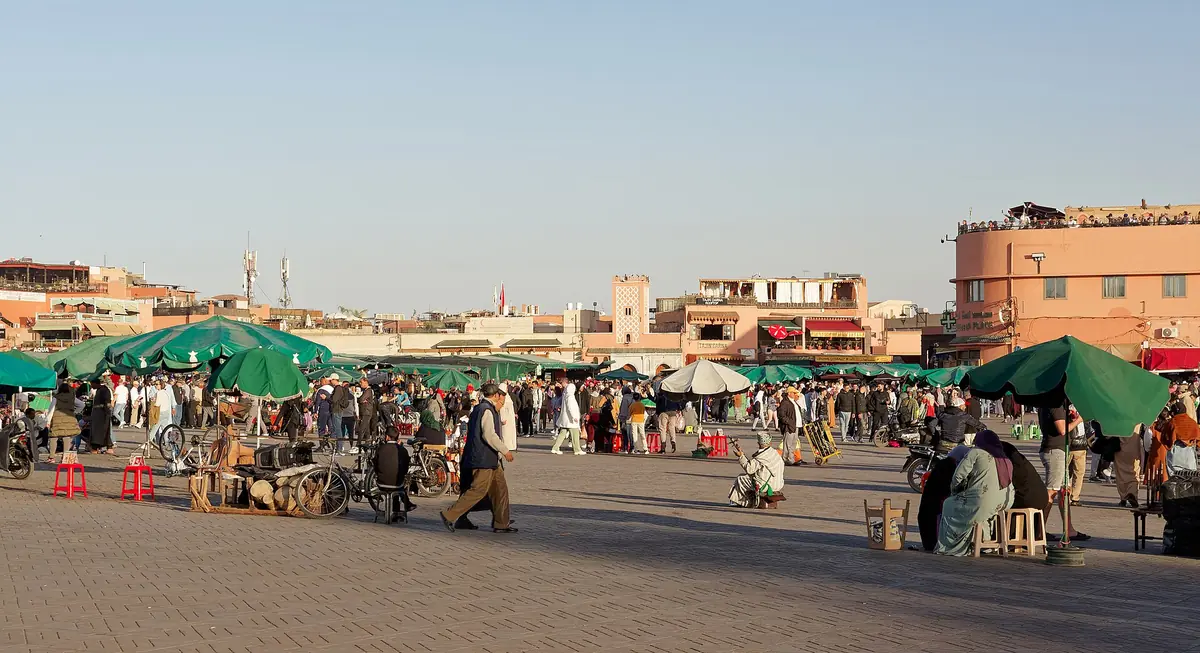
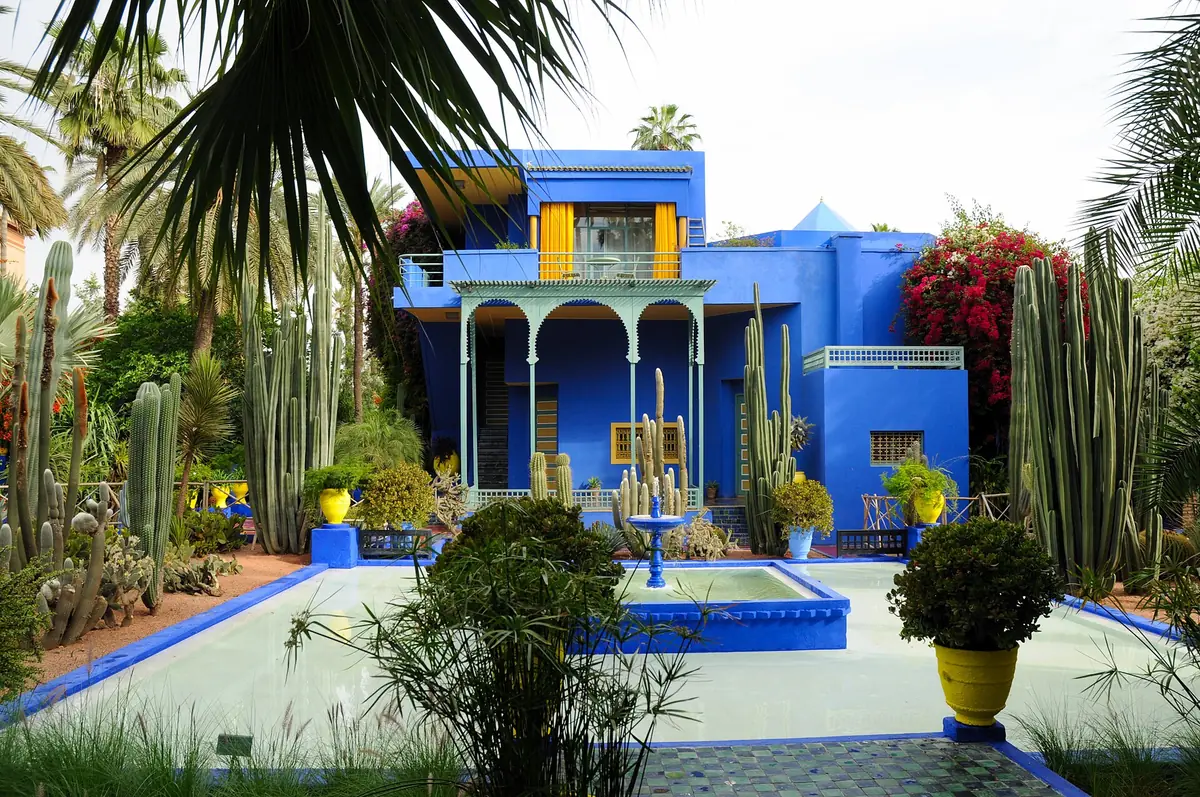
Marrakech is the Moroccan city most trips start or end in, and it rewards three full days more than a quick pass. The medina is walled and walkable. At nightfall Jemaa el-Fnaa turns into an open-air restaurant, with storytellers, singers and Gnawa musicians, and the 77-metre Koutoubia minaret stands over the square. The souks run north from the square towards the Ben Youssef Madrasa, a 16th-century Koranic school. South of the square lie the courtyards of the Bahia Palace, the Saadian Tombs and El Badi Palace. Outside the walls, Jardin Majorelle's bamboo, palms and cacti grow around boldly coloured buildings and Majorelle-blue ornaments. Three nights cover the city on foot; a fourth gives you a day in the High Atlas or on the coast at Essaouira.
In this guide
Find the location ↗ — opens in a new tabThe short answer
Book three nights in a riad inside the medina, between Jemaa el-Fnaa and the Kasbah quarter, and add a fourth if you want a day trip to the High Atlas or Essaouira. Jardin Majorelle's standard ticket is MAD 170; the Bahia Palace, the Saadian Tombs and El Badi each charge foreign adults MAD 100, and the Menara pavilion MAD 60. Book Majorelle first: the garden sells tickets only on its own site, and booking early secures your date and time. Spend one day on the square, the Koutoubia and the souks up to Ben Youssef, and one on the Bahia Palace, the Saadian Tombs and El Badi; Majorelle fits a morning. The Musée Yves Saint Laurent's permanent gallery is closed from 29 November to 18 December 2026 and reopens on 19 December.
- Suggested time
- 3 nights in Marrakech, 4 with a day trip
- Where to stay
- Medina riad between Jemaa el-Fnaa and the Kasbah quarter
- Season and timing
- March to May and September to November are the best months; summer is very hot, and winter days are mild with cool evenings.
Three nights in a riad inside the walls
Sleep inside the medina. A riad is an old town house built around a planted courtyard, and most have a roof terrace for breakfast. From a riad in the southern half of the walled city, you can walk to Jemaa el-Fnaa in the evening and to the palaces in the morning. The northern half, around Mouassine and Ben Youssef, is quieter and closer to the souks, but further from a road where a taxi can stop. Gueliz and Hivernage, outside the ramparts, are the modern districts of wide avenues and international shops. They are easier by car, but you lose the evenings on the square. Our Morocco where-to-stay guide compares the bases across the country.
That guide names riads at budget, mid-range and upper level in the medina, each with a dated rate. Compare your own dates in the booking box below.
Medina lanes are too narrow for cars. The turnings are hard to follow in the dark with luggage, so ask the riad to meet you at the nearest gate or taxi stop on your first evening.
Prices and times checked 28 November 2026
Day one: Jemaa el-Fnaa, the Koutoubia and the souks
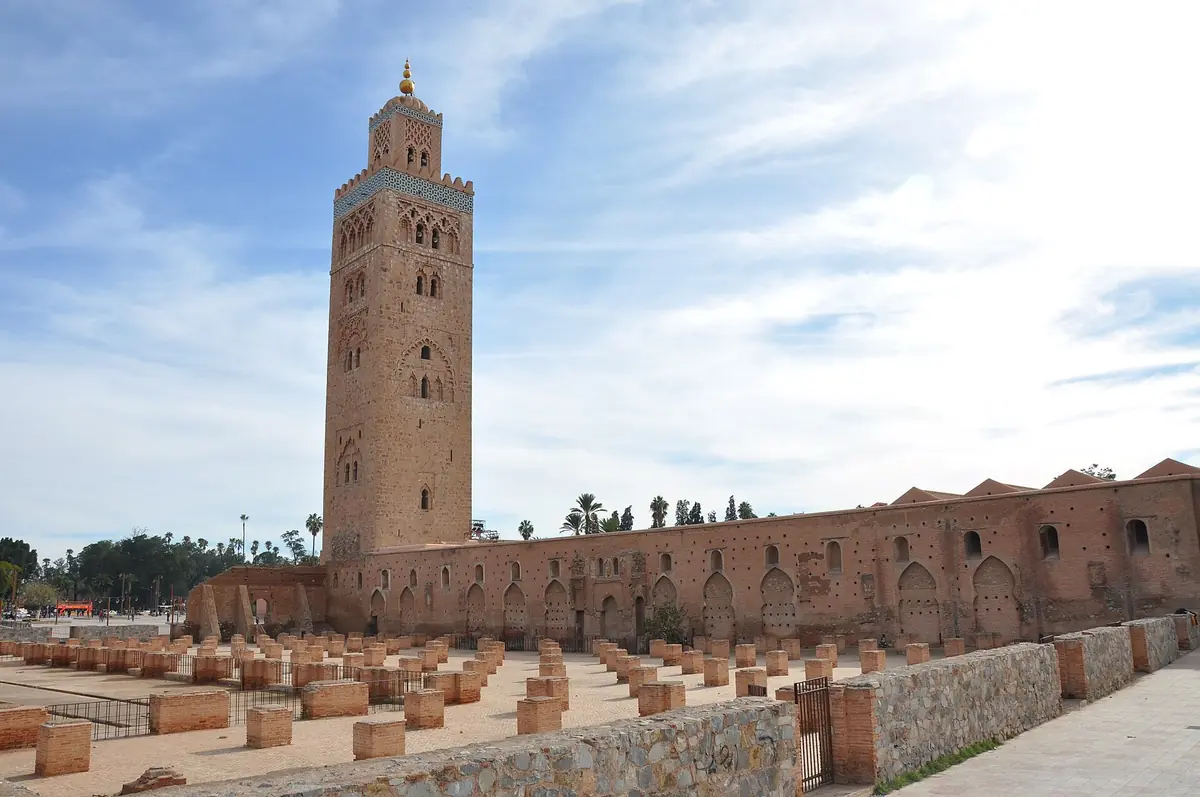
Start at the Koutoubia Mosque, whose minaret rises 77 metres beside the square and is the landmark you will steer by all week. Its design inspired both the Hassan Tower in Rabat and the Giralda in Seville. It is a working mosque, so see it from outside: everyone can walk round the minaret and the gardens beside it.
Jemaa el-Fnaa is the open square at the heart of the medina. As night falls it turns into a giant open-air restaurant, and storytellers, singers, fortune tellers and Gnawa musicians gather their circles. Come back at dusk, and again after dinner.
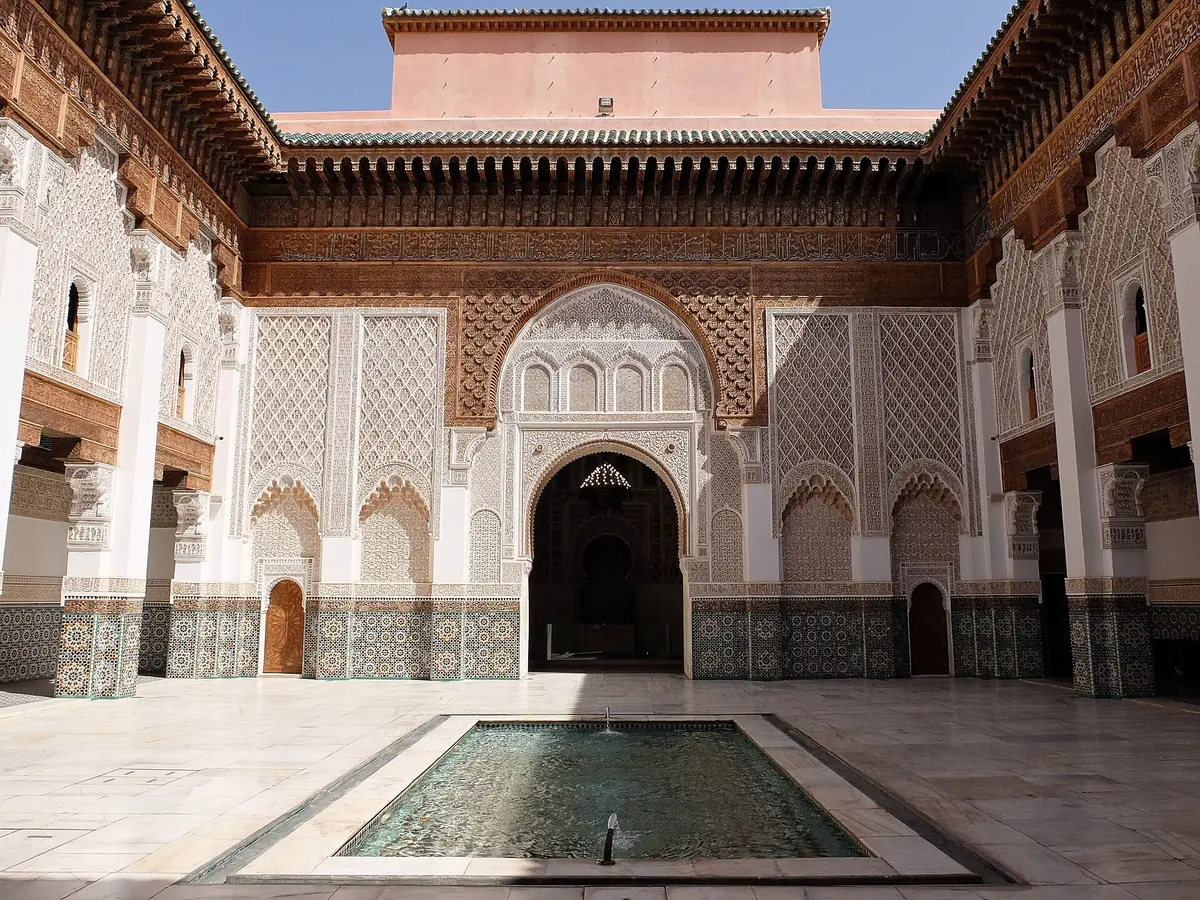
The souks begin on the north side of the square: lanes of spice stalls and craft shops that wind north through the medina. Allow the rest of the morning, then aim for the Ben Youssef Madrasa, one of the largest madrasas in the Maghreb. The Saadian sultan Abdallah al-Ghalib built it in the 16th century, and its 130 student rooms on two floors surround an inner courtyard that opens onto the prayer hall. On the way back, stop at Le Jardin Secret, a restored riad garden laid out on Islamic garden principles, with fountains, pools and pathways. Its panoramic tower looks over the roofs to the Atlas.
Day two: the palaces, the tombs and Jardin Majorelle
Take a petit taxi to Jardin Majorelle for its opening at 08:00. The French painter Jacques Majorelle began planting the garden in 1922 with plants from around the world. Today bamboos, palms and cacti grow around boldly coloured buildings and Majorelle-blue ornaments. The garden's ticket site also sells entry to the Musée Pierre Bergé des Arts Berbères, in Majorelle's former painting studio, with more than 600 Berber objects. Next door, the Musée Yves Saint Laurent Marrakech shows the designer's work and holds temporary exhibitions. Its permanent gallery is closed from 29 November to 18 December 2026 while the next exhibition is mounted, and reopens on 19 December.
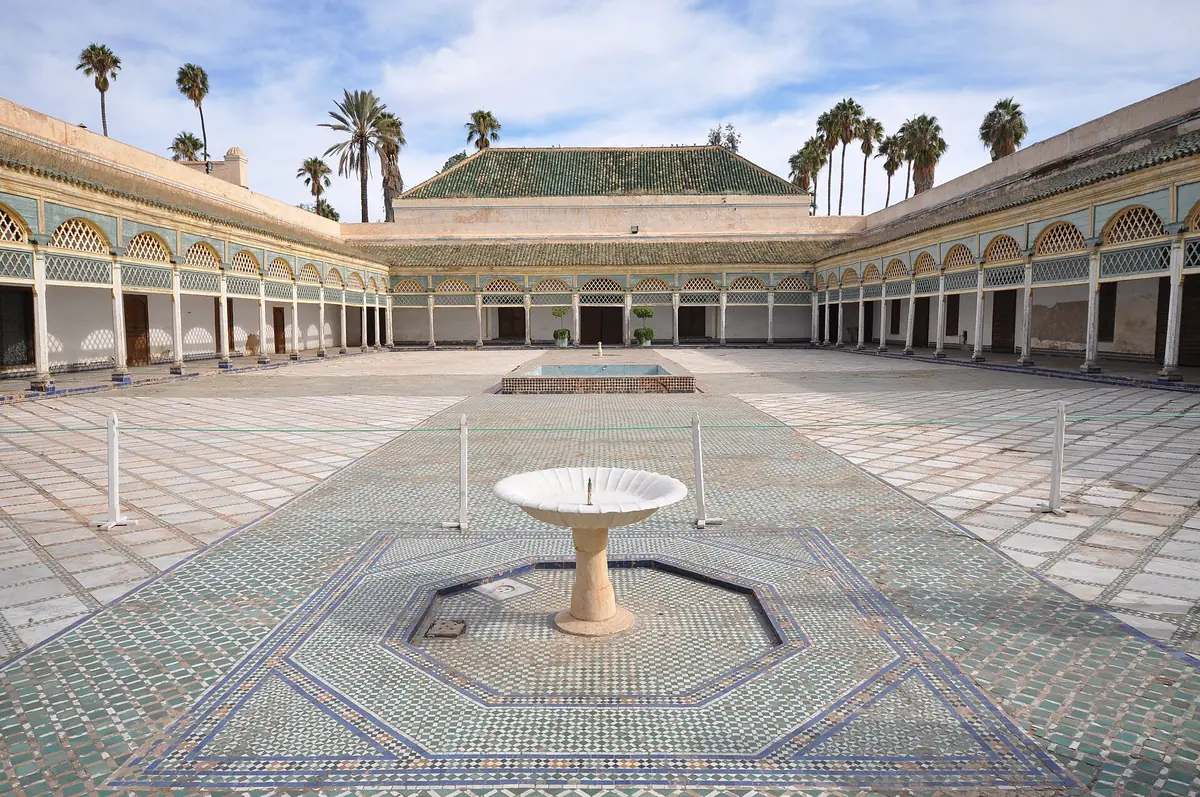
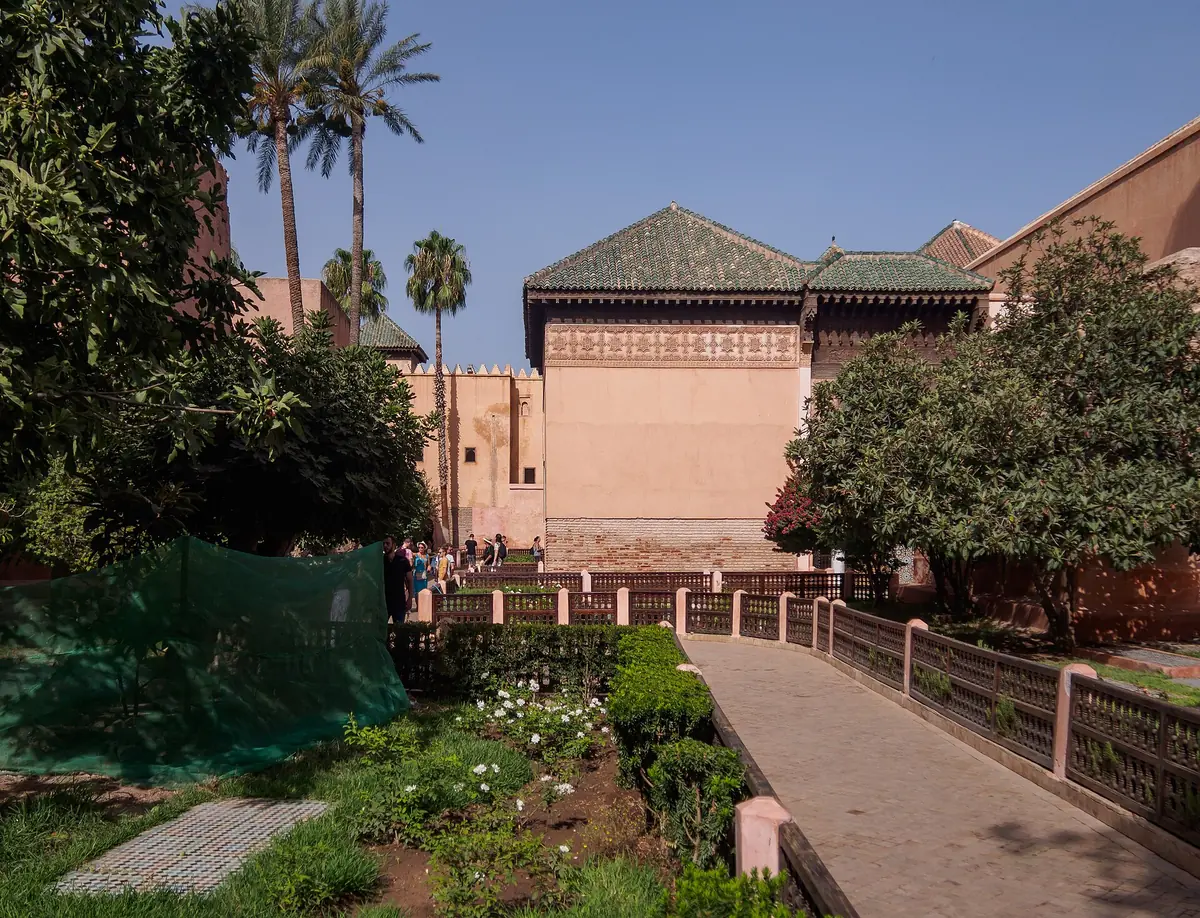
Back in the medina, walk south from the square along Rue Riad Zitoun El Jedid to the Bahia Palace. The vizier Si Moussa built it in the second half of the 19th century, and his son Ba Ahmed enlarged it. Its four main courtyards have fountains and gardens and are decorated with marble, zellige, stained glass, carved and painted wood and stucco. The Saadian Tombs, north of the Almohad Kasbah, hold the burial chambers of the Saadian dynasty from 1557 onwards. They lie in a hall of twelve columns, a mihrab room and a room of three niches, and the tombs are faced in marble or zellige. El Badi Palace, a Saadian palace close by on the edge of the Mellah, was built between 1578 and 1603 with the richest materials of its day, among them gold, onyx and Italian marble. Of its inner gardens there remains a vast esplanade of sunken pools planted with orange trees, enclosed by the ruins of the palace and by high walls where storks nest.
End the day in the Mellah, the old Jewish quarter built in 1558 next to the Bahia and El Badi, with its spice souk and two synagogues. Or take a taxi west to the Menara Gardens, olive groves founded by the Almohads around a large basin with a pavilion, at their best near sunset. A hammam is the Marrakech way to end a hot day: you sweat in the steam, then you are washed with black soap and scrubbed with a rough glove. Hammam de la Rose, at 130 Dar El Bacha in the medina, charges MAD 300 for its 30-minute beldi hammam with eucalyptus black soap and a glove scrub. Every quarter of the medina also has a simpler public hammam; ask your riad which one welcomes visitors.
What to eat and where to look
Tanjia
Marrakech's own dish, the tanjia marrakchia: meat slow-cooked in a tall clay jar, which the regional tourism council lists with tajine, couscous and pastilla among the city's traditional dishes.
- Where to look
- The restaurants of the medina and the souks.
- Fit it into your day
- A lunch on day one, after the souks.
Harira
A soup of beans, pasta and lentils, served on Jemaa el-Fnaa when the square turns into an open-air restaurant at night, and the dish that, with dates and honey sweets, is traditionally prepared for Ramadan.
- Where to look
- The soup stalls among the food stalls of Jemaa el-Fnaa.
- Fit it into your day
- A first course on the square at dusk.
Mechoui
Roast lamb, one of the savoury dishes Visit Morocco, the national tourist office, lists with pastilla, couscous and tajine.
- Where to look
- Medina restaurants such as Le Jardin, which serves a lamb mechoui, and the food stalls of Jemaa el-Fnaa.
- Fit it into your day
- A lunch on day two, between the palaces and the square.
Snail soup
Snails cooked in a broth of spices and herbs, among them oregano, aniseed, pepper and parsley: a Moroccan favourite among the street food of Jemaa el-Fnaa.
- Where to look
- The snail stalls on Jemaa el-Fnaa.
- Fit it into your day
- A small bowl on the square on the first evening.
Grilled meats
Meat and fish grilled to order at the evening food stalls of Jemaa el-Fnaa, the square with the richest street food in Morocco.
- Where to look
- The grill stalls of Jemaa el-Fnaa, or Le Jardin's grill plate of merguez, lamb chop, kefta and chicken skewers if you prefer a table.
- Fit it into your day
- Dinner on the square on day two.
Tickets, opening hours and the closed days
Jardin Majorelle sells tickets only on its own site, tickets.jardinmajorelle.com, which issues the QR code for the garden, the Musée Pierre Bergé des Arts Berbères and the Musée Yves Saint Laurent; tickets from other websites are not accepted at the gate. Standard admission to the garden is MAD 170; Moroccan citizens and residents pay MAD 75, and children under 10 enter free with an adult. The garden is open every day from 08:00 to 17:30 (last entry 17:00), and the Berber museum every day from 08:30 to 17:00 (last entry 16:30). The Musée Yves Saint Laurent is open every day except Wednesday from 10:00 to 18:00 (last entry 17:30). The private garden of Villa Oasis opens every day except Wednesday from 08:00 to 16:30.
The culture ministry runs the Bahia Palace, the Saadian Tombs, El Badi Palace, the Almoravid Koubba and the Menara pavilion, and sells their tickets online on e-services.minculture.gov.ma. The Bahia, the Saadian Tombs, El Badi and the Koubba charge foreign adults MAD 100 and foreign children aged 7 to 13 MAD 50. Moroccan and resident adults pay MAD 30 and children MAD 10. Moroccan nationals enter free on Fridays and on the first day of national and religious holidays. The Menara pavilion charges foreign adults MAD 60 and children MAD 30.
Le Jardin Secret charges MAD 100, plus MAD 40 for its tower, which children under 6 may not climb; buy at the entrance or on its own site. It opens every day at 09:30 and closes at 17:30 in November and December, 18:30 from January to March, 19:30 from April to September and 18:00 in October, with last entry 30 minutes before closing. The Ben Youssef Madrasa, run by the Ministry of Habous and Islamic Affairs, charges foreign adults MAD 50, Moroccan adults MAD 20 and children under 12 MAD 10, with tickets sold at the entrance. It opens every day from 09:00 to 19:00, and from 09:00 to 16:30 during Ramadan.
Prices and times checked 28 November 2026
Guides, taxis and finding your way in the medina
Men offering to show you the way, or telling you a lane is closed, are common around the square and the souks. The UK Foreign Office warns that people posing as official guides harass tourists, and advises that any guide you use in a medina carries an official badge and the local authority's permission. If you want a guide for the souks, book one through your riad or a tour with a named operator. Decline street offers politely and keep walking.
Petits taxis, painted orange in Marrakech, cover the city, the gardens outside the walls and the airport. Agree the fare before you set off or ask for the meter, and expect the driver to pick up other passengers on the way. The Foreign Office notes that cars booked through ride-hailing apps may be unlicensed and uninsured. Inside the medina you walk. Mopeds use the same lanes, so keep to the side.
Download an offline map before you arrive. Street names change from one lane to the next, so save a pin on the riad's door to find your way back late at night.
Getting in, moving on and the day trips
Marrakech Menara Airport (RAK) is just south-west of the city. Taxis between the airport and the city centre charge a regulated MAD 70 by day and MAD 100 at night; at the exit of the arrivals hall a taxi desk sells the ride in advance, by card or in cash. Airport bus 19 runs every 20 minutes from 06:00 to 21:30 for MAD 30, and many riads send a driver to meet you. Trains leave Marrakech station in Gueliz on ONCF's conventional Al Atlas line north to Casablanca and Rabat. For Tangier–Marrakech, take Al Boraq, the high-speed train, to Casablanca or Rabat and change to an Al Atlas train. Works on the Kenitra–Marrakech high-speed line, under construction with service expected at the end of 2029, brought a new ONCF transport plan from 14 September 2026, with changed timetables and shortened routes on some services. Look up train times and fares for your date on oncf-voyages.ma or in the ONCF Voyages app. CTM coaches run the 286 km from Rabat, with fares from MAD 150. CTM also runs about five coaches a day on the 191 km to Essaouira, from MAD 205 one way. Our transport guide covers the classes and the other routes.
The day trips are what make a fourth night worth it. Imlil and the foot of Toubkal are a 65 km drive south. Kasbah du Toubkal's published rate for a private car from Marrakech is EUR 90 per car one way. Our Imlil and High Atlas guide covers the walks and a night in the mountains. The Agafay desert is about 45 minutes away, the Ourika Valley about an hour, and the Atlantic port of Essaouira about two and a half hours.
Ouarzazate lies 194 km away over the Tizi n'Tichka pass, about 3 h 45 by road, and Ait Ben Haddou is about 30 minutes from Ouarzazate. As a day trip from Marrakech, that is a long day. Most readers are better off seeing both places on the way to the Sahara, as our Ouarzazate and Ait Ben Haddou guide explains.
Prices and times checked 28 November 2026
What three days cost on the ground
Beyond the room, the sights are the main cost. A full set for one foreign adult comes to MAD 680: the Bahia Palace, the Saadian Tombs and El Badi MAD 100 each, the Menara pavilion MAD 60, Jardin Majorelle MAD 170, Le Jardin Secret MAD 100 and the Ben Youssef Madrasa MAD 50.
Most riads include breakfast. Lunch at a medina restaurant such as Le Jardin, at 32 Souk Sidi Abdelaziz, comes to about MAD 235 per person: harira and a chicken tagine (MAD 65 and 130) and a large water (MAD 25), plus its 7% service charge. A beef tanjia there at dinner with a mint tea (MAD 190 and 20) adds about MAD 225. That makes about MAD 460 a day, or about MAD 550 with Le Jardin's Moroccan breakfast (MAD 80). A dinner at the food stalls of Jemaa el-Fnaa is the cheapest good meal in the city. Rooms are in our where-to-stay guide, and our Morocco trip-cost guide adds up a whole trip, rooms, meals and transport included.
Prices and times checked 28 November 2026
Practical questions
How many nights should I spend in Marrakech?
Three nights cover the medina, the souks, the palaces and Jardin Majorelle on foot. Add a fourth for a day trip to Imlil and the High Atlas, the Ourika Valley or Essaouira.
Where should I stay in Marrakech?
In a riad inside the medina, ideally between Jemaa el-Fnaa and the Kasbah quarter, so the square and the palaces are both on foot. Our where-to-stay guide names riads at budget, mid-range and upper level.
How do I buy tickets for Jardin Majorelle?
Only on the garden's own site, tickets.jardinmajorelle.com, which issues a QR code for the garden and its two museums. Tickets bought elsewhere are not accepted. The garden opens every day from 08:00 to 17:30, last entry 17:00.
How much does the Bahia Palace cost?
MAD 100 for foreign adults and MAD 50 for foreign children aged 7 to 13; Moroccan and resident adults pay MAD 30. The Saadian Tombs and El Badi Palace charge the same.
Is the Musée Yves Saint Laurent open in December 2026?
The museum stays open, but its permanent exhibition gallery is closed from 29 November to 18 December 2026 and reopens on 19 December. The museum is closed every Wednesday.
Can I visit the Koutoubia Mosque?
It is a working mosque, so see it from outside: everyone can walk around the minaret and the gardens beside it.
What are the best day trips from Marrakech?
Imlil and the High Atlas, about 65 km south; the Agafay desert, about 45 minutes away; the Ourika Valley, about an hour; and Essaouira on the coast, about two and a half hours by road.
Keep planning your trip
Imlil and the High Atlas
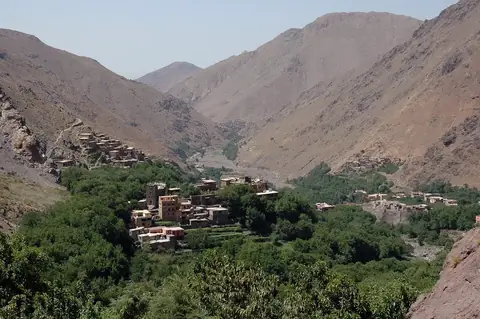
Whether Imlil is a day trip from Marrakech or worth a night, how to climb Toubkal with a guide in two days, the refuge, transfers, prices and seasons.
Read the guide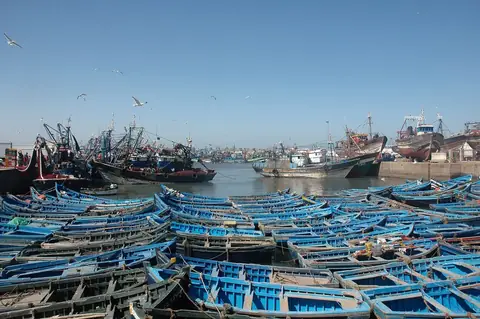
Essaouira
Day trip or two nights in Essaouira: the Skala ramparts, the port and its fish grills, the beach, the CTM coach from Marrakech, riads and costs.
Read the guide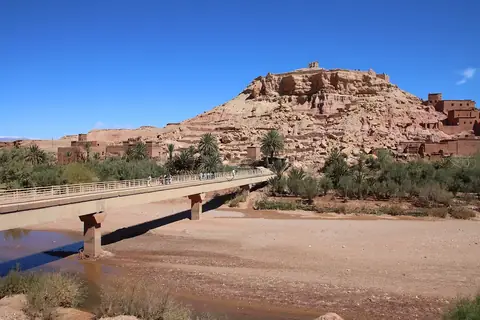
Ouarzazate and Ait Ben Haddou
Whether Ait Ben Haddou and Ouarzazate are a day trip from Marrakech or a night on the road to the Sahara: the ksar, the kasbahs, the film studios, buses and hotels.
Read the guide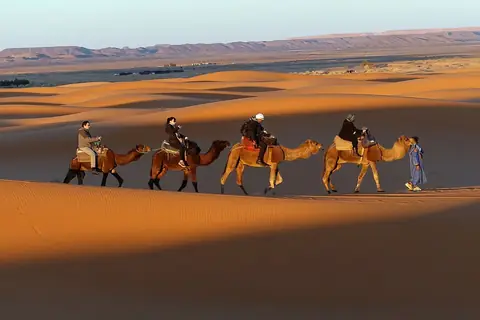
Merzouga and the Sahara
How to plan a night in the dunes of Erg Chebbi: tours from Marrakech or Fes, desert camps, the camel ride, Khamlia, Rissani and the best months for the Sahara.
Read the guide
Transport in Morocco
How to get around Morocco: Al Boraq and ONCF trains, CTM coaches to Chefchaouen and the south, grands taxis, drivers, car hire, flights and city trams.
Read the guide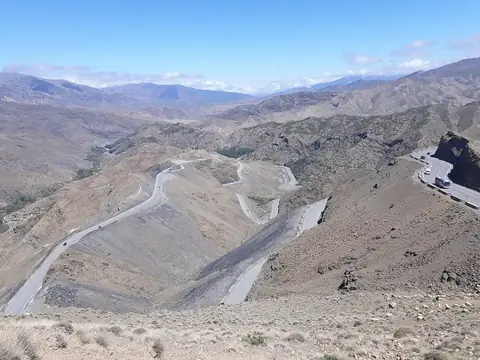
Morocco in 7 days
Seven days and six nights from Marrakech over the High Atlas to a desert camp at Merzouga and on to Fes: the nights, the desert tour and the riads.
Read the guideSources and checks before you travel
(38)
- Visit Morocco (Moroccan National Tourism Office): Marrakech ↗ — opens in a new tab
- Visit Morocco (Moroccan National Tourism Office): the medina of Marrakech ↗ — opens in a new tab
- Jardin Majorelle: official site ↗ — opens in a new tab
- Jardin Majorelle: official ticket office ↗ — opens in a new tab
- Musée Yves Saint Laurent Marrakech ↗ — opens in a new tab
- Le Jardin Secret Marrakech ↗ — opens in a new tab
- UK Foreign Office: Morocco safety and security ↗ — opens in a new tab
- Kasbah du Toubkal: transfers ↗ — opens in a new tab
- Visit Morocco (Moroccan National Tourism Office): getting around Morocco ↗ — opens in a new tab
- Le Matin: ONCF adapts its transport plan to the high-speed works (September 2026) ↗ — opens in a new tab
- CTM: Rabat–Marrakech by coach ↗ — opens in a new tab
- CTM: Marrakech–Essaouira by coach ↗ — opens in a new tab
- Visit Morocco (Moroccan National Tourism Office): Ouarzazate, Zagora and Tinghir (road times) ↗ — opens in a new tab
- Ministry of Culture e-services: Bahia Palace tickets ↗ — opens in a new tab
- Ministry of Culture e-services: Saadian Tombs tickets ↗ — opens in a new tab
- Ministry of Culture e-services: El Badi Palace tickets ↗ — opens in a new tab
- Ministry of Culture e-services: Menara pavilion tickets ↗ — opens in a new tab
- Ministry of Culture e-services: Almoravid Koubba tickets ↗ — opens in a new tab
- Jardin Majorelle: the garden ↗ — opens in a new tab
- Jardin Majorelle: Musée Pierre Bergé des Arts Berbères ↗ — opens in a new tab
- Visit Morocco (Moroccan National Tourism Office): Moroccan gardens ↗ — opens in a new tab
- Visit Morocco (Moroccan National Tourism Office): gastronomy ↗ — opens in a new tab
- Visit Marrakech (Marrakech-Safi Regional Tourism Council): Ben Youssef Madrasa ↗ — opens in a new tab
- Visit Marrakech (Marrakech-Safi Regional Tourism Council): the Mellah ↗ — opens in a new tab
- Visit Marrakech (Marrakech-Safi Regional Tourism Council): history and heritage ↗ — opens in a new tab
- Visit Marrakech (Marrakech-Safi Regional Tourism Council): gastronomy ↗ — opens in a new tab
- Le Jardin Secret: visitor information ↗ — opens in a new tab
- Le Jardin Secret: FAQ ↗ — opens in a new tab
- Le Jardin Marrakech: menu ↗ — opens in a new tab
- Le Jardin Marrakech ↗ — opens in a new tab
- Médersa Ben Youssef (Ministry of Habous and Islamic Affairs): hours and prices ↗ — opens in a new tab
- Visit Marrakech (Marrakech-Safi Regional Tourism Council): El Badi Palace ↗ — opens in a new tab
- Hammam de la Rose ↗ — opens in a new tab
- Le Matin (12 May 2023): taxi desk at Marrakech Menara Airport ↗ — opens in a new tab
- Visit Morocco (Moroccan National Tourism Office): Morocco, a kingdom of delights (gastronomy brochure) ↗ — opens in a new tab
- Visit Marrakech (Marrakech-Safi Regional Tourism Council): transport ↗ — opens in a new tab
- ONCF: annual financial report 2025 (Rapport financier annuel) ↗ — opens in a new tab
- ONCF: Al Atlas travel guide (Guide Al Atlas) ↗ — opens in a new tab
Reference sources for the version dated 28 November 2026. Confirm opening times, access, transport and conditions for your travel dates.
Photo credits
(7)
Jemaa el-Fnaa by day, before the evening food stalls set up.
Photograph: Jakub Hałun — opens in a new tab · CC BY 4.0 — opens in a new tab
Changes: Resized and converted to WebP; displayed with responsive crops. · Original photograph and licence details ↗ — opens in a new tab
The Koutoubia minaret, the landmark of the medina.
Photograph: Jorge Láscar from Australia — opens in a new tab · CC BY 2.0 — opens in a new tab
Changes: Resized and converted to WebP; displayed with responsive crops. · Original photograph and licence details ↗ — opens in a new tab
The great courtyard of the Bahia Palace.
Photograph: Jorge Láscar from Australia — opens in a new tab · CC BY 2.0 — opens in a new tab
Changes: Resized and converted to WebP; displayed with responsive crops. · Original photograph and licence details ↗ — opens in a new tab
The courtyard and pool of the Ben Youssef Madrasa.
Photograph: R Prazeres — opens in a new tab · CC BY-SA 4.0 — opens in a new tab
Changes: Resized and converted to WebP; displayed with responsive crops. · Original photograph and licence details ↗ — opens in a new tab
The blue villa and cactus garden of Jardin Majorelle.
Photograph: Viault — opens in a new tab · CC BY-SA 4.0 — opens in a new tab
Changes: Resized and converted to WebP; displayed with responsive crops. · Original photograph and licence details ↗ — opens in a new tab
The garden and mausoleum of the Saadian Tombs.
Photograph: C messier — opens in a new tab · CC BY-SA 4.0 — opens in a new tab
Changes: Resized and converted to WebP; displayed with responsive crops. · Original photograph and licence details ↗ — opens in a new tab
A snake charmer playing a pipe to two cobras on Jemaa el-Fnaa in Marrakech, with Yuki Ikemori sitting beside him holding a drum
Photo: Yuki Ikemori