Plan your trip
Cash or card in Morocco? Dirhams, ATMs, exchange and the MAD 2,000 rule
Morocco runs on the dirham, and the dirham stays in Morocco: you cannot easily buy it abroad, you may carry only a small amount in or out, and changing leftover notes back depends on paperwork you collect along the way. Cards work in most hotels and many shops in the cities, while small guesthouses, taxis, stalls and the villages on the road to the desert want cash. This guide covers the notes and the rate, how much cash to carry, where to change money and how to keep the receipts that let you change it back, cards and ATMs, what tickets and coaches cost, and the VAT refund at the airport.
In this guide
Find the location ↗ — opens in a new tabThe short answer
Arrive with euros, pounds or dollars and a card, and get dirhams (MAD) after you land, from an ATM or an exchange counter at the airport: the dirham is a closed currency, and you may carry at most MAD 2,000 in dirham banknotes into or out of the country. Keep every exchange receipt (bordereau de change): exchange offices in town buy back leftover dirhams against it, while airport and port counters change back up to MAD 2,000 per passport on a boarding pass for abroad. Pay hotels and larger shops by card, and carry cash for taxis, small riads, stalls and the desert. Two prices: a foreign adult pays MAD 100 at the Bahia Palace in Marrakech or at Volubilis, and a CTM coach from Rabat to Chefchaouen starts at MAD 135. Declare foreign currency worth MAD 100,000 or more when you arrive, even if you plan to spend it all.
- Key point
- Set up before you fly: a card with low foreign fees, a second card as back-up and some euros, pounds or dollars in cash
- Where it applies
- Applies everywhere in Morocco
- Timing
- All year: the rules on dirhams, exchange and cards are the same in every season.
The dirham: notes, coins and the rate
Morocco's currency is the dirham, written MAD in banks and DH or Dhs on price tags and menus. Bank Al-Maghrib, the central bank, issues notes of 20, 50, 100 and 200 dirhams. Several series circulate side by side: the 2023 notes, the 2012 notes and older designs. So one handful of change may hold two different 100-dirham notes. Coins run from 10 and 20 centimes up to 10 dirhams, again in more than one series.
Bank Al-Maghrib publishes the banknote rates that banks use. Banks paid MAD 10.00 for a euro and sold a euro for MAD 11.62. For a US dollar they paid MAD 9.12 and sold at MAD 10.60, and for a pound sterling they paid MAD 11.97 and sold at MAD 13.91. In round figures, MAD 100 is a little under EUR 10. Our Morocco trip-cost guide turns rooms, meals, coaches and the desert tour into a full budget.
Prices and times checked 28 November 2026
How much cash to bring, and the MAD 2,000 limit
The dirham is a closed, non-convertible currency, so it cannot easily be exchanged outside Morocco. Importing and exporting dirhams is forbidden as a rule. The one exception: travellers may carry up to MAD 2,000 in dirham banknotes in or out of the country, to cover a few expenses on arrival. Get your dirhams after you land, and spend or change them back before you leave.
Foreign currency is a different matter. You may bring in as much as you like, but you must declare foreign currency worth MAD 100,000 or more, about GBP 7,600, to customs when you arrive, whatever you plan to do with it. Below that, a declaration is optional. As a visitor you may take out again the foreign currency you brought in, and customs at the border can ask you to justify it with the declaration you made on entry, so keep that form with your passport.
Euros, pounds and US dollars are all on Bank Al-Maghrib's banknote rate table, so bring whichever your own bank gives you most cheaply. How much? On the budget level of our Morocco trip-cost guide, food, transport and the small extras come to about MAD 8,000 for two over ten days, and most of that is paid in cash. Taxis, small guesthouses, guides, stalls, tips and the tourist tax some riads add per guest per night all want cash, so take the larger sums from an ATM in the cities as you go and ask your bank for its daily withdrawal limit abroad.
Prices and times checked 29 November 2026
Where to change money
You can change money at the airports, in banks, at exchange offices in the cities and in some hotels, and each counter asks for your passport. Exchange offices sit in the tourist squares and main streets of every large town, and Visit Morocco, the national tourist office, names them as the best place to change cash. They must be licensed by the Office des Changes, the authority for foreign exchange, and they must display their buying and selling rates where customers can see them. The rates are negotiable under rules set by Bank Al-Maghrib, so compare two counters before you change a large sum.
Every exchange gives you a printed receipt, the bordereau de change, with your name on it. Keep each one until you leave Morocco: it is the proof that your dirhams came from foreign currency you changed legally, and you need it to change dirhams back.
A hotel with an exchange licence changes foreign money at its reception desk, which is handy on arrival day. A hotel's licence does not let it buy dirhams back. Exchange companies and payment-institution agencies may do that.
Prices and times checked 28 November 2026
Changing dirhams back before you fly
Licensed exchange offices may buy back the dirhams you have left over. They need two documents: your exchange receipts, in your name and less than six months old, and the customs declaration of the foreign currency you brought in. The counter writes the amount changed on that declaration. The declaration is compulsory only for foreign currency worth MAD 100,000 or more. Without one, an office can change back up to MAD 20,000 against receipts less than six months old.
At the exchange counters inside ports and airports the rule is simpler. Show your boarding pass for a flight or a ferry abroad, and you can change back up to MAD 2,000 per passport. That suits the last notes in your wallet. For larger sums, change them back in town before the day you leave. Any dirham notes you still carry count towards the MAD 2,000 you may take out.
Prices and times checked 29 November 2026
Cards and ATMs
Credit cards are widely accepted, especially in tourist areas: Visa and Mastercard work in most hotels and in some restaurants, shops and petrol stations. Smaller hotels and shops and remote areas may accept only cash. The bank that issued your card sets the commission on a payment abroad, generally 1% according to Visit Morocco; look up your bank's charges for payments and withdrawals before you fly.
ATMs are widespread across Morocco, and machines marked with your card's network, such as Visa or Mastercard, give cash on a credit card. Whether a debit card works depends on its bank's terms, so ask your bank before you leave. Pack a second card from a different bank as a back-up. An ATM or a card terminal may offer to charge you in your home currency: decline and pay in dirhams, so that your own bank does the conversion.
Credit card fraud and scams are common, and aggressive begging is common around ATMs. Use machines inside banks or shopping centres where you can, shield the keypad, and do not carry large amounts of cash or valuables through the medinas.
Prices and times checked 28 November 2026
What tickets and coaches cost
The Ministry of Culture's monuments charge in dirhams and sell tickets on the ministry's own e-ticket site. In Marrakech the Bahia Palace and the El Badi Palace cost MAD 100 each for a foreign adult and MAD 50 for a foreign child aged 7 to 13, and the same prices apply at the Roman site of Volubilis near Meknes. The Kasbah in Chefchaouen costs a foreign adult MAD 80 and a foreign child aged 7 to 13 MAD 40. Moroccan and resident adults pay MAD 30 at all four. In Fes, the Batha museum of Islamic arts charges foreign visitors MAD 60.
The Jardin Majorelle in Marrakech sells its tickets only online, on its own ticket site, so buy them before your Marrakech day; tickets bought elsewhere are not valid.
Coaches are cheap by European standards: CTM's fares start at MAD 135 from Rabat to Chefchaouen and at MAD 150 from Rabat to Marrakech; buy seats on ctm.ma or at CTM's own stations and agencies. In the cities' petits taxis, agree the fare before you get in or check that the meter is running.
For rooms, our where-to-stay guide compares riads and hotels in each town.
Prices and times checked 28 November 2026
Souks, guides, tips and the price of things
Prices in the souks are set by talking, and the first figure is the start of a conversation rather than the price. Settle the price, in dirhams, before a carpet, lamp or leather bag is wrapped, and watch it being packed: substituting inferior goods for the ones you bought is a known scam, as are other confidence tricks aimed at visitors.
The same habit saves money elsewhere. Agree what a guide's walk includes and costs before you start, using only guides with an official badge, and agree a taxi fare before the car moves. Small notes and coins make all of this easier, so break your 200-dirham notes in shops and cafés whenever you can.
Tips are paid in cash, in dirhams. Some restaurants already add a service charge of 7% to 9% to the bill, so look before you add more; elsewhere, round up or leave a few coins. Give your riad's staff, a guide and the driver of a desert tour a tip at the end of their service, by hand. Porters who wheel your bags through the medina to the riad and attendants at public toilets expect a few coins, so keep small change for them.
Getting the VAT back on purchases
Visitors who live outside Morocco can claim back the VAT on goods they buy in Morocco and take home. The purchase must be retail, not for resale, and must come to at least MAD 2,000 including VAT from one shop on one day. The shop fills in an export sales slip (bordereau de vente à l'exportation). It gives you the original slip and two copies of it, the itemised invoices and a prepaid envelope addressed to the tax authority. When you leave, within three months of the purchase, you show the goods, the slip and the invoices to customs, and customs stamps the slip. You then post the original to the tax authority within 30 days of leaving. The VAT is paid back to the bank account written on the slip.
Food and drink, tobacco, medicines, unmounted precious stones, weapons, private vehicles and their equipment, and cultural goods are excluded. Only a VAT-registered seller that agrees to fill in the slip can issue it. So ask the shop before you pay whether it does the refund paperwork.
Practical questions
Can I buy Moroccan dirhams before I travel?
Not easily: the dirham is a closed currency, and you may carry at most MAD 2,000 in dirham banknotes into Morocco. Get dirhams after you land, from an ATM or an exchange counter at the airport.
Can I pay by card in Morocco?
Yes, in most hotels and in many restaurants, shops and petrol stations in the tourist areas. Small hotels and shops and remote areas may accept only cash.
How do I change dirhams back when I leave?
At a licensed exchange office, with your exchange receipts (less than six months old): up to MAD 20,000 without a customs declaration, or more with one. Airport and port counters change up to MAD 2,000 per passport on a boarding pass.
Do I have to declare cash at Moroccan customs?
Only foreign currency worth MAD 100,000 or more, about GBP 7,600, which you declare on arrival whatever you plan to do with it; below that a declaration is optional. Keep the form to show customs where it came from when you leave. Dirham banknotes are limited to MAD 2,000 in or out.
How much do monuments cost in Morocco?
At the Ministry of Culture's sites a foreign adult pays MAD 100 at the Bahia Palace, the El Badi Palace and Volubilis, and MAD 80 at the Kasbah in Chefchaouen; children aged 7 to 13 pay half. The Jardin Majorelle sells its tickets online only.
Is bargaining expected in Morocco?
In the souks, yes: agree the price in dirhams before the item is wrapped, and watch it being packed. Agree taxi fares and guides' prices before you start too.
Keep planning your trip
First trip to Morocco
Choose seven days or ten for Marrakech, the Sahara at Merzouga and Fes: the order of the cities, the desert road, the season, entry, cash and the medina basics.
Read the guide
Entry to Morocco
Who enters Morocco visa-free for 90 days, passport validity, the MAD 2,000 cash limit, what to declare, drones, vaccines, and arriving by air or by ferry.
Read the guide
Morocco trip cost
Ten days from Rabat through Chefchaouen and Fes to the Sahara and Marrakech: about MAD 9,600 per person on a budget, 11,200 mid-range or 18,400 in comfort.
Read the guide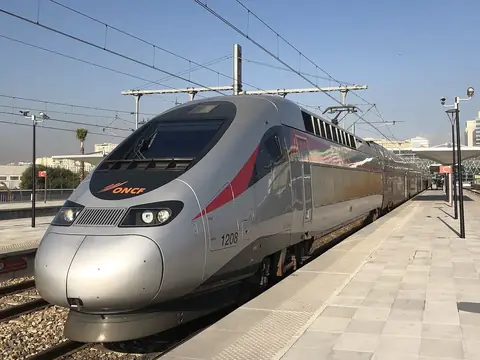
Transport in Morocco
How to get around Morocco: Al Boraq and ONCF trains, CTM coaches to Chefchaouen and the south, grands taxis, drivers, car hire, flights and city trams.
Read the guide
Where to stay in Morocco
Riad or hotel, which quarter of Marrakech, Fes and Chefchaouen to sleep in, nights per base, and three hotels per base from budget to upper.
Read the guide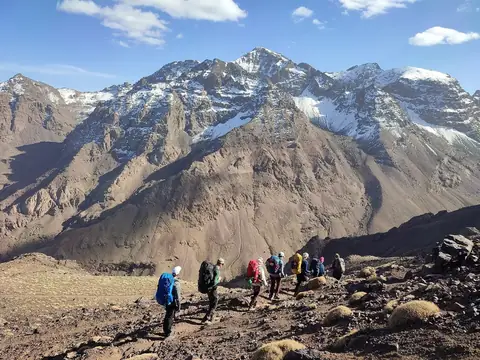
Health and safety in Morocco
Where governments draw lines in Morocco, false guides and scams, the numbers to save, clinics and insurance, vaccines, stray dogs, Toubkal, heat and the laws.
Read the guideSources and checks before you travel
(20)
- Bank Al-Maghrib: banknotes in circulation ↗ — opens in a new tab
- Bank Al-Maghrib: foreign banknotes exchange rate ↗ — opens in a new tab
- UK Foreign Office (GOV.UK): Morocco entry requirements ↗ — opens in a new tab
- UK Foreign Office (GOV.UK): Morocco safety and security ↗ — opens in a new tab
- German Federal Foreign Office: Morocco travel and safety advice ↗ — opens in a new tab
- Office des Changes: frequently asked questions (exporting dirhams; non-residents exporting foreign currency) ↗ — opens in a new tab
- Office des Changes: Instruction régissant l'activité de change de devises (15 June 2026) ↗ — opens in a new tab
- Visit Morocco (Moroccan National Tourist Office): useful information, currency ↗ — opens in a new tab
- Ministry of Youth, Culture and Communication: e-ticket office for historic monuments ↗ — opens in a new tab
- Fondation Nationale des Musées: Al Batha Museum of Islamic Arts ↗ — opens in a new tab
- Jardin Majorelle: official ticket office ↗ — opens in a new tab
- Jardin Majorelle: official site ↗ — opens in a new tab
- CTM: Rabat–Chefchaouen by coach ↗ — opens in a new tab
- CTM: Rabat–Marrakech by coach ↗ — opens in a new tab
- Moroccan Customs (ADII): foreigners visiting Morocco ↗ — opens in a new tab
- Code Général des Impôts, 2023 edition (DGI text, published by the Casablanca-Settat Regional Investment Centre) ↗ — opens in a new tab
- Le Jardin Marrakech: menu ↗ — opens in a new tab
- Nomad, Marrakech: menu ↗ — opens in a new tab
- Riad Laaroussa, Fes: rates ↗ — opens in a new tab
- Office des Changes: Instruction générale des opérations de change 2026 (declaration of foreign currency) ↗ — opens in a new tab
Reference sources for the version dated 29 November 2026. Confirm opening times, access, transport and conditions for your travel dates.
Photo credits
(6)
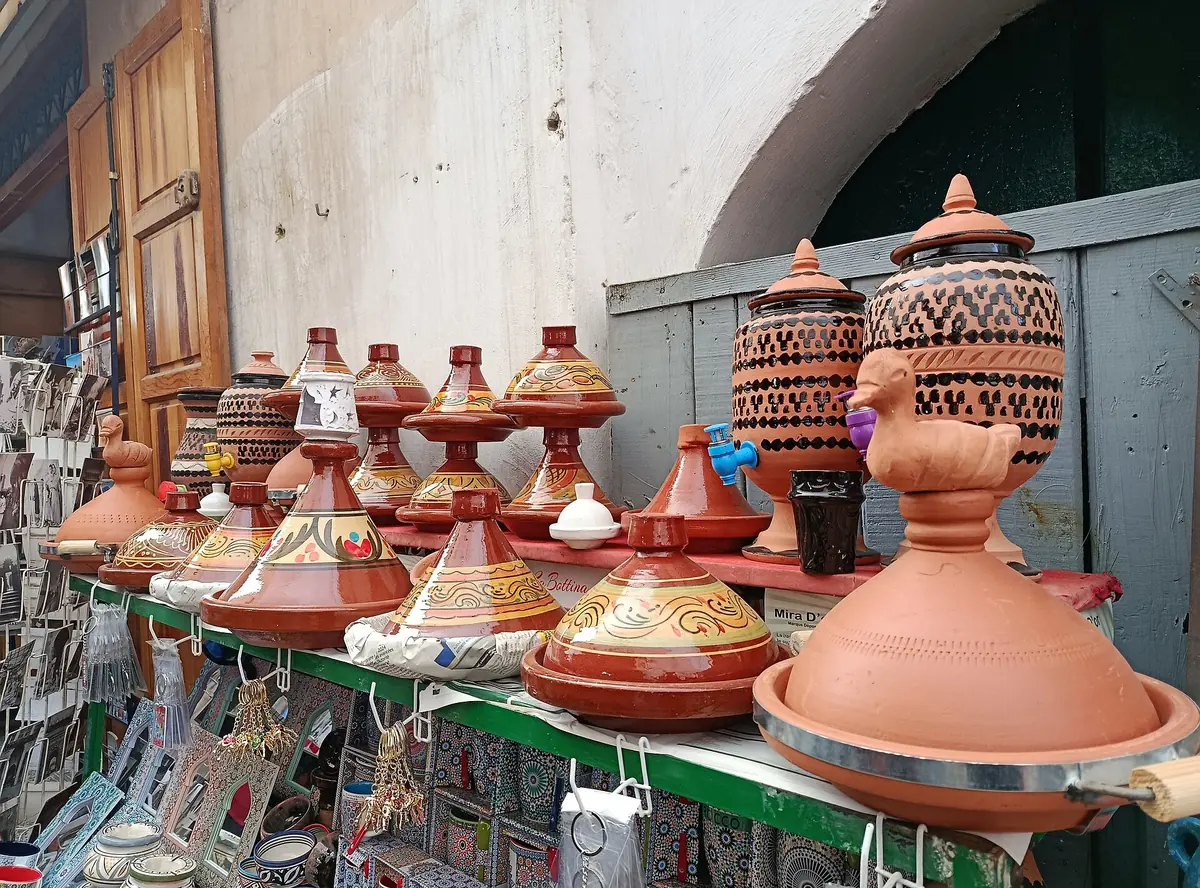
Glazed tagines and pottery for sale in the Fes medina
Photograph: AdilElouarti — opens in a new tab · CC0 — opens in a new tab
Changes: Resized and converted to WebP; displayed with responsive crops. · Original photograph and licence details ↗ — opens in a new tab
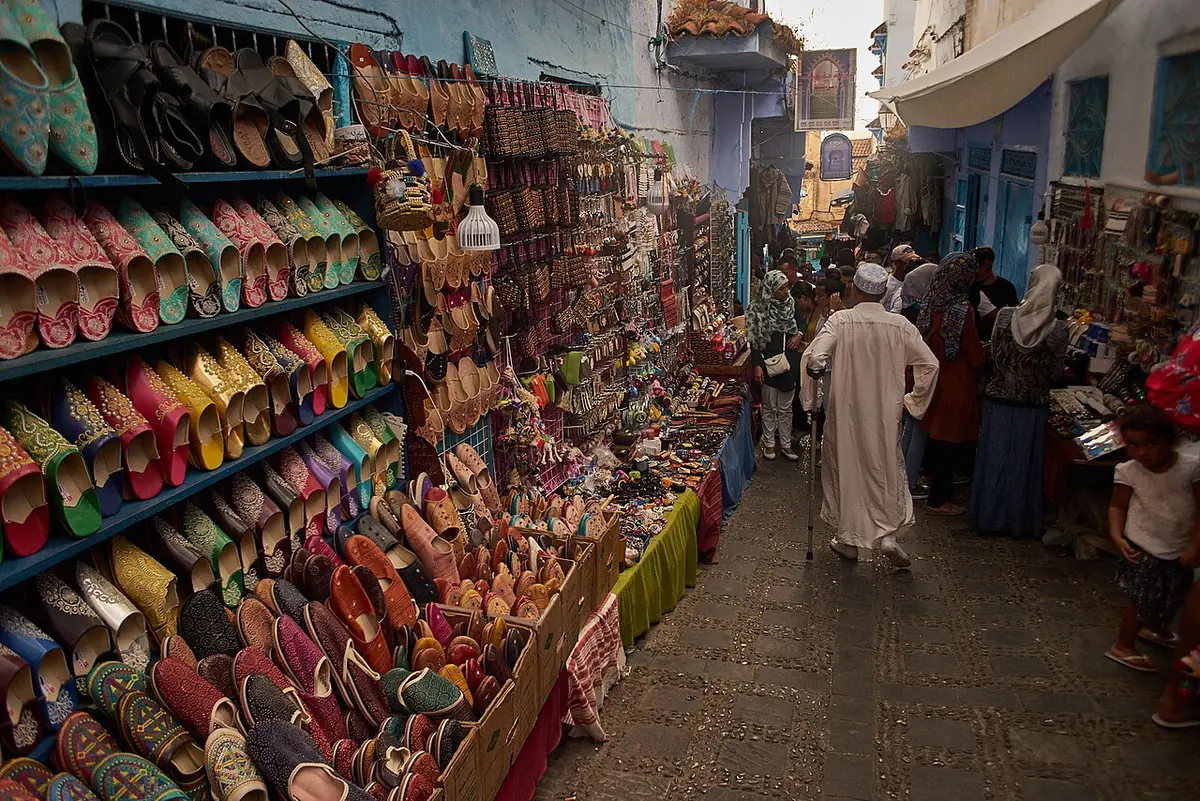
Babouche slippers and leather goods on sale in a lane of the Chefchaouen medina
Photograph: Rodrigo Silva — opens in a new tab · CC BY 2.0 — opens in a new tab
Changes: Resized and converted to WebP; displayed with responsive crops. · Original photograph and licence details ↗ — opens in a new tab
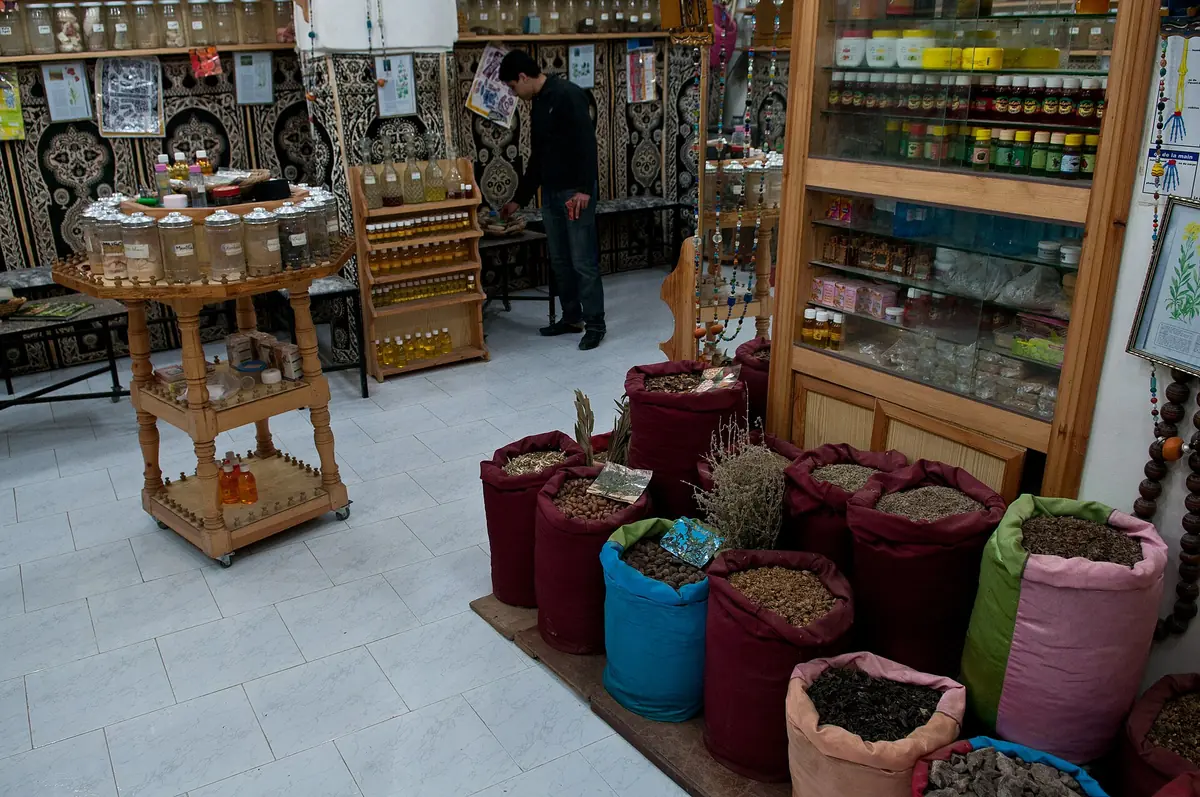
A spice shop in Fes, with herbs and spices sold by weight from open sacks
Photograph: Michal Osmenda from Brussels, Belgium — opens in a new tab · CC BY-SA 2.0 — opens in a new tab
Changes: Resized and converted to WebP; displayed with responsive crops. · Original photograph and licence details ↗ — opens in a new tab
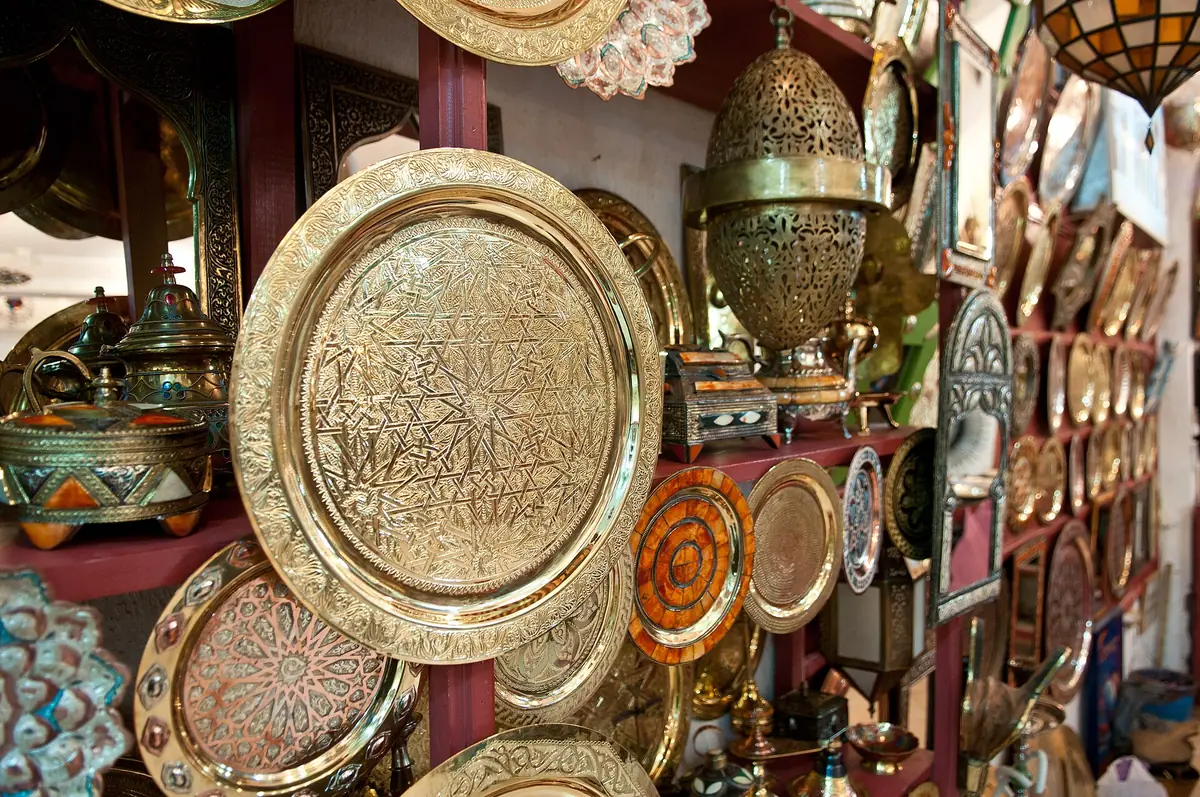
Brass trays and lanterns in a metalwork shop in Fes
Photograph: Michal Osmenda from Brussels, Belgium — opens in a new tab · CC BY-SA 2.0 — opens in a new tab
Changes: Resized and converted to WebP; displayed with responsive crops. · Original photograph and licence details ↗ — opens in a new tab
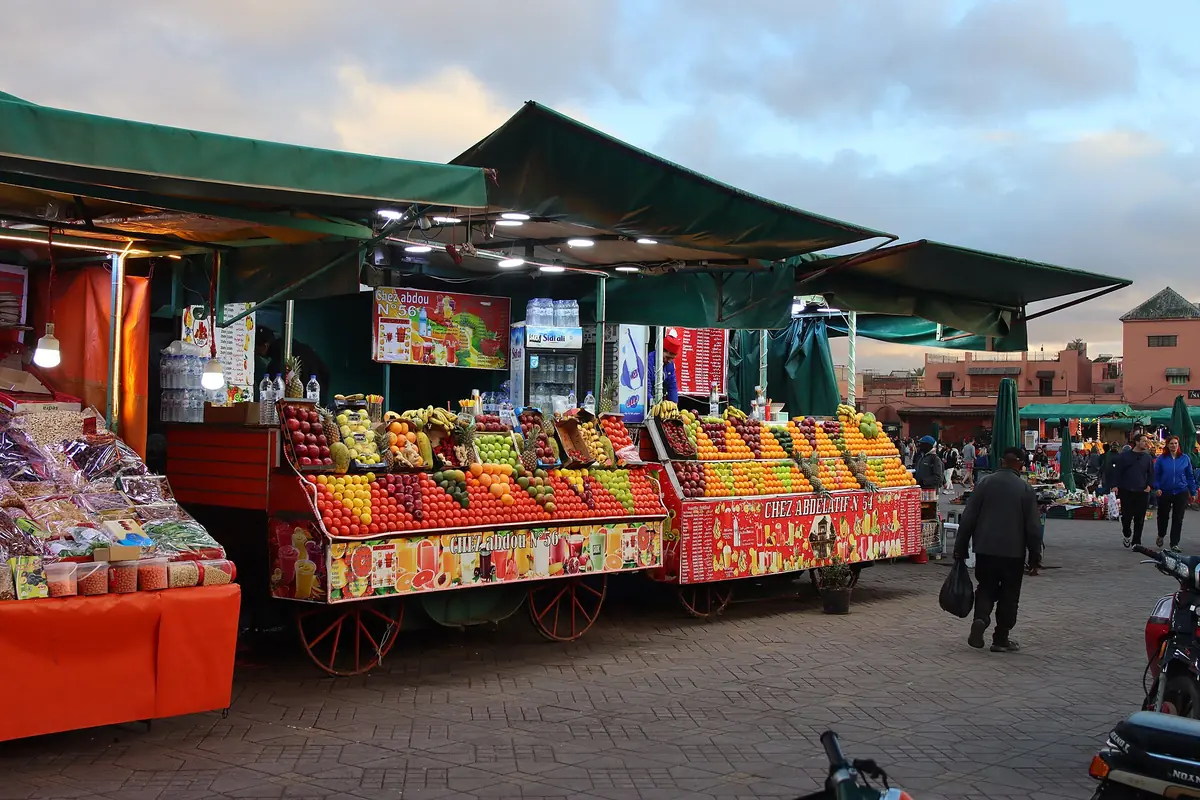
Juice stalls on Jemaa el-Fnaa, Marrakech
Photograph: Draceane — opens in a new tab · CC BY-SA 4.0 — opens in a new tab
Changes: Resized and converted to WebP; displayed with responsive crops. · Original photograph and licence details ↗ — opens in a new tab
Yuki Ikemori in a scarf shop in the Marrakech souks, head and face wrapped in a grey scarf
Photo: Yuki Ikemori