Rabat-Salé-Kénitra
Rabat: the Kasbah of the Udayas, Hassan Tower and a calm medina
Rabat is Morocco's capital and sits on the train line between Casablanca and Tangier. It is a quieter stop than Fes or Marrakech, and the regional tourism office calls its medina peaceful. The whole historic city is a UNESCO World Heritage Site. It takes in the bluish lanes of the Kasbah of the Udayas above the mouth of the Bou Regreg, the Hassan Tower, which is the minaret of a mosque never finished, and the Marinid and Roman ruins of the Chellah, with its storks. Across the river lies the old town of Salé. This guide covers how many nights to spend, where to sleep, what each sight is like, the tram, the boat to Salé, and the trains and coaches on to Fes, Chefchaouen and Tangier.
In this guide
Find the location ↗ — opens in a new tabThe short answer
Give Rabat one night on a north–south route, or two if you want the museums and Salé as well. Al Boraq takes 1 h 20 from Tangier, and ONCF trains run on to Casablanca, Fes and Marrakech; times and fares for every train are on ONCF's booking site, oncf-voyages.ma. Sleep in the medina, with the Kasbah of the Udayas on foot, or near Rabat-Ville station for the trains. Walk to the kasbah on the first afternoon, and leave the Chellah, the Hassan Tower and the Mausoleum of Mohammed V for the next morning. For the longer hops, the tram costs MAD 7 a ride. The Udayas jewellery museum and the Mohammed VI Museum of modern art each charge foreign visitors MAD 60 and close on Tuesdays. From Rabat–Salé Airport, city bus line 2 costs MAD 6.
- Suggested time
- 1 night, or 2 nights with the museums and Salé
- Where to stay
- The Rabat medina, a short walk from the Kasbah of the Udayas, or near Rabat-Ville station
- Season and timing
- Visit Morocco, the national tourist office, recommends April to June and September to October, when the weather is mild; winter can be rainy. Our best-time guide has the month-by-month picture.
Where to sleep: the medina or the station district
Rabat is compact, and the choice is between two kinds of night. The medina puts you in a riad among the lanes, a short walk from the Kasbah of the Udayas. The kasbah is about 15 minutes on foot from the city centre. The medina is the better base for a single night and an evening at the kasbah. The area around Rabat-Ville station and the tram stop Mohammed V – Gare de Rabat suits a stop between trains. The same tram stop serves the Mohammed VI Museum.
Our ten-day itinerary names a riad for its night in Rabat, and our where-to-stay guide for Morocco compares riads and hotels across the country.
The Kasbah of the Udayas, its garden and the Café Maure
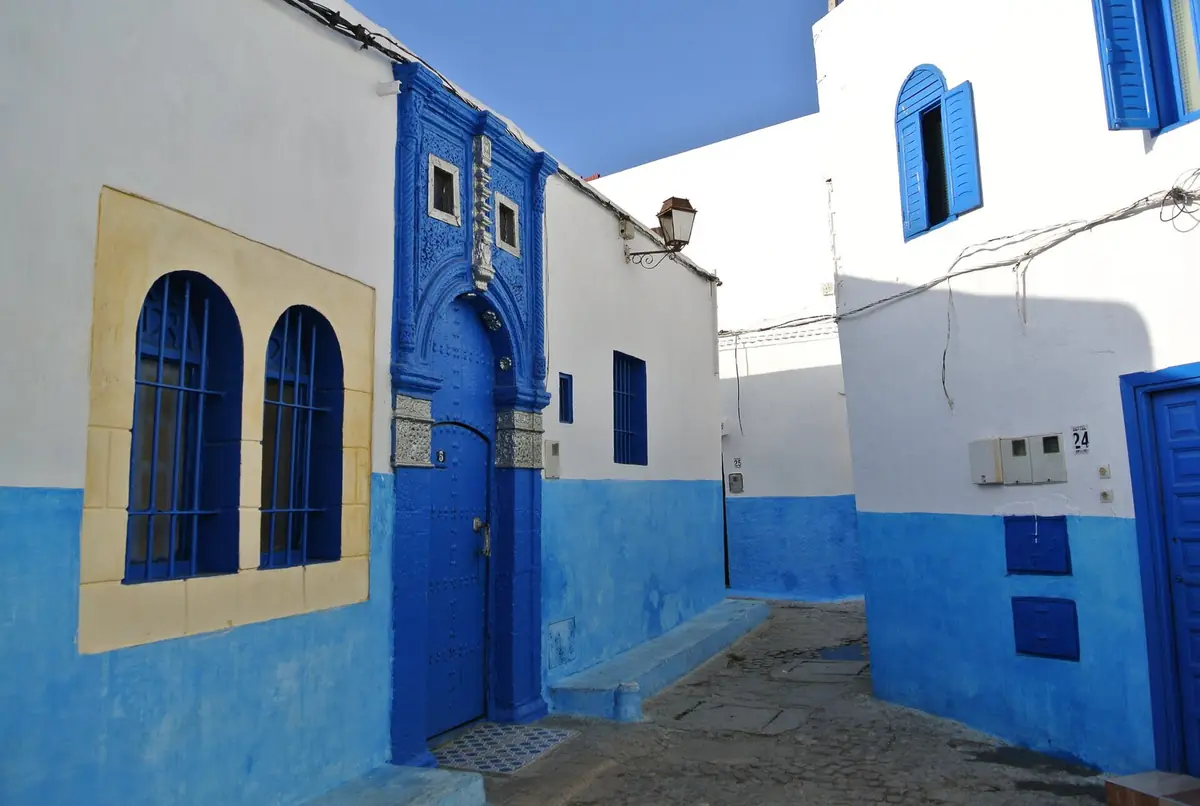
The kasbah was the first core of medieval Rabat. The Almoravids settled this rock above the mouth of the Bou Regreg, the Almohads rebuilt it as a fortress, and in the 17th century Moriscos expelled from Andalusia moved in and restored it from 1609; in the 19th century part of the Udayas tribe settled inside and gave it its name. You enter through the great Almohad gate into lanes whose bluish walls Visit Morocco, the national tourist office, compares to Chefchaouen's.
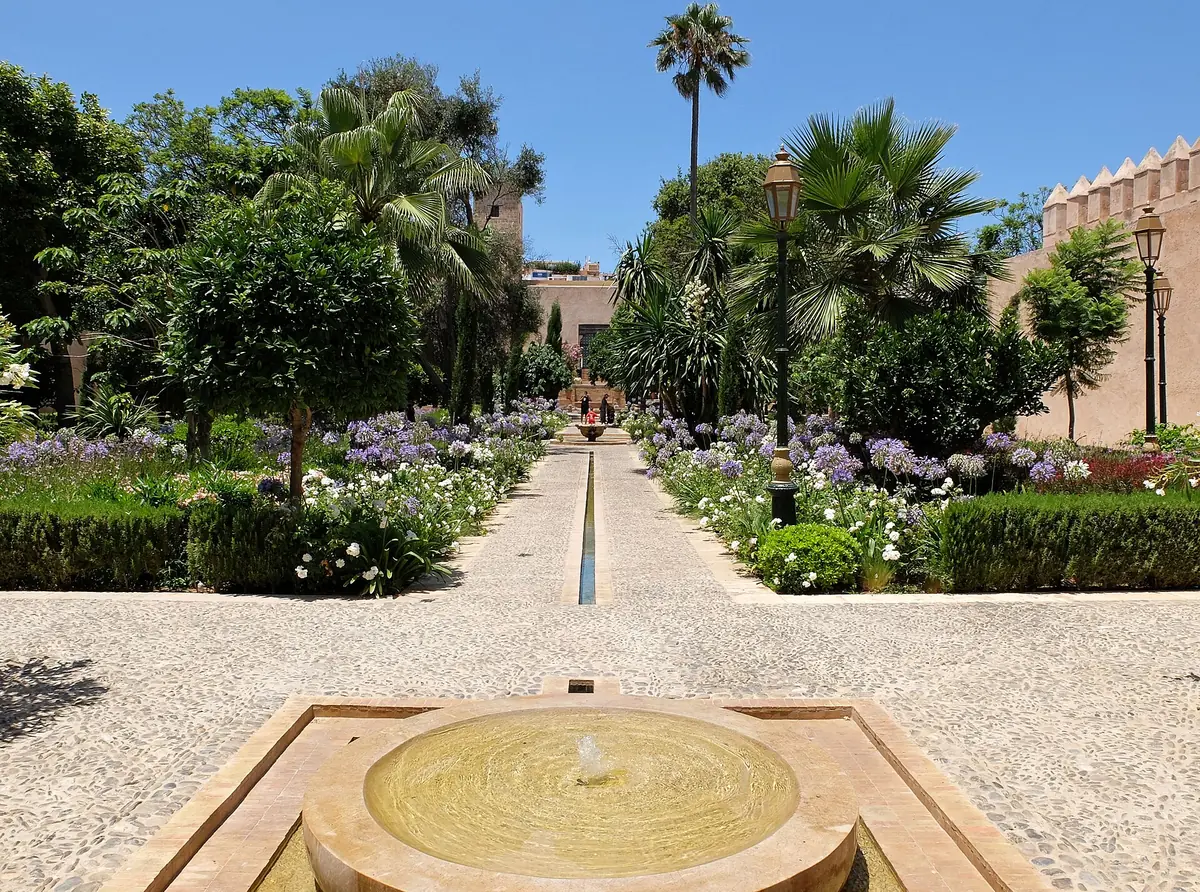
The kasbah, a quarter of lanes, riads and old mosques, is open to visitors daily from 09:00 to 20:00. Below its walls lies the Andalusian garden, laid out when the kasbah was restored. Nearby, the terrace of the Café Maure serves mint tea and almond pastries, with a view over the mouth of the Bou Regreg, the Atlantic and Salé on the opposite bank.
At the western end of the kasbah, a 17th-century building finished under Sultan Moulay Ismail houses the Udayas National Museum of Adornment. The museum reopened on 9 January 2023. It shows Moroccan jewellery and dress ornaments, including King Mohammed VI's personal collection of Amazigh jewellery. It is open daily from 10:00 to 18:00 except Tuesday. Foreign visitors pay MAD 60, Moroccan adults MAD 30 and Moroccans under 18 MAD 15.
Prices and times checked 28 November 2026
Hassan Tower and the Mausoleum of Mohammed V
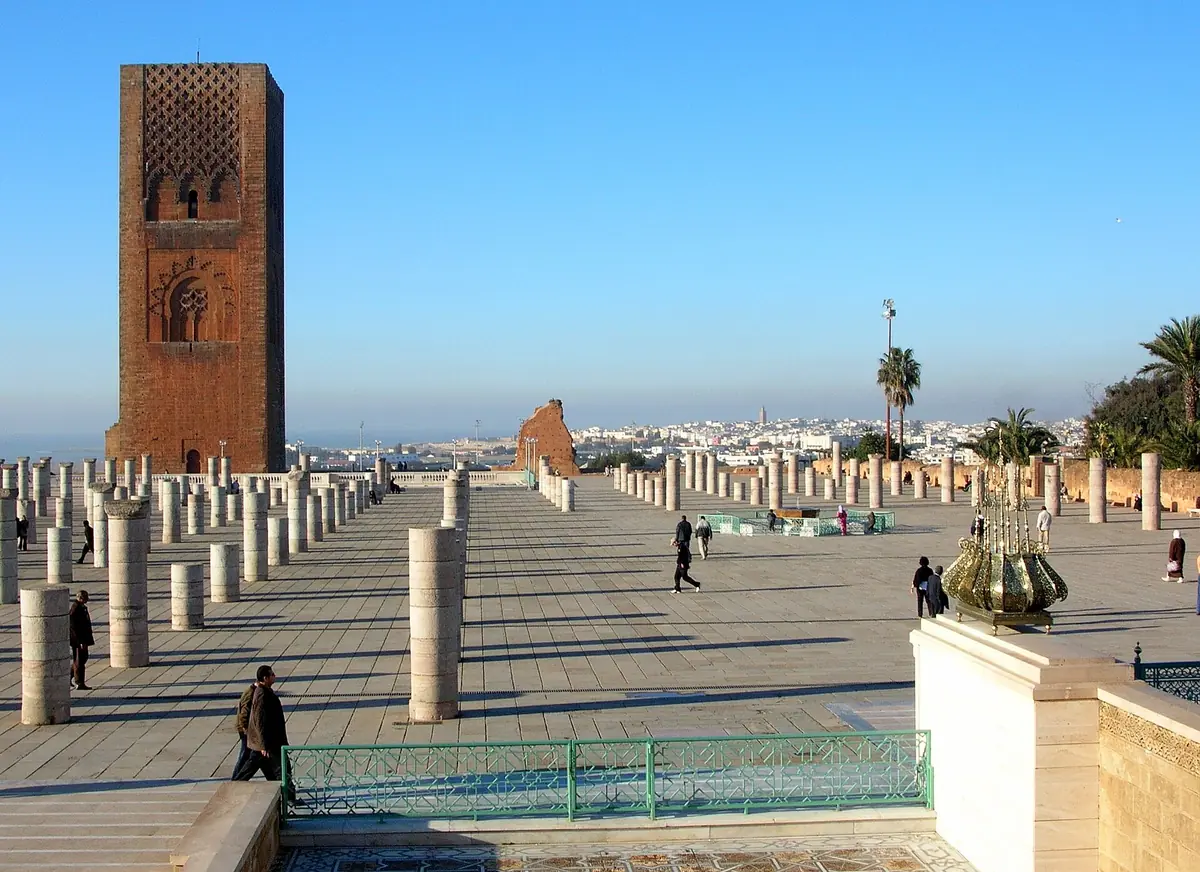
On a rise above the river, the Hassan Tower is all that stands of what the Almohad sultan Yacoub al-Mansour meant to be the largest mosque in the Muslim world. Work stopped at his death in 1199, and the Lisbon earthquake of 1755 brought down much of what had been built. Only the minaret still stands. It is 44 m high and close in design to the Koutoubia in Marrakech and the Giralda in Seville. The site is open daily from 09:00 to 18:00; the tram stops for it are Place du 16 Novembre and Pont Hassan II.
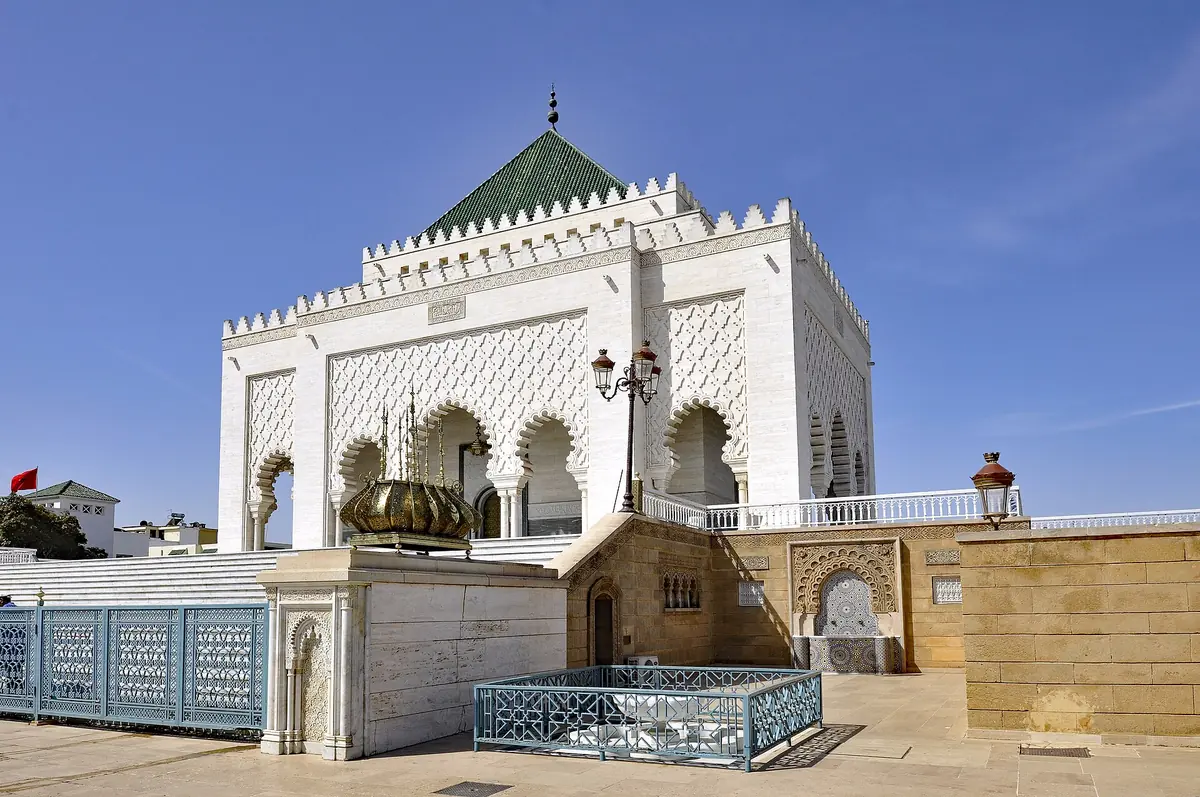
At the other end of the esplanade, the Mausoleum of Mohammed V holds the tombs of King Mohammed V and his two sons, King Hassan II and Prince Moulay Abdallah. Built between 1962 and 1971, it has white marble walls under a green-tiled roof, with gilded cedar, onyx and bands of calligraphy inside. Royal guards in full dress stand at the door. The mausoleum is open to the public, on weekdays from 08:00 to 18:00 and at weekends from 08:15 to 17:45. Visitors go in through the guarded door; follow the guards' directions. It is a sacred place, so dress modestly and keep your voice down. From the edge of the esplanade you look down to the river and Salé.
Prices and times checked 28 November 2026
The Chellah: Roman ruins, a Marinid necropolis and storks
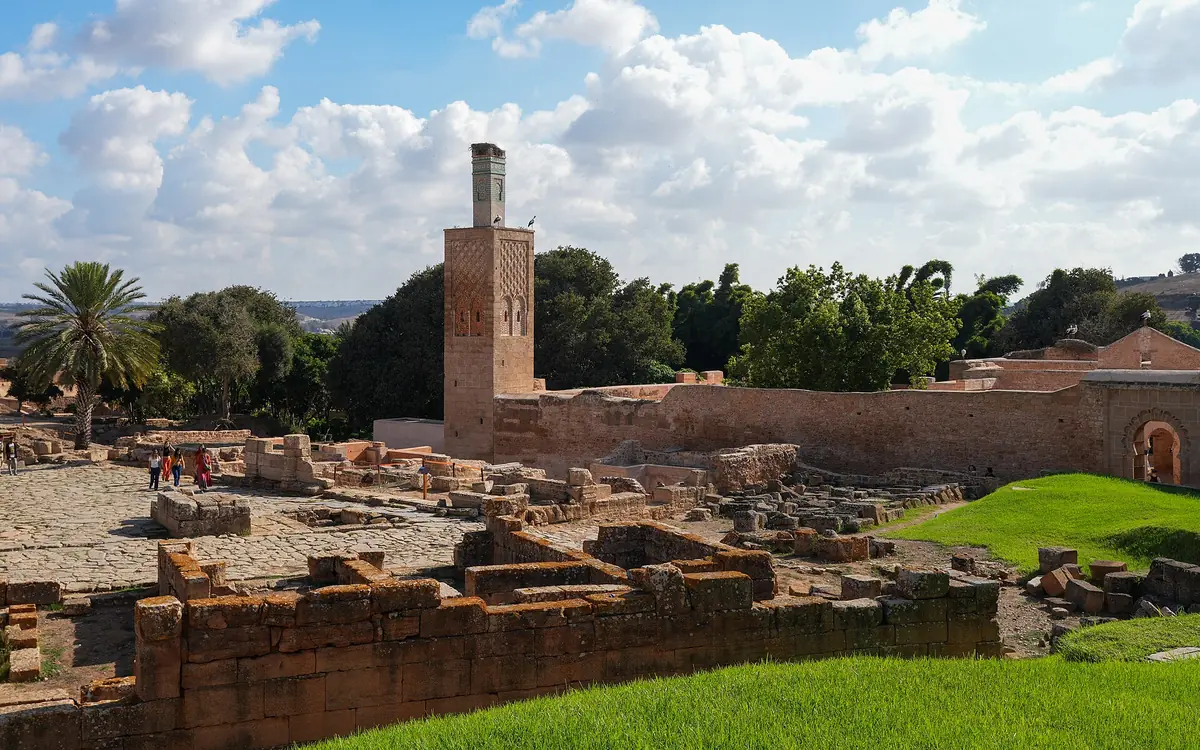
Outside the Almohad walls, about 2 km from the centre, the Chellah is the most atmospheric hour in Rabat. The Marinids built a necropolis here in the 14th century over the ruins of the Roman town of Sala Colonia. Historians believe the hill above the river was the oldest settlement at the mouth of the Bou Regreg, long before the medieval city. Through the great Marinid gate, a paved path lined with trees and flowers leads down to the ruins, where Roman and Marinid remains lie side by side. The minaret of the old mosque, decorated with coloured tiles, stands over the site. Storks perch among the ruins, and coins lie scattered in a pool where fish, turtles and eels swim.
The Chellah is open daily from 09:00 to 17:00. It stands on Avenue Mohammed VI, a short petit-taxi ride from the centre. Carry dirhams for the entrance ticket.
Prices and times checked 28 November 2026
The medina, Rue des Consuls and two museums
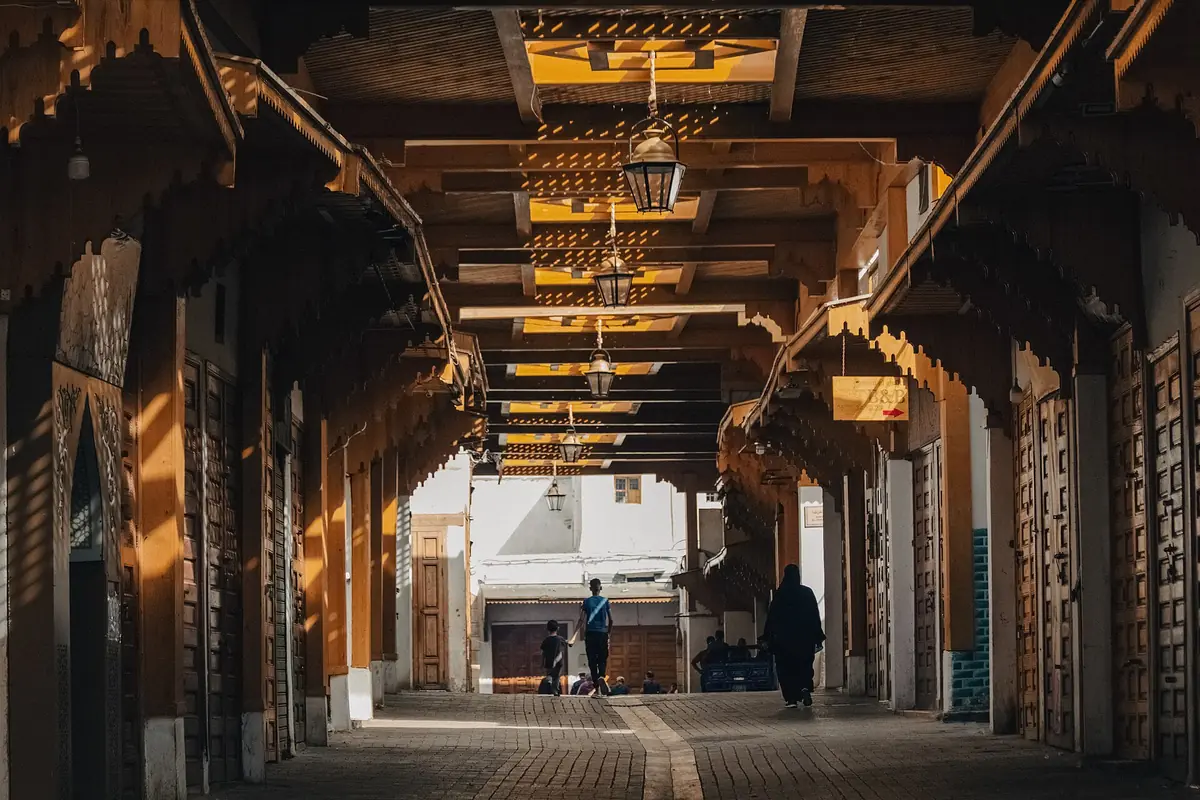
Rabat's medina is a peaceful one, with lively lanes, traditional souks and old houses. Walk Rue des Consuls, hung with carpets and lined with shops selling pottery, leather, jewellery and textiles, then Souika street and the Souk Sebbat, which smells of leather. The tram stop Médina Rabat is at its edge.
Two museums are worth an afternoon. The Mohammed VI Museum of Modern and Contemporary Art opened in 2014 at 2 Avenue Moulay Hassan, by the tram stop Mohammed V – Gare de Rabat. The museum holds more than 500 paintings and about ten sculptures, with the great names of Moroccan painting such as Melehi, Gharbaoui and Belkahia. It is open daily from 10:00 to 18:00 except Tuesday. Foreign visitors pay MAD 60, Moroccan adults MAD 30 and Moroccans under 18 MAD 15. The Museum of History and Civilisations, at 23 Rue El Brihi, reopened in 2017. It tells Morocco's story from prehistory through the Punic, Roman and Islamic periods. Its showpieces include Roman bronzes of Juba II and of Cato, found at ancient sites such as Volubilis. This museum keeps the same hours. Adults pay MAD 20, visitors from 12 MAD 10 and children under 12 MAD 5.
Prices and times checked 28 November 2026
Across the river: Salé by flouka and the Marinid madrasa
Salé, Rabat's twin city on the right bank of the Bou Regreg, was founded in the 11th century and grew under the Almohads and Marinids. It was home to the Salé corsairs who sailed the Atlantic, and its ramparts and medina keep that past. The classic way over is the flouka, a traditional boat that crosses the river from Avenue Al Marsa in a few minutes. The tram is the other way across: both lines link the two cities.
The reason to go is the Marinid madrasa, a 14th-century Koranic school covered in coloured zellige tiles, carved stucco and chiselled cedar. Its roof terrace looks over the river to Rabat. The madrasa is open daily from 09:30 to 16:30, on Rue Ash al Shaiara in the Salé medina. The Ministry of Culture sells tickets on its e-ticket site. Foreign adults pay MAD 80 and foreign children aged 7 to 13 MAD 40. Moroccan and resident adults pay MAD 30, and their children aged 7 to 13 MAD 10. Moroccan nationals enter free every Friday and on the first day of national and religious holidays.
Prices and times checked 28 November 2026
One night or two in Rabat
One night covers the essentials if you arrive by early afternoon. A second night adds the museums and Salé at an easy pace.
- Day 1 (afternoon): arrive by train at Rabat-Ville, drop your bags, then walk to the Kasbah of the Udayas, the Andalusian garden and tea at the Café Maure before sunset. Sleep in Rabat: night 1.
- Day 2 (morning): the Chellah when it opens at 09:00, then the Hassan Tower and the Mausoleum of Mohammed V, and Rue des Consuls in the medina before an afternoon train or coach onward.
- With a second night: spend day 2 afternoon at the Mohammed VI Museum or the Museum of History and Civilisations (both closed on Tuesday), sleep in Rabat again, and on day 3 take the flouka to Salé for the Marinid madrasa and the Salé medina before you leave.
What to eat and where to look
Grilled fish and seafood
Rabat and Salé face the Atlantic, and the restaurants of the Bou Regreg marina grill fresh fish and seafood, some of them in the Spanish style with tapas and paella.
- Where to look
- Al Marsa, at the Bou Regreg marina in Salé, looking across to the Kasbah of the Udayas and the Hassan Tower.
- Fit it into your day
- Lunch on day 3, after the flouka to Salé.
Harira
A soup of pulses, tomatoes, pasta and flour, traditionally eaten during Ramadan and served in most restaurants.
- Where to look
- Small eateries along Souika street and the main lanes of the medina.
- Fit it into your day
- A quick lunch between Rue des Consuls and the station.
Pastilla
A sweet-and-savoury pie of crisp brick pastry, filled in Rabat with pigeon, toasted almonds and cinnamon and dusted with icing sugar; fish and chicken versions exist too.
- Where to look
- Dinarjat, a restaurant in a former palace at 6 Rue Belgnaoui in the medina, serves pigeon pastilla at lunch and dinner.
- Fit it into your day
- Dinner on night 1.
Friday couscous
Morocco's staple dish, of Amazigh origin and traditionally eaten on Fridays; in Rabat it comes with seven vegetables and tender meat, often with a glass of lben, fermented milk, on the side.
- Where to look
- The restaurant of Dar El Kebira, a riad off the Rue des Consuls in the medina, whose menu has a couscous royal for two.
- Fit it into your day
- Lunch on day 2 if it falls on a Friday.
Tajine with prunes and almonds
Rabat's tajines are slow-cooked over a low flame, sweet with prunes and almonds or sharp with preserved lemon and olives, with artichokes and peas in season.
- Where to look
- Dinarjat in the medina, which serves tajines alongside its pastilla.
- Fit it into your day
- Dinner on night 2, if you stay a second night.
Arriving and moving on: the airport, trains, tram and coaches
Rabat–Salé Airport is the region's main international gateway, about 20 to 30 minutes from the city depending on traffic and where you are going. City bus line 2 runs every 30 minutes for MAD 6, a taxi costs about MAD 100 to 150, and you can also hire a car. Carry cash: buses, trams and taxis mostly do not take cards. From Casablanca Mohammed V Airport, take the ONCF airport train to Casablanca and change for Rabat.
The train is the easy way in and out. Al Boraq, the high-speed train, runs between Tangier, Kenitra, Rabat and Casablanca and takes 1 h 20 from Rabat to Tangier. ONCF's conventional trains continue inland to Meknes and Fes and south to Marrakech; ONCF's booking site, oncf-voyages.ma, has the times and fares of every train. By road, Casablanca is about an hour away, and Fes is 207.1 km, which Visit Morocco gives as 2 h 16 min. There is no train to Chefchaouen. CTM's coaches cover the 254 km in about 6 hours, with 11 departures a day and fares from MAD 135. Long-distance coaches use Rabat's new coach station, near the Moulay Abdallah sports complex. Our transport guide has the details of each, and our Chefchaouen guide the next stop north.
In town, two tram lines run about 20 km, with 31 stations between Rabat and Salé. A single ticket costs MAD 7 and is valid for one hour from the first validation, including a change to the other line. Validate it every time you board: riding without a validated ticket costs a MAD 50 fine. Useful stops are Mohammed V – Gare de Rabat for the station and the Mohammed VI Museum, Médina Rabat, Place du 16 Novembre and Pont Hassan II for the Hassan Tower, and Bab Lamrissa for Salé. Petits taxis in Rabat are blue; ask for the meter or agree the fare first. Ride-hailing apps such as Careem and inDrive work in Rabat, but the regional tourism office notes that their legal status is unclear.
Prices and times checked 28 November 2026
Practical questions
Is Rabat worth visiting?
Yes, for a night or two. The Kasbah of the Udayas, the Hassan Tower, the Mausoleum of Mohammed V and the Chellah are among the finest sights in Morocco, the medina is calm, and the whole historic city is a UNESCO World Heritage Site.
How many days do you need in Rabat?
One night covers the kasbah, the Hassan Tower, the mausoleum and the Chellah. A second night adds the Mohammed VI Museum or the Museum of History and Civilisations and a boat across the river to Salé.
What are the opening hours of the Kasbah of the Udayas and the Chellah?
The kasbah quarter is open to visitors daily from 09:00 to 20:00, the Hassan Tower daily from 09:00 to 18:00 and the Chellah daily from 09:00 to 17:00. The Udayas jewellery museum opens from 10:00 to 18:00 and closes on Tuesdays.
How do I get from Rabat–Salé Airport to the city?
Take city bus line 2, every 30 minutes for MAD 6, or a taxi for about MAD 100 to 150. The ride takes about 20 to 30 minutes.
How much is the Rabat tram?
A single ticket costs MAD 7 and is valid for one hour from the first validation, including a change to the other line. Validate it each time you board.
How do I get from Rabat to Chefchaouen?
By CTM coach: 254 km in about 6 hours, 11 departures a day, from MAD 135. There is no train to Chefchaouen.
Keep planning your trip
Chefchaouen
Whether Chefchaouen is worth a night: the blue medina, the kasbah and Outa el Hammam square, the walk to the hillside mosque, Akchour, and the road from Fes and Tangier.
Read the guide
Fes
How many nights Fes needs: Fes el-Bali on foot, the madrasas and tanneries, the Batha museum, and a day trip to Meknes and Volubilis, with tickets and riads.
Read the guide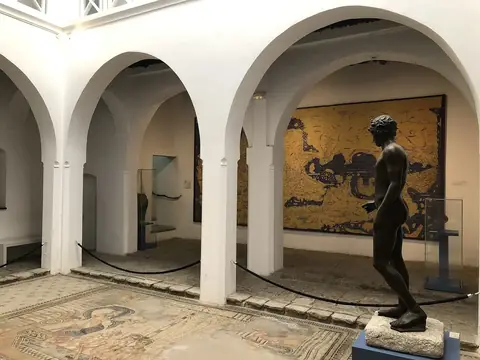
Northern Morocco in 7 days
Seven days and six nights from Tangier to the blue town of Chefchaouen, the Fes medina, Volubilis and Meknes, ending in Rabat: the nights, the coach and the road days.
Read the guide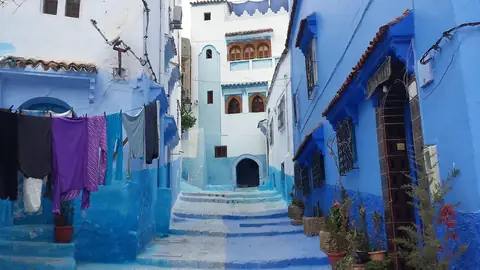
Morocco in ten days
Ten days and nine nights from Rabat through Chefchaouen and Fes to the Merzouga dunes, Ait Ben Haddou and Marrakech, with named rooms and the desert days.
Read the guide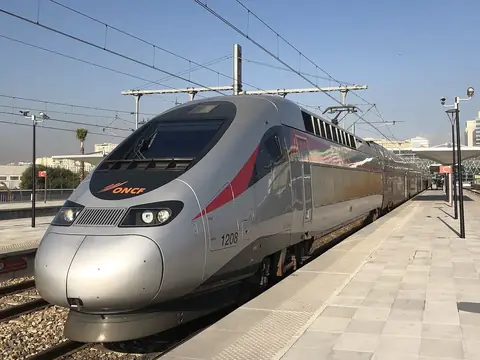
Transport in Morocco
How to get around Morocco: Al Boraq and ONCF trains, CTM coaches to Chefchaouen and the south, grands taxis, drivers, car hire, flights and city trams.
Read the guide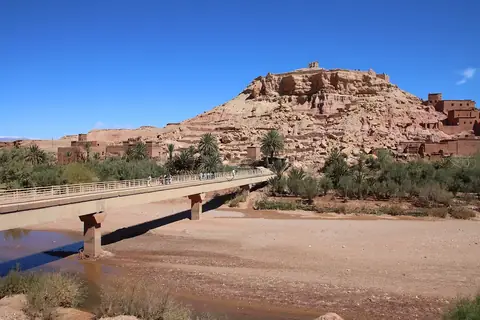
Where to stay in Morocco
Riad or hotel, which quarter of Marrakech, Fes and Chefchaouen to sleep in, nights per base, and three hotels per base from budget to upper.
Read the guideSources and checks before you travel
(29)
- Visit Rabat (Rabat-Salé-Kénitra regional tourism council): Kasbah of the Udayas ↗ — opens in a new tab
- Visit Rabat: Hassan Tower ↗ — opens in a new tab
- Visit Rabat: the Chellah ↗ — opens in a new tab
- Visit Rabat: Rabat medina ↗ — opens in a new tab
- Visit Rabat: Mohammed VI Museum ↗ — opens in a new tab
- Visit Rabat: Bou Regreg crossing ↗ — opens in a new tab
- Visit Rabat: Marinid madrasa, Salé ↗ — opens in a new tab
- Visit Rabat: Salé, the twin city ↗ — opens in a new tab
- Visit Rabat: access and mobility ↗ — opens in a new tab
- Fondation Nationale des Musées: Oudayas, National Museum of Adornment ↗ — opens in a new tab
- Fondation Nationale des Musées: Mohammed VI Museum of Modern and Contemporary Art ↗ — opens in a new tab
- Fondation Nationale des Musées: Museum of History and Civilisations ↗ — opens in a new tab
- Tramway Rabat-Salé: tickets and fines ↗ — opens in a new tab
- Tramway Rabat-Salé: tourism, sport and culture stops ↗ — opens in a new tab
- Visit Morocco (Moroccan National Tourist Office): Rabat ↗ — opens in a new tab
- Visit Morocco: medinas in Morocco ↗ — opens in a new tab
- Visit Morocco: historic sites ↗ — opens in a new tab
- Visit Morocco: UNESCO heritage ↗ — opens in a new tab
- Visit Morocco: getting around Morocco ↗ — opens in a new tab
- Visit Morocco: Fez (road times) ↗ — opens in a new tab
- Visit Morocco: food and drinks ↗ — opens in a new tab
- CTM: Rabat–Chefchaouen by coach ↗ — opens in a new tab
- Ministry of Youth, Culture and Communication e-services: Marinid madrasa (Salé) tickets ↗ — opens in a new tab
- Visit Rabat: Mausoleum of Mohammed V ↗ — opens in a new tab
- Visit Rabat: gastronomy and the art of living in Rabat ↗ — opens in a new tab
- Visit Rabat: Dinarjat ↗ — opens in a new tab
- Visit Rabat: Al Marsa ↗ — opens in a new tab
- ONCF: Al Atlas passenger guide ↗ — opens in a new tab
- Dar El Kebira, Rabat: restaurant ↗ — opens in a new tab
Reference sources for the version dated 28 November 2026. Confirm opening times, access, transport and conditions for your travel dates.
Photo credits
(6)
The Hassan Tower, the minaret of an Almohad mosque that was never finished
Photograph: Bernard Gagnon — opens in a new tab · CC BY-SA 3.0 — opens in a new tab
Changes: Resized and converted to WebP; displayed with responsive crops. · Original photograph and licence details ↗ — opens in a new tab
The Mausoleum of Mohammed V, at the far end of the Hassan Tower esplanade
Photograph: P. Hughes — opens in a new tab · CC BY 4.0 — opens in a new tab
Changes: Resized and converted to WebP; displayed with responsive crops. · Original photograph and licence details ↗ — opens in a new tab
The Chellah: Roman and Merinid ruins below the old mosque's minaret
Photograph: Timothy A. Gonsalves — opens in a new tab · CC BY-SA 4.0 — opens in a new tab
Changes: Resized and converted to WebP; displayed with responsive crops. · Original photograph and licence details ↗ — opens in a new tab
A white and blue lane inside the Kasbah of the Udayas
Photograph: Ben Bender — opens in a new tab · CC BY-SA 3.0 — opens in a new tab
Changes: Resized and converted to WebP; displayed with responsive crops. · Original photograph and licence details ↗ — opens in a new tab
The Andalusian garden beneath the walls of the Kasbah of the Udayas
Photograph: R Prazeres — opens in a new tab · CC BY-SA 4.0 — opens in a new tab
Changes: Resized and converted to WebP; displayed with responsive crops. · Original photograph and licence details ↗ — opens in a new tab
Rue des Consuls, the carpet street of the Rabat medina
Photograph: OussamaHamama — opens in a new tab · CC BY-SA 4.0 — opens in a new tab
Changes: Resized and converted to WebP; displayed with responsive crops. · Original photograph and licence details ↗ — opens in a new tab