Plan your trip
First trip to Egypt: seven days or ten, train or Nile cruise
A first trip to Egypt follows the Nile. You land in Cairo, spend the first days at the Pyramids of Giza, the Grand Egyptian Museum and the old city, then travel south up the river to the temples and royal tombs of Luxor and the islands of Aswan. The real decisions are how many days to give it, whether to travel between Luxor and Aswan by train or on a cruise ship, and which tickets to buy before you leave home.
In this guide
Find the location ↗ — opens in a new tabThe short answer
Give Egypt seven days and six nights for Giza, Luxor and Aswan: fly south to Luxor, take the train to Aswan and fly back to Cairo. Ten days and nine nights give you three nights in Cairo, a three-night Nile cruise from Aswan to Luxor and two nights by the Red Sea at Hurghada. Apply for the e-visa first: it costs USD 30 for a single entry, and you must apply at least 7 days before you fly. On the ten-day route, fix the cruise sailing date next. Then book the domestic flights and a timed slot at the Grand Egyptian Museum. A foreign adult pays EGP 700 at the Giza Pyramids site and EGP 1,830 at the museum. The seven days cost about EGP 44,600 per person for two sharing, with rooms, both flights, the Luxor–Aswan train, meals, tickets, an eSIM, the ride from Cairo airport and a 10% buffer; taxis and boats in Luxor and Aswan are paid ride by ride.
- Key point
- 7 days / 6 nights (Giza 2, Luxor 2, Aswan 2) or 10 days / 9 nights (Cairo 3, Aswan 1, cruise 3, Hurghada 2)
- Where it applies
- Cairo or Giza for the Pyramids and museums, then Luxor and Aswan, or a cruise ship between them, and on ten days Hurghada on the Red Sea
- Timing
- November to March, when the average daytime high in Luxor is 23.0–29.5 °C; June to August averages 41.0–41.4 °C there
Seven days or ten: what each length buys
Both routes start in Cairo and fly south up the Nile Valley to the temples of Luxor and Aswan. The seven days link Luxor and Aswan by train and fly back to Cairo for the flight home. The ten days put three nights on a cruise ship between Aswan and Luxor, which turns the river itself into part of the trip, and end by the Red Sea.
- 7 days / 6 nights: Giza 2, a flight to Luxor and 2 nights there, the train to Aswan and 2 nights there, then the flight back to Cairo on day 7 for the flight home. The seven-day itinerary gives you Giza and the Grand Egyptian Museum, both banks of Luxor, and Philae and a felucca at Aswan, or Abu Simbel on the second Aswan day.
- 10 days / 9 nights: Cairo 3, a flight to Aswan and 1 night there, a cruise from Aswan to Luxor 3, then about four hours by road to Hurghada for 2 nights by the Red Sea and the flight home from there on day 10. The ten-day itinerary adds old Cairo, the temples at Kom Ombo and Edfu from the ship and a boat day to the Giftun Islands; Abu Simbel or Alexandria can replace a beach night.
- Under a week: keep Cairo and Luxor and leave Aswan out. One sleeper each way links them.
Cairo, Luxor and Aswan in the order you meet them
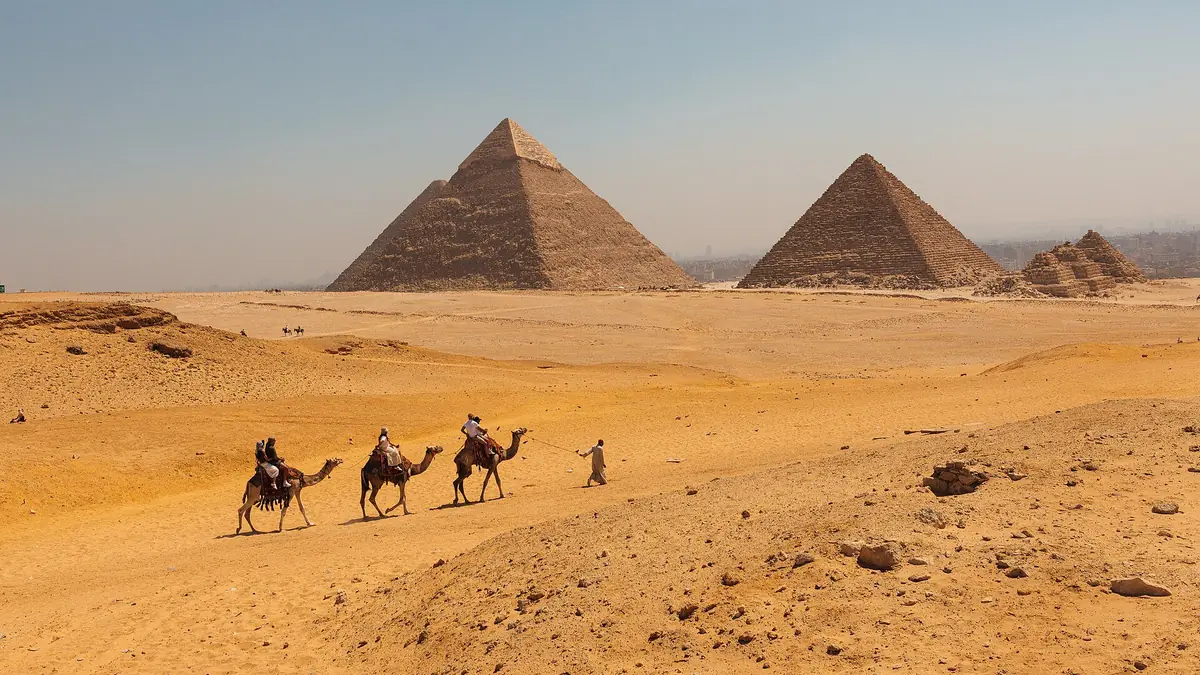
Cairo and Giza come first. On the Giza plateau the Great Pyramid, built for Khufu around 2589–2566 BC, stands beside the pyramids of his son Khafre and grandson Menkaure and the Great Sphinx. The Grand Egyptian Museum holds the Tutankhamun Galleries and Khufu's Boats Museum. In the city centre the older Egyptian Museum, opened in 1902, still shows the Narmer Palette and the statues of the three pyramid builders. In Old Cairo the Hanging Church stands on the ruins of a Roman fort.
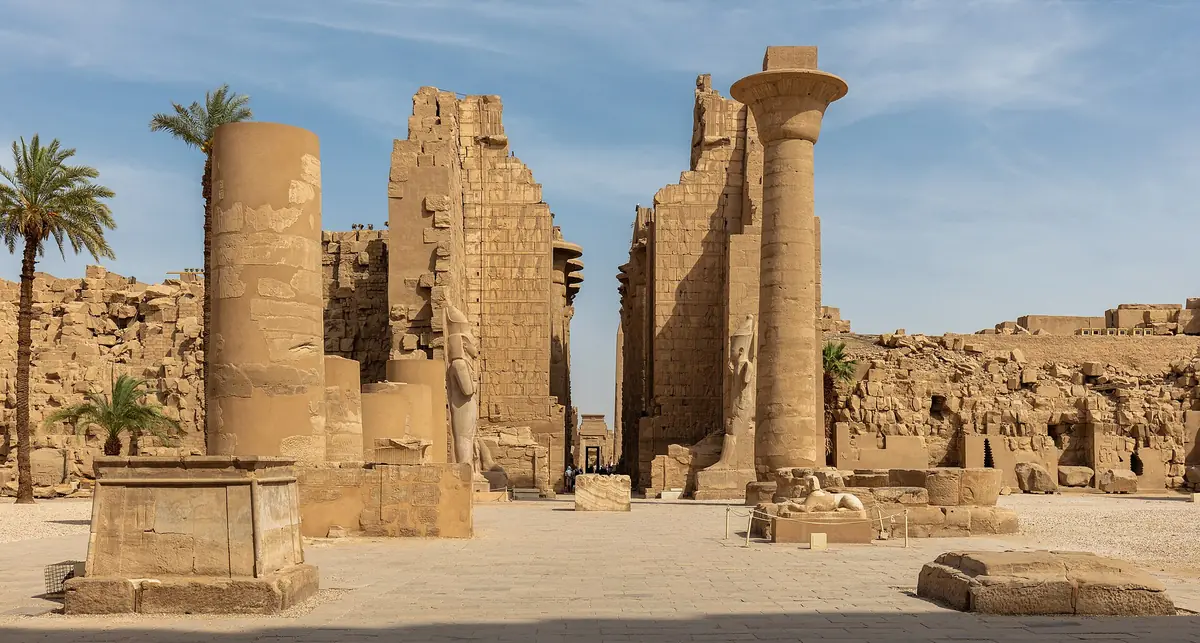
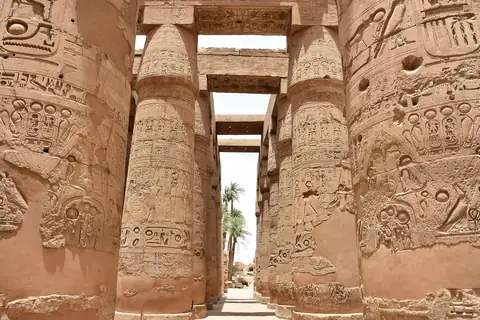
Luxor is the ancient city of Thebes, with temples on the east bank and tombs on the west. At Karnak the Great Hypostyle Hall is a forest of 134 columns, the central twelve 21 metres tall, and Hatshepsut's obelisk nearby is almost 30 metres high. Luxor Temple stands about three kilometres to the south, once joined to Karnak by an avenue of sphinxes. Across the river, the Valley of the Kings holds more than sixty tombs of the New Kingdom pharaohs, cut into a desert valley below a pyramid-shaped peak.
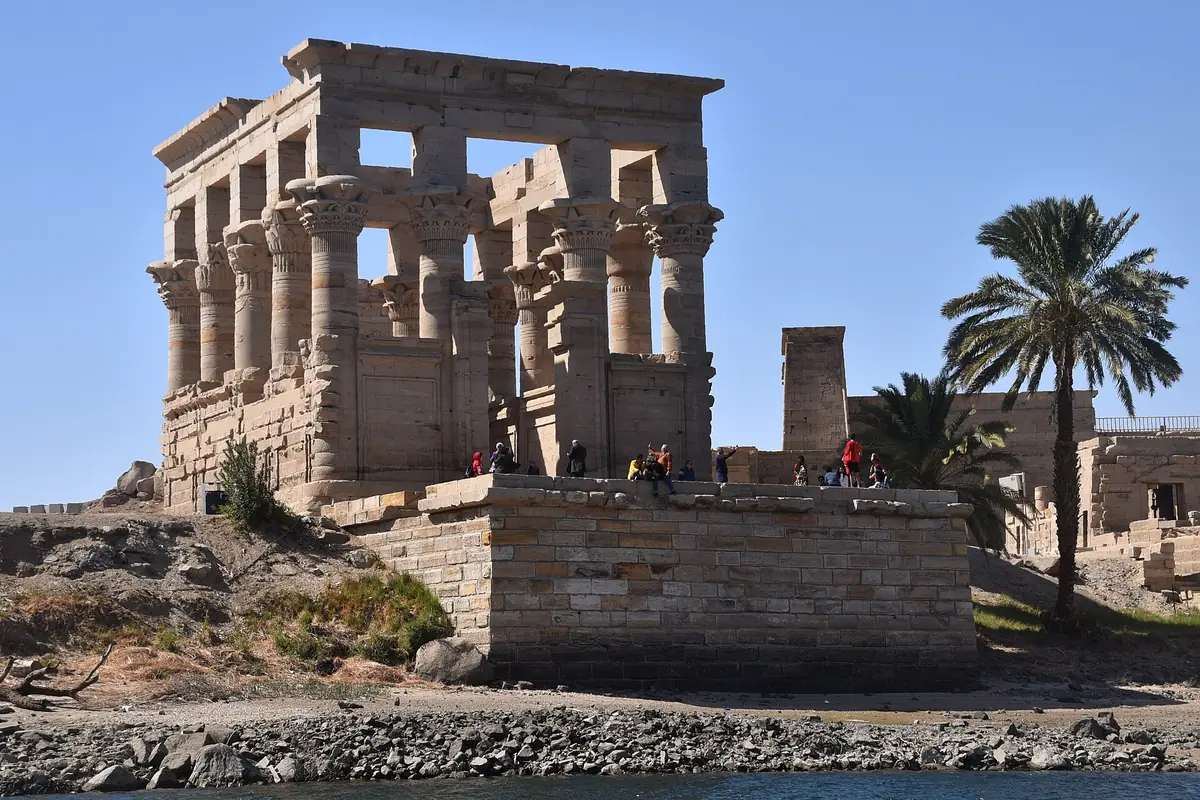
Aswan is the slowest and greenest stop. Its main temple, Philae, is a Ptolemaic temple of Isis. The temple was moved to Agilkia island in the 1960s when the Aswan High Dam was built. The Kiosk of Trajan, which once fronted the temple complex, still stands without its roof. From Aswan, Abu Simbel is a day trip south, close to Egypt's southern border: four seated colossi of Ramesses II front the Great Temple, and on 22 February and 22 October the sun reaches the statues in its innermost sanctuary.
Flights, the sleeper train or a Nile cruise
The seven-day route flies Cairo–Luxor and Aswan–Cairo because a week has no evening to spare: the flights take about 1 h and 1 h 25. If you would rather save a hotel night, take the sleeper from Giza on the evening of day 2 instead. The sleepers leave Giza between 19:50 and 23:10 and reach Luxor 8 h 20 to 10 h 10 later. A berth in a shared two-berth cabin costs USD 110 one way, or USD 125 on the Elite trains, with dinner and breakfast. Between Luxor and Aswan the sleepers take 2 h 40 to 3 h 25 and the VIP express day trains 3 h 25 to 3 h 40, at USD 35 in second class or USD 40 in first. The transport guide covers the timetable, the day trains and the domestic flights.
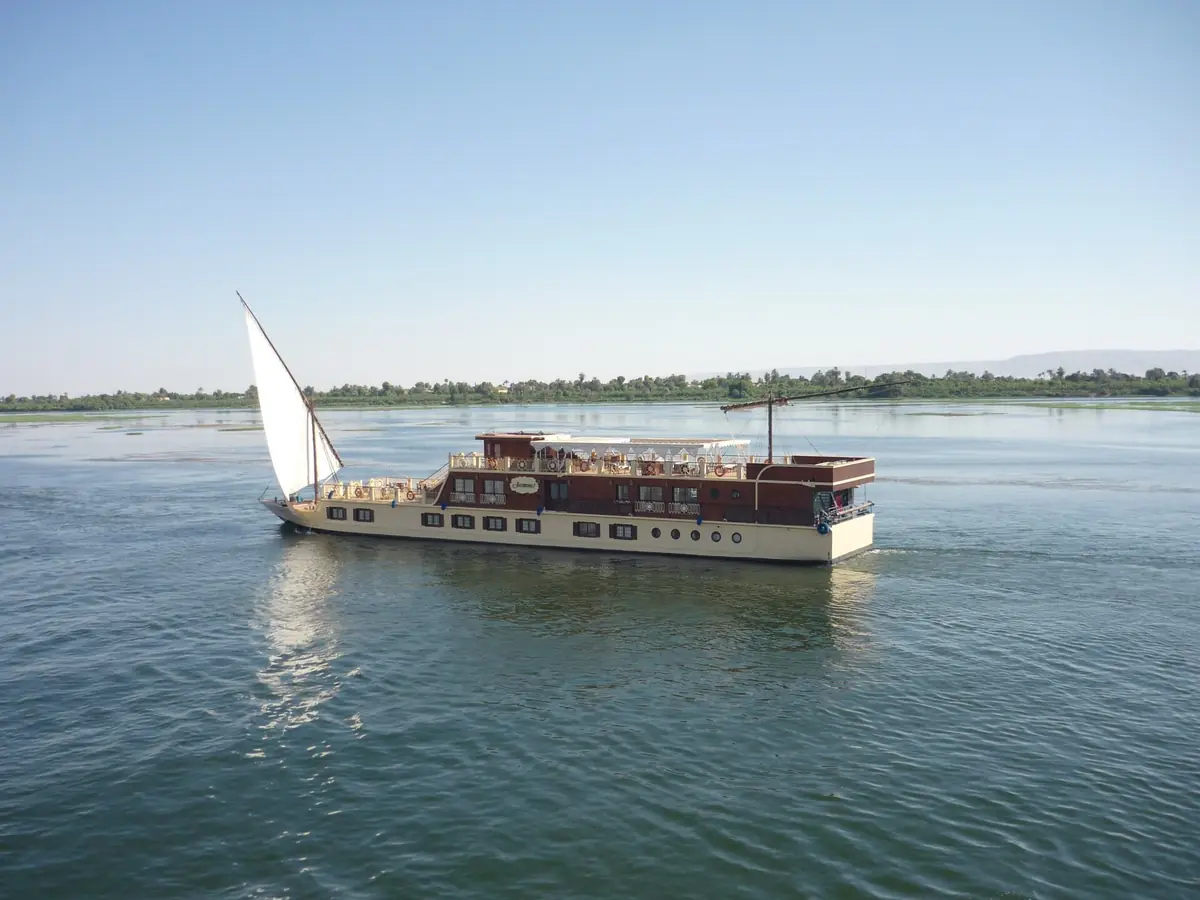
A cruise replaces the Luxor–Aswan train and the hotel nights between them. On the Sonesta Sun Goddess, for example, the Aswan to Luxor sailing lasts three nights and four days and leaves every Friday. The Luxor to Aswan sailing lasts four nights and five days and leaves every Monday. Both sailings are full board, and the ship stops at Kom Ombo and Edfu on the way. Our ten-day route prices the three-night cruise of Luxor and Aswan Travel, which sails from Aswan on Mondays, Wednesdays and Fridays: from September to April, USD 1,075 per person in a double cabin on its standard ships or USD 1,460 on its deluxe ships, with meals, guided visits and temple tickets. That fixed sailing day is why the cruise is the first thing to place in a ten-day plan. The Nile cruise guide compares ships, dahabiyas and the direction to sail.
Choose the train if you want more time on land in Luxor and the lowest cost; choose the cruise if you want the river and the smaller temples without planning each transfer.
Prices and times checked 28 November 2026
What to book before you fly
Book these in order, as soon as your dates are fixed.
- The visa. The e-visa costs USD 30 for a single entry or USD 65 for multiple entries, paid by Visa or Mastercard on visa2egypt.gov.eg, and the application must be made at least 7 days before you leave. Press reports describe a change to Egypt's visa fees from January 2027 that no official Egyptian page has confirmed, so check the fee on visa2egypt.gov.eg before you pay. The entry guide explains the visa on arrival instead.
- The cruise, for ten days. The sailing day sets the rest of the route, so fix it before the flights.
- The domestic flights. The seven-day route flies Cairo–Luxor and Aswan–Cairo, the ten-day route Cairo–Aswan. One-way fares on these routes typically ran about USD 80–160 on KAYAK's route pages, and change by date.
- The Grand Egyptian Museum. Entry is by timed ticket for a set date and time, booked in advance on tickets.gem.eg, the museum's only official ticket site. A foreign adult pays EGP 1,830 and a foreign student or child EGP 920. Tickets cannot be refunded or exchanged.
- Your first night in Cairo or Giza. The where-to-stay guide compares the two.
Prices and times checked 29 November 2026
Choose the season
November to March is the comfortable time for the south: Luxor's average daytime high is 29.0 °C in November, 24.3 °C in December, 23.0 °C in January, 25.1 °C in February and 29.5 °C in March, and Aswan is within a degree of it. Mornings are cold in midwinter, with an average January low of 5.9 °C in Luxor, so bring a warm layer for dawn starts. From June to August Luxor and Aswan average highs of 41.0–41.4 °C; if you go then, see the west-bank tombs at opening time and rest through the afternoon. Cairo is milder, with average highs of 19.0 °C in January and 34.8 °C in July.
The dates of Ramadan move each year. During Ramadan it is culturally insensitive to eat, drink or smoke in public in daylight. Check shop and restaurant opening hours. Hotels and restaurants that serve food in fasting hours may screen off guests who are not fasting. The best-time guide goes month by month, and the festivals guide lists the holidays.
Tickets and what the trip costs
Admission to the Giza Pyramids site is EGP 700 for a foreign adult and EGP 350 for a foreign student. The separate Grand Egyptian Museum ticket is EGP 1,830 for a foreign adult from 1 November 2026, the price Egyptian Streets reported from the museum's board. In Luxor a foreign adult pays EGP 600 at Karnak, EGP 500 at Luxor Temple and EGP 750 for the Valley of the Kings; at Aswan, Philae is EGP 550 and Abu Simbel EGP 750 on the ministry's list, or EGP 822 on the official booking site. Tickets for the ministry's sites are sold on the official EgyMonuments platform, in the Experience Egypt app and at the site counters, all of which take Visa and Mastercard. Ministry tickets cannot be refunded or replaced if lost, so buy them for the day you will go.
Our seven-day itinerary comes to about EGP 42,600 per person, EGP 85,300 for two sharing, for six hotel nights, the two domestic flights, the Luxor–Aswan train, the ride from Cairo airport, three meals a day, every admission in its day plan and a 10% buffer. Add a seven-day eSIM (USD 32, about EGP 1,760, with the same buffer) and the week comes to about EGP 44,600 per person, EGP 89,200 for two. Taxis in Luxor and Aswan, the Luxor ferry, the Philae boat and a felucca are paid ride by ride, at prices you agree on the spot. The ten-day cruise route in our trip-cost guide comes to about EGP 90,900 per person on a budget, EGP 99,100 mid-range and EGP 141,800 in comfort, with every room, the cruise with its meals and temple tickets, the Cairo–Aswan flight, the car to Hurghada, the ride from Cairo airport, an eSIM, the Cairo tickets, a boat day and a 10% buffer. Meals off the ship bring the budget and mid-range trips to about EGP 94,700 and EGP 103,900 per person; taxis come on top.
Prices and times checked 29 November 2026
Visa, passport and cash at the border
Most visitors need a visa: the e-visa, USD 30 for a single entry by card at least 7 days before you fly, or a visa on arrival for USD 30 in cash; at Cairo airport you can also buy a digital visa for USD 36 by card at the machines. The UK asks for a passport valid six months from the day you arrive, with a blank page, and Egypt's consulate in London for six months beyond the day you leave, so make sure yours is valid six months past your departure; the entry guide covers who can buy which visa and the free Sinai-only stamp.
You can bring in or take out up to EGP 5,000 in Egyptian pounds, and must declare foreign currency worth more than USD 10,000 on arrival. Police check ID regularly and will ask to see your passport, so carry it. They may detain you if you cannot show your ID and your visa, or a digital or paper copy.
Prices and times checked 29 November 2026
Money, cards and tips
Carry Egyptian pounds (EGP) in cash for taxis, cafés, markets and tips, and pay the big sights by card: the ministry's ticket counters, machines, website and app take Visa and Mastercard. Withdraw pounds at a bank ATM with a credit card and take out a few days' cash at a time: debit cards usually work only at banks' own machines, and withdrawals have a daily limit. For data, buy an eSIM before you fly: an online eSIM seller lists Egypt plans with unlimited data at USD 32 for seven days and USD 35 for ten.
Keep a pocket of small notes for baksheesh, the small tips for small services such as minding your shoes at a mosque, and leave a small tip in restaurants even when service is included. Bring some US dollars in cash too, for the visa on arrival and for train tickets, which foreigners pay in dollars or euros. The money guide covers rates, cards and how much to tip.
Prices and times checked 28 November 2026
Dress, mosques and photography
Dress modestly, especially in the countryside, in mosques and in the souqs. Holding hands is generally fine, but other affection in public is frowned upon. Drinking alcohol is illegal anywhere other than licensed restaurants and bars, private homes and certain tourist resorts.
At the ancient sites you can use your phone camera without a permit, but drones need permission from the Ministry of Defence. Ask before you photograph anyone: the Ministry of Tourism's rules require an Egyptian's written permission to take their photo, and photographing children is prohibited. Do not photograph military sites, including the Suez Canal.
Where the advice says not to go
Both routes stay in Cairo, the Nile Valley and Hurghada, outside the areas where the UK and other governments advise against travel: the Libyan and Sudanese border zones, North Sinai and northern South Sinai, and the Western Desert away from the valley. The UK also warns against driving outside the main cities and resorts at night, so book road transfers, including the drive to Abu Simbel and any run to the Red Sea, to end in daylight. The health and safety guide gives the exact lines and covers balloon flights, heat, water and scams.
Practical questions
Is a week enough for a first trip to Egypt?
Yes for Giza, Luxor and Aswan, with two domestic flights and the train between Luxor and Aswan, as in the seven-day itinerary. A Nile cruise or the Red Sea needs the ten-day route.
Should I take a Nile cruise or the train?
The train is faster and leaves more time on land: the sleepers take 2 h 40 to 3 h 25 between Luxor and Aswan, and the VIP express day trains 3 h 25 to 3 h 40. A cruise takes three nights from Aswan to Luxor or four the other way, with meals included and stops at Kom Ombo and Edfu.
Do I need a visa for Egypt?
Most visitors do; British passport holders, for example, normally need one. The e-visa costs USD 30 for a single entry, and you must apply at least 7 days before you leave. British, EU, US and some other travellers can instead buy a visa on arrival: USD 30 in cash, or at Cairo International Airport a digital visa for USD 36, by card at the machines. The entry guide has the details.
Do I need to book the Grand Egyptian Museum in advance?
Yes. Entry is by timed ticket, booked in advance on tickets.gem.eg, the museum's only official ticket site. A foreign adult pays EGP 1,830.
When is the best time to go?
November to March, when Luxor's average daytime high is 23.0–29.5 °C. From June to August it averages 41.0–41.4 °C; the best-time guide goes month by month.
Can I pay by card at the sites?
Yes. The ministry's sites take Visa and Mastercard online, in the Experience Egypt app and at the counters.
Keep planning your trip
Egypt in 7 days
Seven days, two nights each at Giza, Luxor and Aswan: the Pyramids and the Grand Egyptian Museum, Karnak, the Valley of the Kings, Philae and the cost for two.
Read the guide
Egypt in ten days
Nine nights: three in Cairo for Giza and the Grand Egyptian Museum, one in Aswan, three on a Nile cruise to Luxor and two in Hurghada, with sailing days and costs.
Read the guide
Entering Egypt
Whether to buy Egypt's e-visa before you fly or a visa on arrival, who gets the free Sinai-only stamp, passport validity, land and sea borders and customs.
Read the guide
Transport in Egypt
How to travel Egypt: the sleeper train from Giza to Luxor and Aswan, day trains, domestic flights, buses, ride-hailing cars and the Cairo Metro, with journey times.
Read the guide
Nile cruise from Luxor to Aswan
Choose between a 3- or 4-night Nile cruise, a 4- or 5-night dahabiya and the train between Luxor and Aswan, with cabin fares, temple tickets and what the fare covers.
Read the guide
Best time to visit Egypt
When to go to Egypt: cool months for Luxor and Aswan, 41°C summers in the south, Alexandria's winter rain, Ramadan 2027 and Red Sea water by month.
Read the guideSources and checks before you travel
(43)
- Egypt e-Visa Portal (Ministry of Interior): FAQ ↗ — opens in a new tab
- Egypt e-Visa Portal (Ministry of Interior): home page ↗ — opens in a new tab
- UK FCDO: Egypt entry requirements ↗ — opens in a new tab
- German Foreign Office: Egypt travel and safety advice (Reise- und Sicherheitshinweise) ↗ — opens in a new tab
- Consulate General of Egypt in London: visas ↗ — opens in a new tab
- UK FCDO: Egypt warnings and insurance ↗ — opens in a new tab
- UK FCDO: Egypt safety and security ↗ — opens in a new tab
- Abela Trains (Watania sleeping trains): timetable ↗ — opens in a new tab
- Abela Egypt: train schedule (timetable data behind abelatrains.com) ↗ — opens in a new tab
- Abela Trains: online booking search (trip availability data) ↗ — opens in a new tab
- Sonesta: Sun Goddess Nile cruise ↗ — opens in a new tab
- Sonesta: Sun Goddess cruise programme (PDF) ↗ — opens in a new tab
- Grand Egyptian Museum: official ticketing website ↗ — opens in a new tab
- Egyptian Streets: Grand Egyptian Museum announces new ticket prices (27 October 2026) ↗ — opens in a new tab
- EgyMonuments (Ministry of Tourism and Antiquities): FAQ ↗ — opens in a new tab
- Ministry of Tourism and Antiquities: Giza plateau ↗ — opens in a new tab
- Ministry of Tourism and Antiquities: The Egyptian Museum ↗ — opens in a new tab
- Ministry of Tourism and Antiquities: The Hanging Church ↗ — opens in a new tab
- Ministry of Tourism and Antiquities: Karnak ↗ — opens in a new tab
- Ministry of Tourism and Antiquities: Luxor Temple ↗ — opens in a new tab
- Ministry of Tourism and Antiquities: Valley of the Kings ↗ — opens in a new tab
- Ministry of Tourism and Antiquities: Philae ↗ — opens in a new tab
- Ministry of Tourism and Antiquities: Abu Simbel ↗ — opens in a new tab
- World Meteorological Organization: climate of Luxor ↗ — opens in a new tab
- World Meteorological Organization: climate of Aswan ↗ — opens in a new tab
- World Meteorological Organization: climate of Cairo ↗ — opens in a new tab
- Seat61 (independent rail guide): Cairo to Luxor and Aswan by sleeper train ↗ — opens in a new tab
- Seat61 (independent rail guide): train travel in Egypt ↗ — opens in a new tab
- FlightMapper: EgyptAir Cairo to Luxor schedule ↗ — opens in a new tab
- FlightMapper: EgyptAir Aswan to Cairo schedule ↗ — opens in a new tab
- KAYAK: Cairo to Luxor flights (booking site) ↗ — opens in a new tab
- KAYAK: Aswan to Cairo flights (booking site) ↗ — opens in a new tab
- KAYAK: Cairo to Aswan flights (booking site) ↗ — opens in a new tab
- Daytrip: Luxor to Hurghada private transfer (booking site) ↗ — opens in a new tab
- Luxor and Aswan Travel: 4-day Aswan to Luxor Nile cruise ↗ — opens in a new tab
- Uber: rides from Cairo International Airport (CAI) ↗ — opens in a new tab
- Careem Egypt: rides ↗ — opens in a new tab
- Experience Egypt (Egyptian Tourism Authority): useful information ↗ — opens in a new tab
- Rough Guides: Egypt culture and etiquette ↗ — opens in a new tab
- Airalo: Egypt eSIM (eSIM seller) ↗ — opens in a new tab
- Egypt e-Visa Portal (Ministry of Interior): FAQ ↗ — opens in a new tab
- Adventure Travel Trade Association (trade press report): Egypt visa fee change from January 2027 ↗ — opens in a new tab
- EgyMonuments (official ticket platform): Abu Simbel ↗ — opens in a new tab
Reference sources for the version dated 29 November 2026. Confirm opening times, access, transport and conditions for your travel dates.
Photo credits
(5)
Camel riders on the desert edge of the Giza plateau, with the pyramids of Khufu and Khafre behind
Photograph: Ludovic Delot — opens in a new tab · CC BY 4.0 — opens in a new tab
Changes: Resized and converted to WebP; displayed with responsive crops. · Original photograph and licence details ↗ — opens in a new tab
Inside the temple of Amun at Karnak, Luxor
Photograph: Diego Delso — opens in a new tab · CC BY-SA 4.0 — opens in a new tab
Changes: Resized and converted to WebP; displayed with responsive crops. · Original photograph and licence details ↗ — opens in a new tab
A cruise boat on the Nile between Luxor and Esna
Photograph: Rémih — opens in a new tab · CC BY-SA 3.0 — opens in a new tab
Changes: Resized and converted to WebP; displayed with responsive crops. · Original photograph and licence details ↗ — opens in a new tab
The Kiosk of Trajan on Agilkia island, Philae, seen from the boat
Photograph: Carole Raddato from FRANKFURT, Germany — opens in a new tab · CC BY-SA 2.0 — opens in a new tab
Changes: Resized and converted to WebP; displayed with responsive crops. · Original photograph and licence details ↗ — opens in a new tab
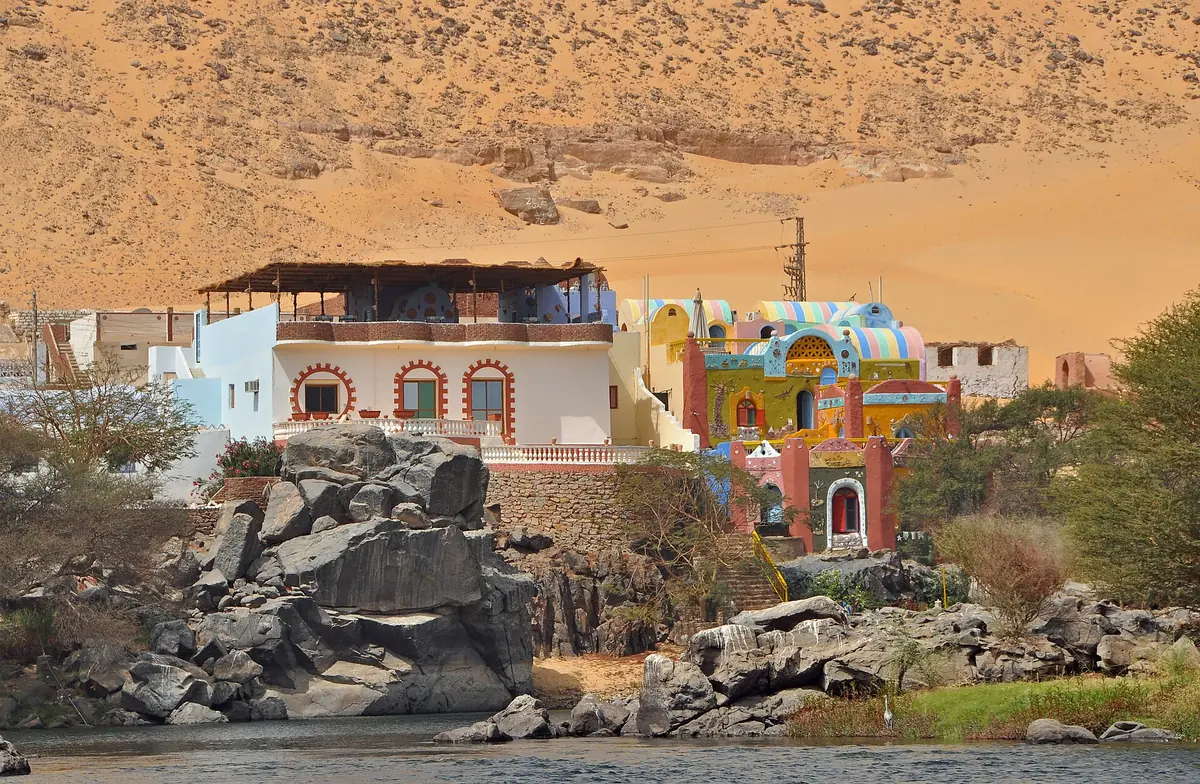
The Nubian village of Gharb Soheil on the west bank of the Nile, south of Aswan
Photograph: Marc Ryckaert ( MJJR ) — opens in a new tab · CC BY 3.0 — opens in a new tab
Changes: Resized and converted to WebP; displayed with responsive crops. · Original photograph and licence details ↗ — opens in a new tab