Plan your trip
Moroccan food: tagine, couscous, pastilla, harira and mint tea
Moroccan cooking changes from one city to the next, and the best way to eat well is to follow it along the usual route. Marrakech has tanjia, the meat slow-cooked in a clay urn, and the evening food stalls of Jemaa el-Fnaa. Fes, whose cooking mixes sweet and savoury, is the city of chicken pastilla and the place to take a cooking class. On the Atlantic, Essaouira's fishermen grill sardines and sea bream a few steps from the boats. Tagine and couscous follow you everywhere, mint tea comes with every pause, and harira and chebakia belong to the evenings of Ramadan. This guide gives each dish a place to try it, with prices from the menus that restaurants publish.
In this guide
Find the location ↗ — opens in a new tabThe short answer
Eat tanjia and the stalls of Jemaa el-Fnaa in Marrakech, pastilla in Fes, and grilled fish at Essaouira's port. Have couscous at Friday lunch, the day it is traditionally served. Book one thing ahead: a cooking class in Fes. Café Clock's group class there costs MAD 600 per person; it starts at 10:00 with shopping in the souk and lasts 4.5 to 5 hours. In the Marrakech medina, Le Jardin lists a chicken tagine with olives at MAD 130 and mint tea at MAD 20, and a day of sit-down meals there comes to about MAD 550 per person.
- Key point
- One food day each in Marrakech, Fes and Essaouira, inside a first trip
- Where it applies
- Marrakech for street food and tanjia, Fes for pastilla and a cooking class, Essaouira for grilled fish
- Timing
- Couscous is traditionally eaten on Fridays. In Ramadan, harira comes with dates and chebakia, the pastry of the holy month.
Tagine and couscous, on every table
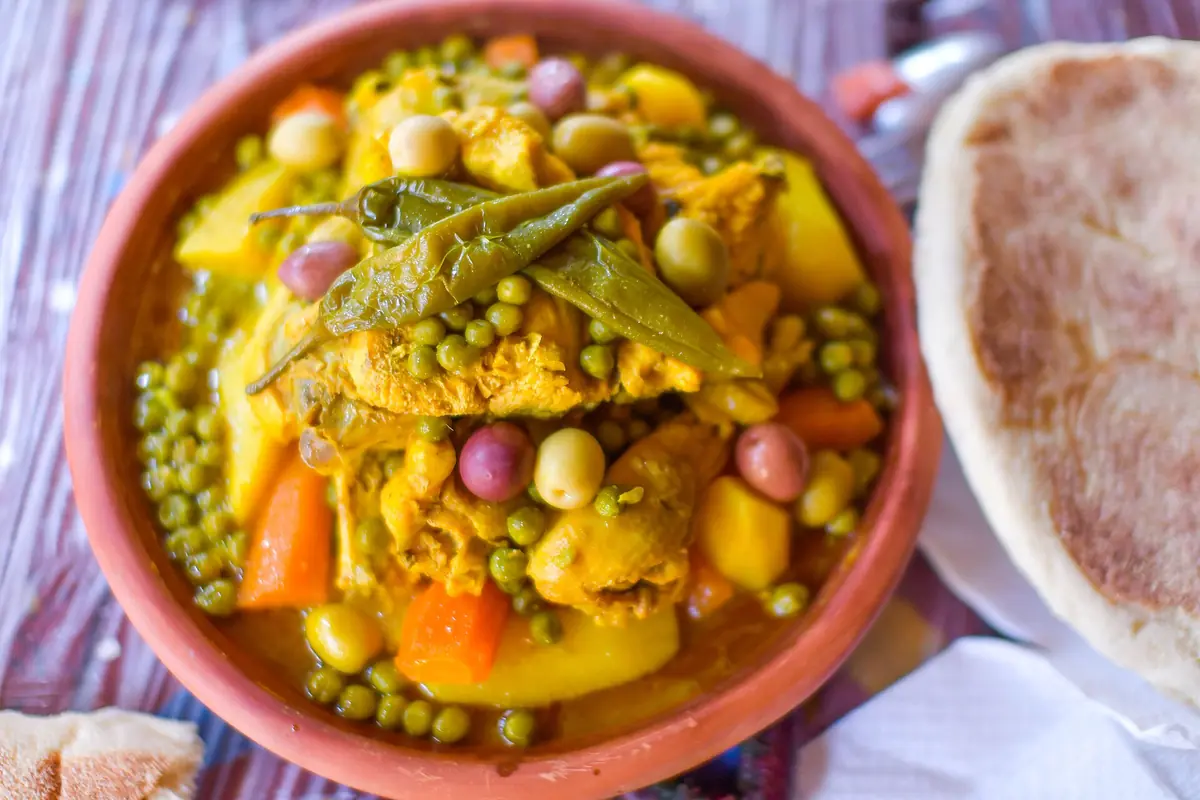
Tagine is both the dish and the terracotta pot it is cooked and served in: meat, chicken, fish or vegetables cook slowly with spices, sometimes with nuts, prunes or apricots. Moroccan potters shape tagine dishes by hand from local clay. The classics are chicken with preserved lemon and olives, meat with prunes and dates, and kefta, spiced meatballs, cooked with eggs. In the Marrakech medina, Le Jardin lists a chicken tagine with olives at MAD 130 and a kefta tagine with eggs at MAD 125. Nomad, also in Marrakech, lists a lamb shank tagine braised with spices and market vegetables at MAD 150.
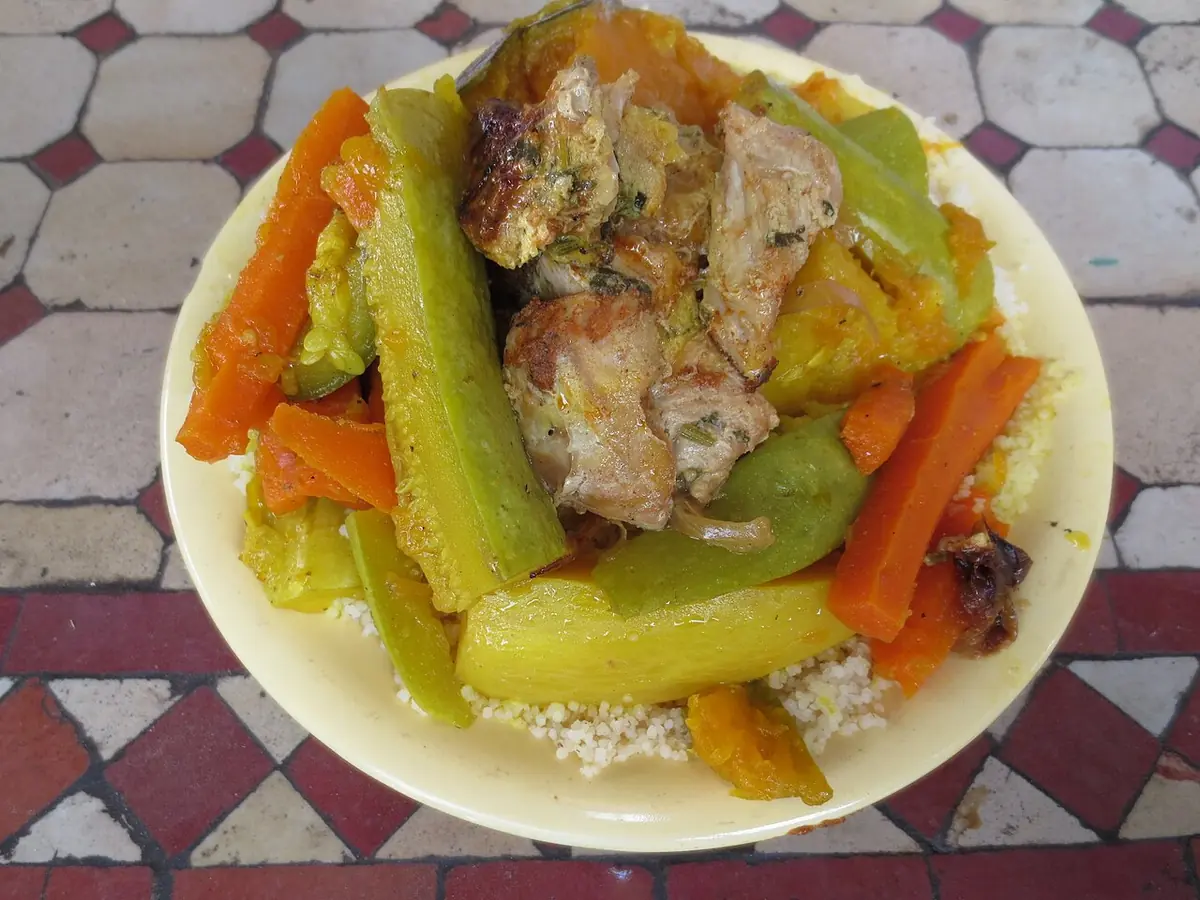
Couscous is the national dish. It comes from the Amazigh tradition and is traditionally eaten on Friday, the day of the congregational prayer, so Friday lunch is the time to order it. The semolina is rolled by hand, steamed and served under meat, chicken, fish or vegetables, with a vegetable broth, marqa, poured over it, and often with lben, fermented milk, on the side. In 2020 UNESCO inscribed the knowledge and practices of couscous, shared by Algeria, Mauritania, Morocco and Tunisia, on its list of the intangible cultural heritage of humanity. Le Jardin's chicken couscous with tfaya, a topping of onions and candied grapes, is MAD 130, and its vegetarian couscous MAD 110.
Pastilla, and a cooking class in Fes
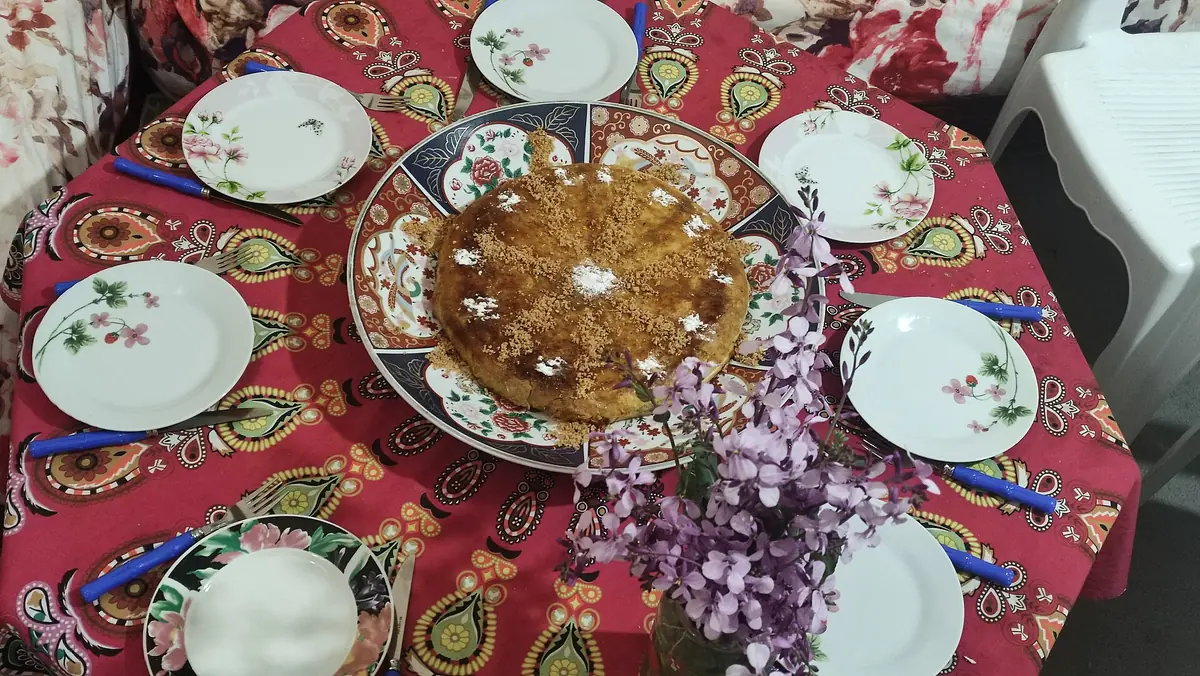
Fes is renowned for its cooking, a mix of cultures that combines sweet and savoury, and its most popular dish is chicken pastilla, a pie of thin, light pastry. Pastilla is also made with pigeon, with fish or with almonds alone; Le Jardin in Marrakech lists a chicken pastilla with almonds at MAD 100.
A cooking class is the way to learn the city's food. Café Clock in the Fes medina, at 7 Derb El Magana off Talaa Kbira, runs a traditional Moroccan cooking class at MAD 600 per person in a group, MAD 1,000 per person for a private class, and MAD 150 for a friend who joins only for the four-course lunch. The class lasts 4.5 to 5 hours. You arrive at 10:00, choose the menu with the chef and shop for the ingredients in the souk; cooking starts at about 11:00 and the feast at about 14:30. You make a salad, a soup, a dessert and one main dish. The main is couscous, a tagine or b'stella, the pastilla. The tagine can be chicken with preserved lemon and olives, or fish when the souk has fish. Café Clock also has branches in Marrakech and Chefchaouen. Our Fes guide covers the medina and how many nights to spend there.
Prices and times checked 28 November 2026
Marrakech: tanjia, mechoui and the stalls of Jemaa el-Fnaa
Tanjia is Marrakech's own dish: lamb or veal marinated in spices and slow-cooked for long hours in the local oven, in an urn-shaped terracotta pot of the same name, until the meat is tender. Mechoui is a whole lamb or sheep slow-cooked in a clay oven. Le Jardin, a 1960s riad turned restaurant at 32 Souk Sidi Abdelaziz in the medina, lists a beef tanjia Marrakchia at MAD 190 and a lamb mechoui at MAD 180, and adds a 7% service charge to the bill.
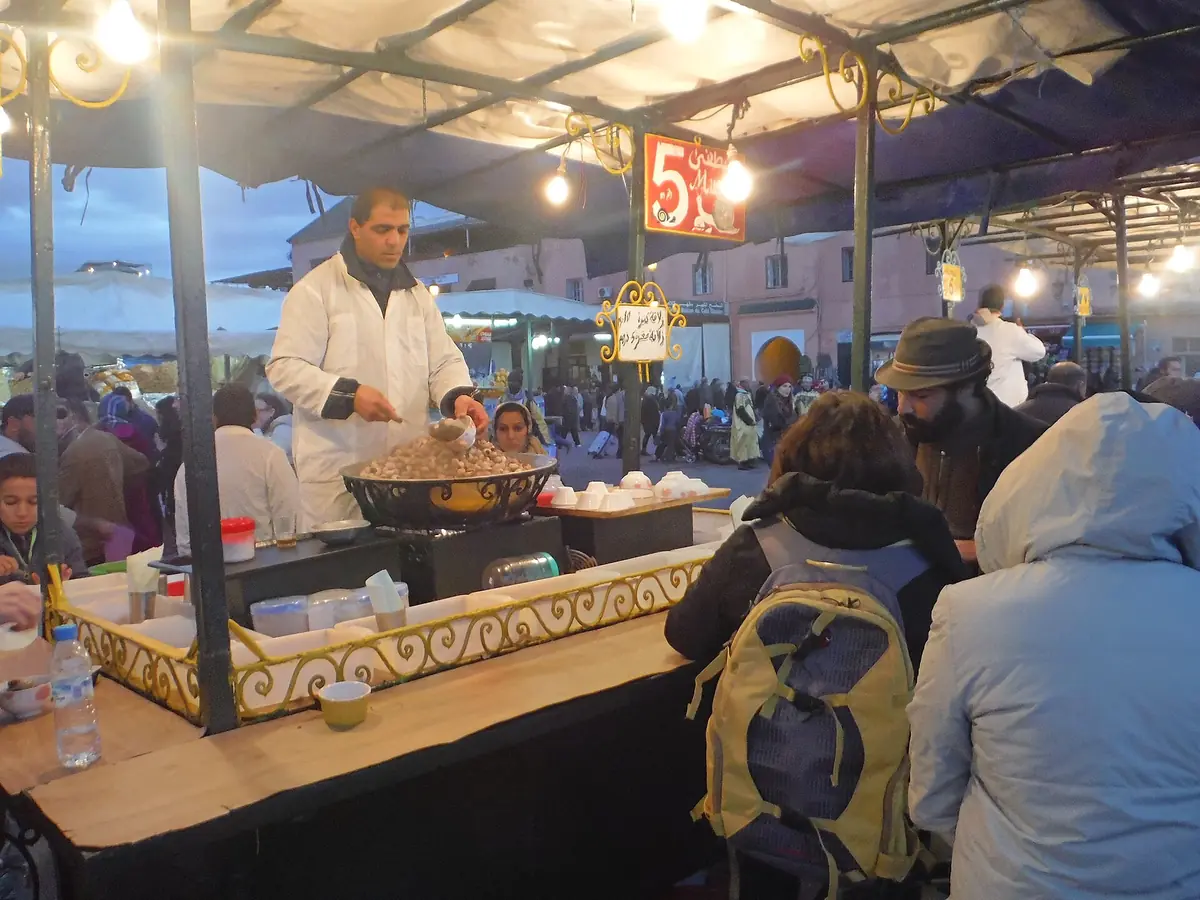
Jemaa el-Fnaa, the great square at the heart of the medina, has the richest street food in the country. More than twenty juice sellers work from carts on the square, and as night falls it turns into a giant open-air restaurant: grilled meat and fish, sandwiches, mint tea, harira, and snails cooked in a broth of herbs and spices that includes oregano, aniseed, pepper and parsley. Agree the price of each dish before you sit down. Black olives from the Marrakech region are the local pride. Our Marrakech guide covers the square and the medina.
Grilled fish on the Atlantic coast
In the port cities of Tangier, Essaouira and Dakhla, fish is the reason to go. Essaouira has one of the country's finest fish markets, supplied by the local fishermen, and at its fishing port you can eat grilled sardines, sea bream and red mullet, often prepared by the fishermen themselves. Agree the price of the fish before it goes on the grill. Tangier and Agadir have the same kind of port grills, and further north on the coast, Oualidia farms oysters.
The coast also cooks fish in sauce. A fish tagine is layered on carrots, potatoes, tomatoes and courgettes and cooked with chermoula, a marinade of parsley, coriander, garlic, paprika, cumin, ginger and lemon juice, with preserved lemon and green olives on top. Our Essaouira guide covers the port and the town.
Breakfast, starters and soups
Breakfast is msemen, Moroccan pancakes spread with butter and honey, with freshly squeezed orange juice; Le Jardin lists a Moroccan breakfast with tea or coffee, orange juice, pancakes with honey and butter, an omelette and a fruit salad at MAD 80. At dawn, some start the day with belboula, a barley and millet soup with thyme, eaten with hard-boiled eggs and dates.
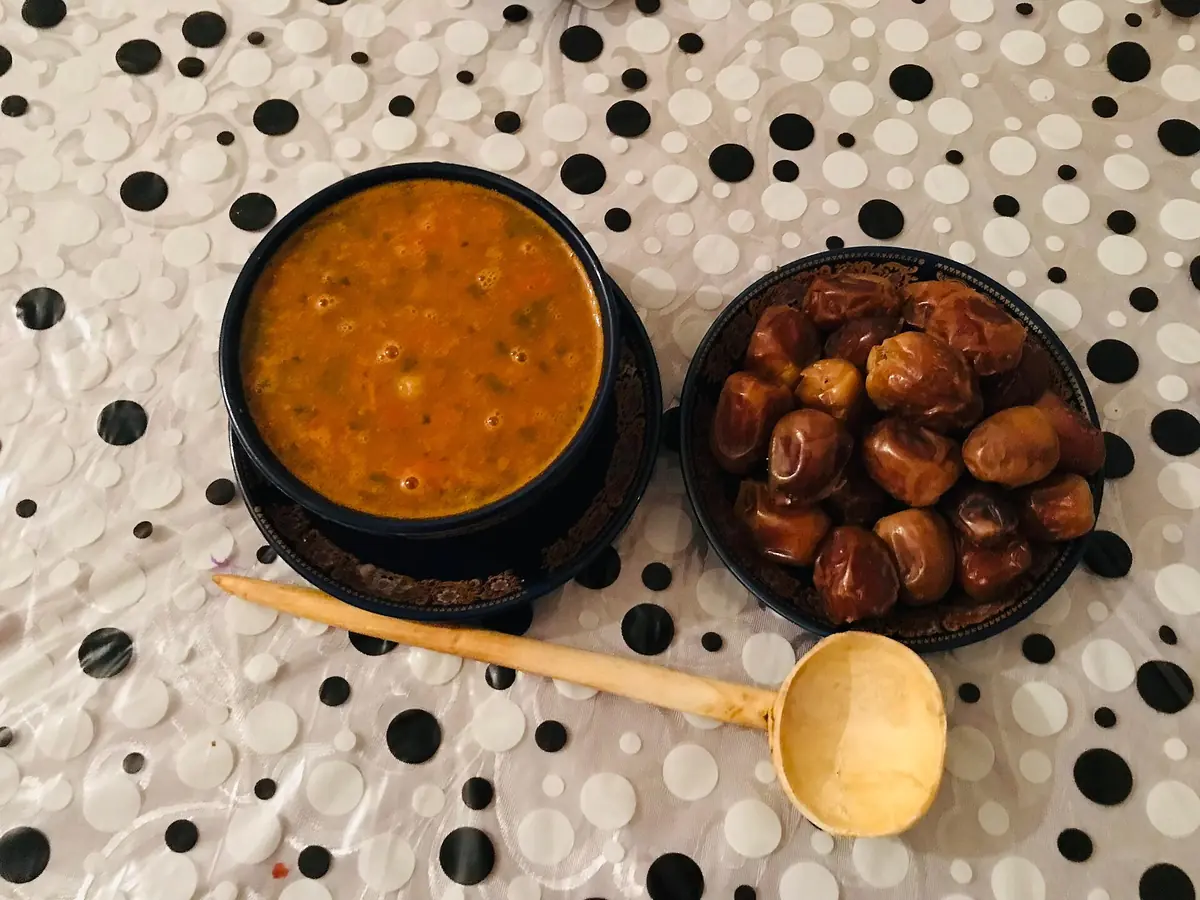
Harira is the soup of the country, made with pulses such as beans and lentils, tomatoes, pasta and flour. It is the traditional Ramadan soup, eaten with dates and chebakia. Most restaurants serve harira; Le Jardin lists a bowl at MAD 65. Bread comes with most main dishes: white, wholemeal or sourdough.
Meals open with small dishes. Zaalouk is an aubergine purée; taktouka a ratatouille of peppers and tomatoes; and briouats are crisp pastry triangles filled with chicken or minced meat. R'fissa, which comes from Casablanca, is msemen under chicken in an onion broth with lentils, fenugreek, coriander and ras el hanout.
Mint tea, pastries and amlou
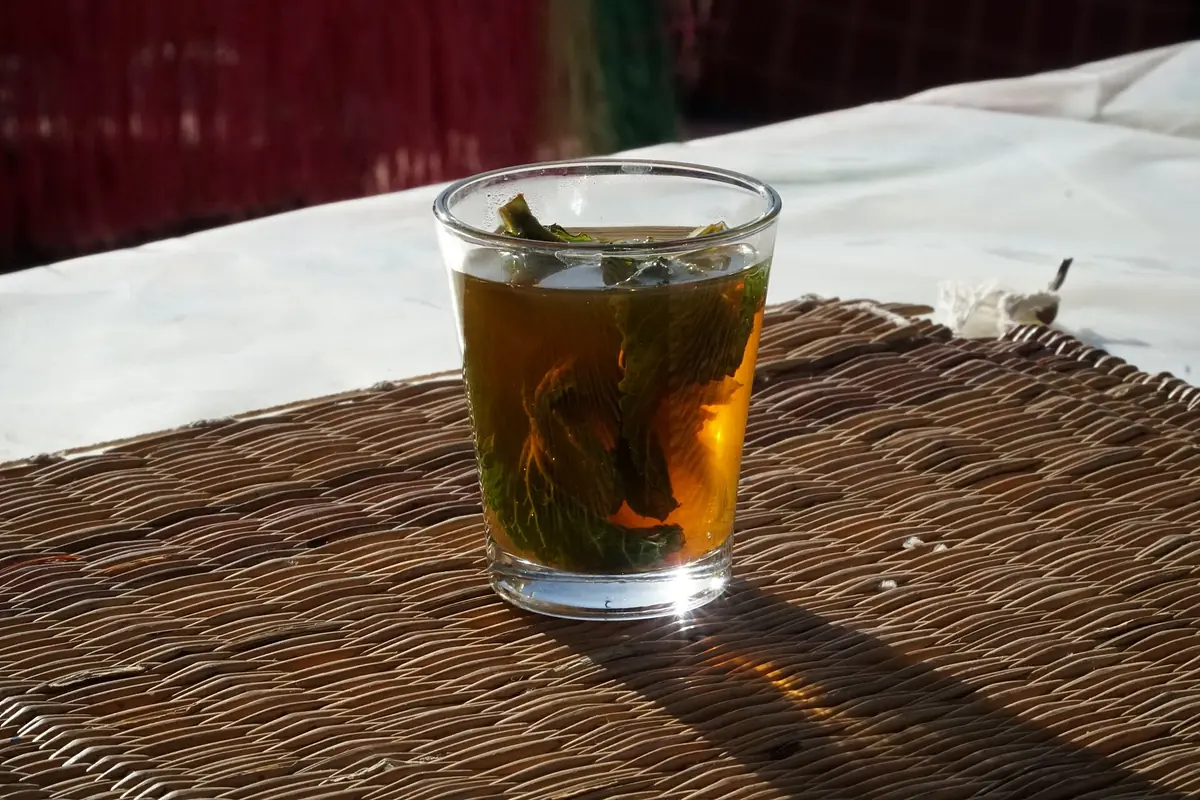
Mint tea is the drink of friendship and hospitality, served to guests and drunk at any time of day, with meals and after them. Green tea is steeped in boiling water, then sugar and a few mint leaves go in. The tea is poured from a height into a small glass to froth it, and each glass goes back into the pot until the sugar and mint are mixed. In some regions rosebuds, saffron or verbena are added. A mint tea is MAD 20 at Le Jardin in the Marrakech medina and MAD 40 at Nomad, also in Marrakech.
Pastries come in dozens of kinds. Chebakia is the country's favourite cake, eaten with harira or tea and made above all in Ramadan; gazelle horns wrap crushed almonds in thin pastry scented with orange blossom; and almond briouats and fekkas are among the best known of the rest. Amlou, a spread of almonds, honey and argan oil, is the most common recipe of the south. Argan oil is a speciality of Agadir. A jar of amlou is a good thing to bring home, with a bottle of orange blossom water.
What to eat and where to look
Tanjia
Marrakech's own dish: meat marinated in spices and slow-cooked for hours in an urn-shaped terracotta pot of the same name.
- Where to look
- Le Jardin, 32 Souk Sidi Abdelaziz, in the Marrakech medina, which lists a beef tanjia Marrakchia at MAD 190.
- Fit it into your day
- Dinner on a Marrakech evening.
Harira and snails at Jemaa el-Fnaa
Harira, a soup of beans, pasta and lentils, and snails cooked in a broth of oregano, aniseed, pepper and parsley, from the stalls of the square.
- Where to look
- The food stalls of Jemaa el-Fnaa, Marrakech, as night falls.
- Fit it into your day
- A cheap first course at dusk on the square.
Chicken pastilla
A light pastry pie of chicken, sweet and savoury at once: the most popular dish of Fes.
- Where to look
- Café Clock, 7 Derb El Magana, Talaa Kbira, Fes medina, where b'stella is one of the dishes of its cooking class.
- Fit it into your day
- Cook it at the Fes class and eat it for lunch.
Pastilla, amlou and many pastries are made with almonds; say so early if you have a nut allergy.
Grilled sardines and sea bream
Sardines, sea bream and red mullet from the local boats, grilled and often prepared by the fishermen themselves.
- Where to look
- Essaouira's fishing port.
- Fit it into your day
- Lunch on the Essaouira day, after the port in the morning.
Couscous with tfaya
Hand-rolled semolina steamed under chicken and vegetables, topped with tfaya, onions and candied grapes, and served with broth.
- Where to look
- Le Jardin, Marrakech medina (MAD 130), or any family restaurant at Friday lunch.
- Fit it into your day
- Friday lunch, wherever you are.
What a day of meals costs
Each day below is per person, priced from the menus of two Marrakech restaurants. A riad rate that includes breakfast lowers each total.
- Budget, about MAD 360, in the Marrakech medina: Le Jardin's Moroccan breakfast (MAD 80), a vegetarian couscous at lunch (MAD 110), a kefta tagine at dinner (MAD 125) and a large water (MAD 25), plus the 7% service charge.
- Mid-range, about MAD 550, in the Marrakech medina: Le Jardin's Moroccan breakfast (MAD 80), harira and a chicken tagine for lunch (MAD 65 and 130), a mint tea (MAD 20), a beef tanjia for dinner (MAD 190) and a large water (MAD 25), plus the 7% service charge.
- Comfort, about MAD 700, in Marrakech: the same breakfast and lunch, then dinner at Nomad: a lentil salad with Essaouira goat cheese (MAD 90), slow-braised beef with Moroccan spices and mint couscous (MAD 240) and a mint tea (MAD 40), plus its 9% service charge.
- Fes: the Café Clock class (MAD 600 per person) includes the four-course lunch you cook.
Prices and times checked 28 November 2026
Practical questions
What is the national dish of Morocco?
Couscous, hand-rolled semolina steamed under meat, chicken, fish or vegetables. It is traditionally eaten on Fridays, and UNESCO inscribed its knowledge and practices, shared with Algeria, Mauritania and Tunisia, as intangible heritage in 2020.
What should I eat in Marrakech?
Tanjia, the city's slow-cooked meat in a clay jar, and the street food of Jemaa el-Fnaa: harira, grilled meat, snails and fresh juice. Le Jardin in the medina lists tanjia at MAD 190.
Where can I take a cooking class in Fes?
Café Clock in the Fes medina runs a group class at MAD 600 per person. It starts at 10:00 with shopping in the souk and lasts 4.5 to 5 hours; you cook a salad, a soup, a dessert and a main of couscous, a tagine or pastilla.
How much does a meal cost in Morocco?
At Le Jardin in the Marrakech medina, a tagine is MAD 125 to 130 and a mint tea MAD 20, and a day of meals there comes to about MAD 360 on a budget or MAD 550 with three sit-down meals.
Can vegetarians eat well in Morocco?
Yes, with care: vegetable tagines and couscous, zaalouk, taktouka and harira are common. Le Jardin in Marrakech lists a vegetarian couscous at MAD 110.
What is eaten during Ramadan?
Harira is traditionally eaten during Ramadan, with dates and chebakia, the pastry prepared above all in the holy month.
Keep planning your trip
Marrakech
How many nights Marrakech needs, where to sleep in the medina, Jemaa el-Fnaa, the palaces and Majorelle, ticket prices and hours, and the day trips.
Read the guide
Fes
How many nights Fes needs: Fes el-Bali on foot, the madrasas and tanneries, the Batha museum, and a day trip to Meknes and Volubilis, with tickets and riads.
Read the guide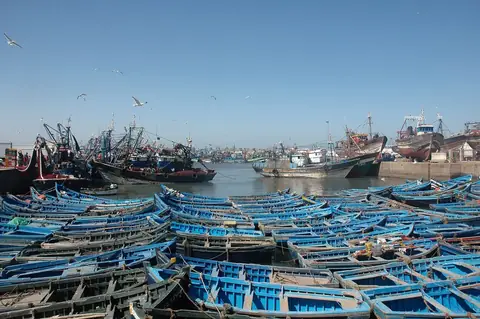
Essaouira
Day trip or two nights in Essaouira: the Skala ramparts, the port and its fish grills, the beach, the CTM coach from Marrakech, riads and costs.
Read the guide
First trip to Morocco
Choose seven days or ten for Marrakech, the Sahara at Merzouga and Fes: the order of the cities, the desert road, the season, entry, cash and the medina basics.
Read the guide
Morocco festivals and events 2027
Morocco's year by month: Ramadan and the Eids, public holidays, the Fes sacred music festival, Gnaoua in Essaouira, Mawazine, the rose festival and Imilchil.
Read the guide
Morocco trip cost
Ten days from Rabat through Chefchaouen and Fes to the Sahara and Marrakech: about MAD 9,600 per person on a budget, 11,200 mid-range or 18,400 in comfort.
Read the guideSources and checks before you travel
(10)
- Visit Morocco (Moroccan National Tourism Office): food and drinks ↗ — opens in a new tab
- Visit Morocco: Morocco through gastronomy (brochure) ↗ — opens in a new tab
- Visit Morocco: gastronomy ↗ — opens in a new tab
- UNESCO Intangible Cultural Heritage: couscous ↗ — opens in a new tab
- Le Jardin Marrakech: menu ↗ — opens in a new tab
- Le Jardin Marrakech: home ↗ — opens in a new tab
- Nomad Marrakech: menu ↗ — opens in a new tab
- Café Clock: traditional Moroccan cooking class ↗ — opens in a new tab
- Café Clock: contact ↗ — opens in a new tab
- Café Clock: FAQ about our classes ↗ — opens in a new tab
Reference sources for the version dated 28 November 2026. Confirm opening times, access, transport and conditions for your travel dates.
Photo credits
(7)
A tagine in its terracotta dish, with bread to scoop it up
Photograph: Houssain tork — opens in a new tab · CC BY-SA 4.0 — opens in a new tab
Changes: Resized and converted to WebP; displayed with responsive crops. · Original photograph and licence details ↗ — opens in a new tab
Pigeon pastilla in Fes, the city's proudest dish
Photograph: Slg04 — opens in a new tab · CC BY-SA 4.0 — opens in a new tab
Changes: Resized and converted to WebP; displayed with responsive crops. · Original photograph and licence details ↗ — opens in a new tab
Couscous with meat and vegetables, the traditional Friday lunch
Photograph: Arnaud 25 — opens in a new tab · CC BY-SA 4.0 — opens in a new tab
Changes: Resized and converted to WebP; displayed with responsive crops. · Original photograph and licence details ↗ — opens in a new tab
Harira with dates, the soup that breaks the fast in Ramadan
Photograph: Atiqa ezahiri — opens in a new tab · CC BY-SA 4.0 — opens in a new tab
Changes: Resized and converted to WebP; displayed with responsive crops. · Original photograph and licence details ↗ — opens in a new tab
A snail stall on Jemaa el-Fnaa, where bowls of snails come in a spiced broth
Photograph: Elgaard — opens in a new tab · CC BY-SA 4.0 — opens in a new tab
Changes: Resized and converted to WebP; displayed with responsive crops. · Original photograph and licence details ↗ — opens in a new tab
A glass of mint tea in Marrakech, served with every meal and pause
Photograph: Adam Harangozó — opens in a new tab · CC BY-SA 4.0 — opens in a new tab
Changes: Resized and converted to WebP; displayed with responsive crops. · Original photograph and licence details ↗ — opens in a new tab
A tagine in its shallow clay dish in Marrakech, with sliced potato and tomato on top
Photo: Yuki Ikemori