Ma'an
Petra: the Siq, the Treasury and the Monastery in two days
Petra is the city the Nabataeans cut into the sandstone of southern Jordan more than 2,000 years ago, and it is far bigger than the Treasury photograph suggests. A gorge just over 1.2 km long, the Siq, leads to the Treasury; beyond it a street of tomb facades, a theatre and the Royal Tombs open into a valley with a Roman colonnaded street and the temple of Qasr al-Bint, and some 800 steps above them stands the Monastery. One day covers the main trail at a walk. Two days, on a ticket that costs only JOD 5 more, add the Monastery, the High Place of Sacrifice and the quieter trails at the right hour of the day.
In this guide
Find the location ↗ — opens in a new tabThe short answer
Book two nights in Wadi Musa, the town at the gate, and buy the two-day ticket: JOD 55 for visitors staying overnight in Jordan (one day is JOD 50; a day visitor who does not stay a night in Jordan pays JOD 90), or a Jordan Pass that includes it, bought before you arrive. Spend the first day on the Siq, the Treasury, the Royal Tombs and the colonnaded street, and the second on the Monastery and the High Place. Petra by Night costs JOD 30 on Sunday to Thursday evenings and is not included in any day ticket or the Jordan Pass. The site is open from 06:30 to 17:00 until 1 March 2027.
- Suggested time
- 2 nights in Wadi Musa
- Where to stay
- Wadi Musa, near the Petra Visitor Centre
- Season and timing
- March to May and September to November are the mildest months; summer middays are hot on the open trails, and winter rain can bring flash floods.
Two nights in Wadi Musa, at the gate
There is nowhere to sleep inside the archaeological park, so the base is Wadi Musa, the town that runs uphill from the Petra Visitor Centre. Sleep as close to the Visitor Centre as you can afford, so that a short walk to the gate makes an opening-time start easy. Two nights give two full days inside, with the evening between them free for Petra by Night or a cooking class.
The hotels closest to the gate stand on Tourism Street, which leads to the entrance. Our where-to-stay guide names hotels in Wadi Musa with their rates and compares the towns for a longer trip.
Day one: the Siq, the Treasury and the city centre
The main trail runs 3.9 km one way from the Visitor Centre to Qasr al-Bint, about 1 hour 30 to 1 hour 45 minutes without stopping, and it is easy walking on sand and old paving. In Bab al-Siq, about 400 metres from the Visitor Centre, three square Djinn Blocks stand cut free from the rock on four sides, among the oldest monuments in Petra, probably from the 2nd century BC. Above the path, the Obelisk Tomb carries four tall pyramids over a dining hall where funeral banquets were held.
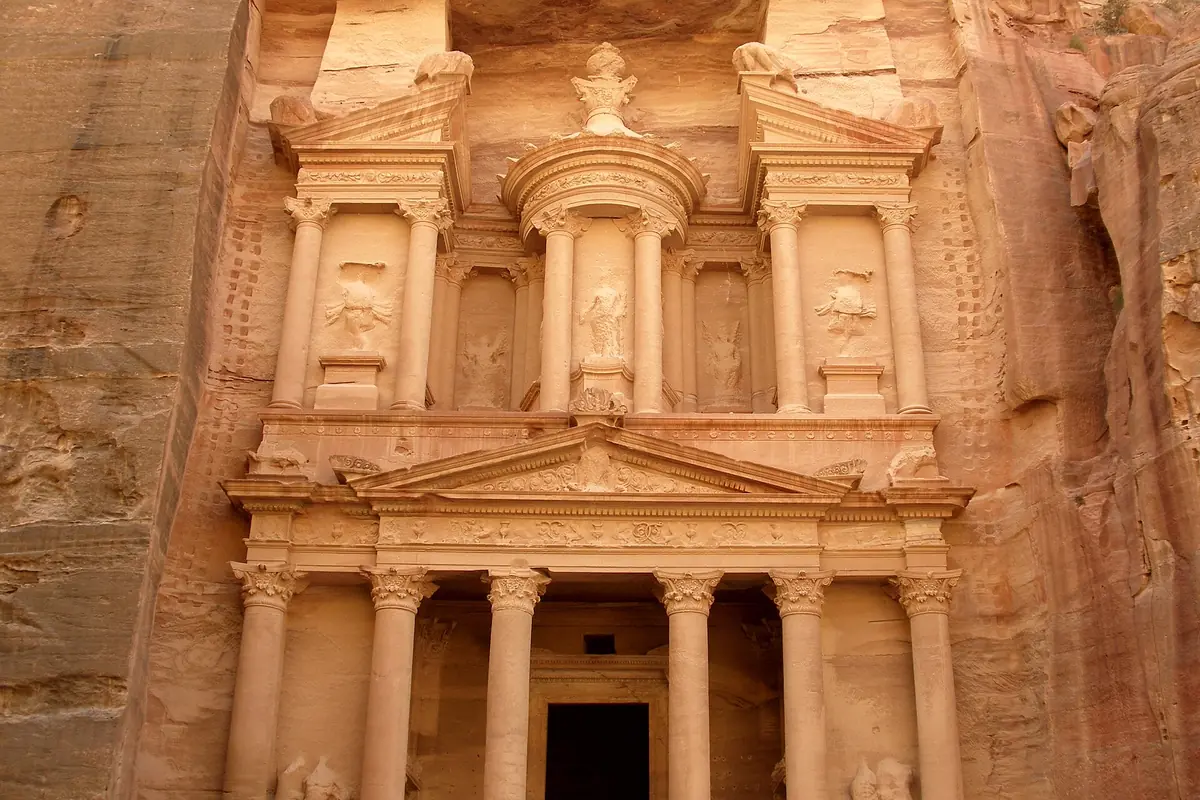
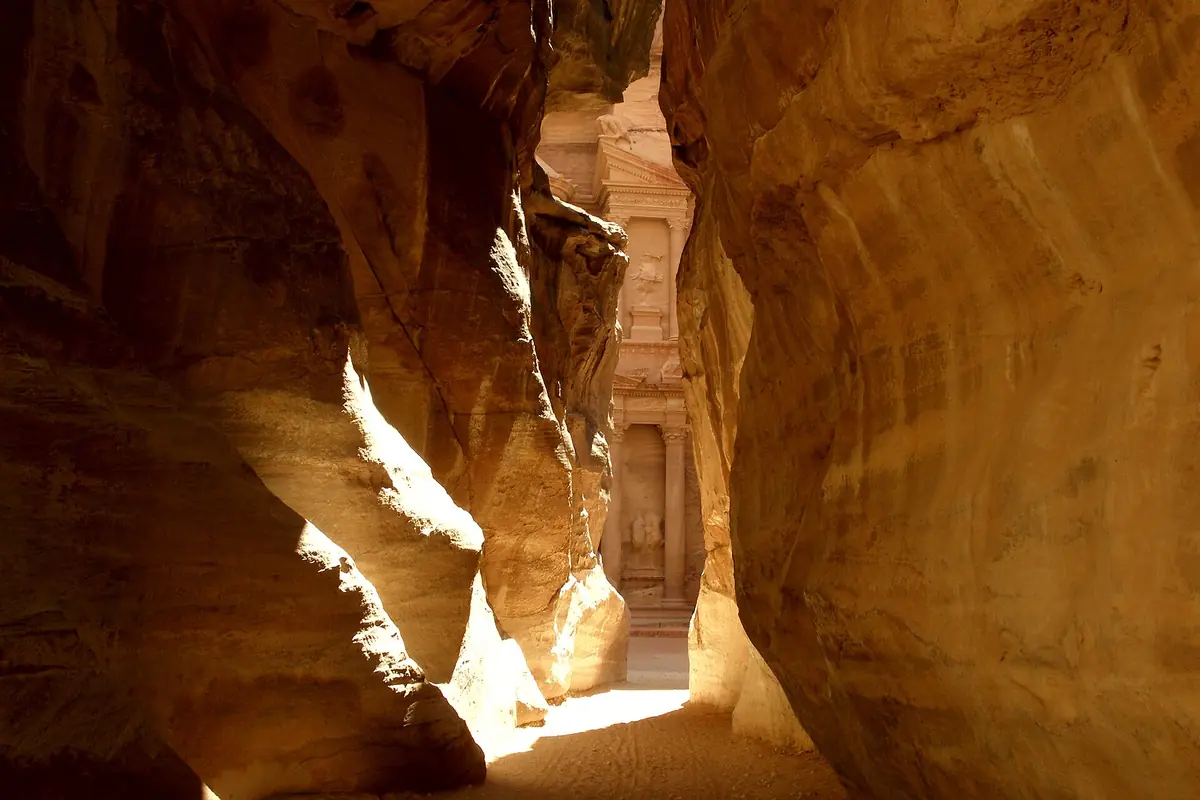
The Siq is a natural cleft in the sandstone that winds for just over 1.2 km and narrows in places to 3 metres. Look for the two water channels along its walls, a clay pipe on the north side that carried spring water from Wadi Musa and a covered channel cut into the rock on the south side, and for the stretches of original Nabataean paving. The gorge opens without warning onto the Treasury (Al-Khazna), 39.5 metres high and carved from the cliff face, with Corinthian capitals, winged griffins and figures of Isis on its facade. The Treasury was possibly the tomb of King Aretas IV, who ruled from 9 BC to AD 40. In 2003 archaeologists found three royal tombs beneath the Treasury.
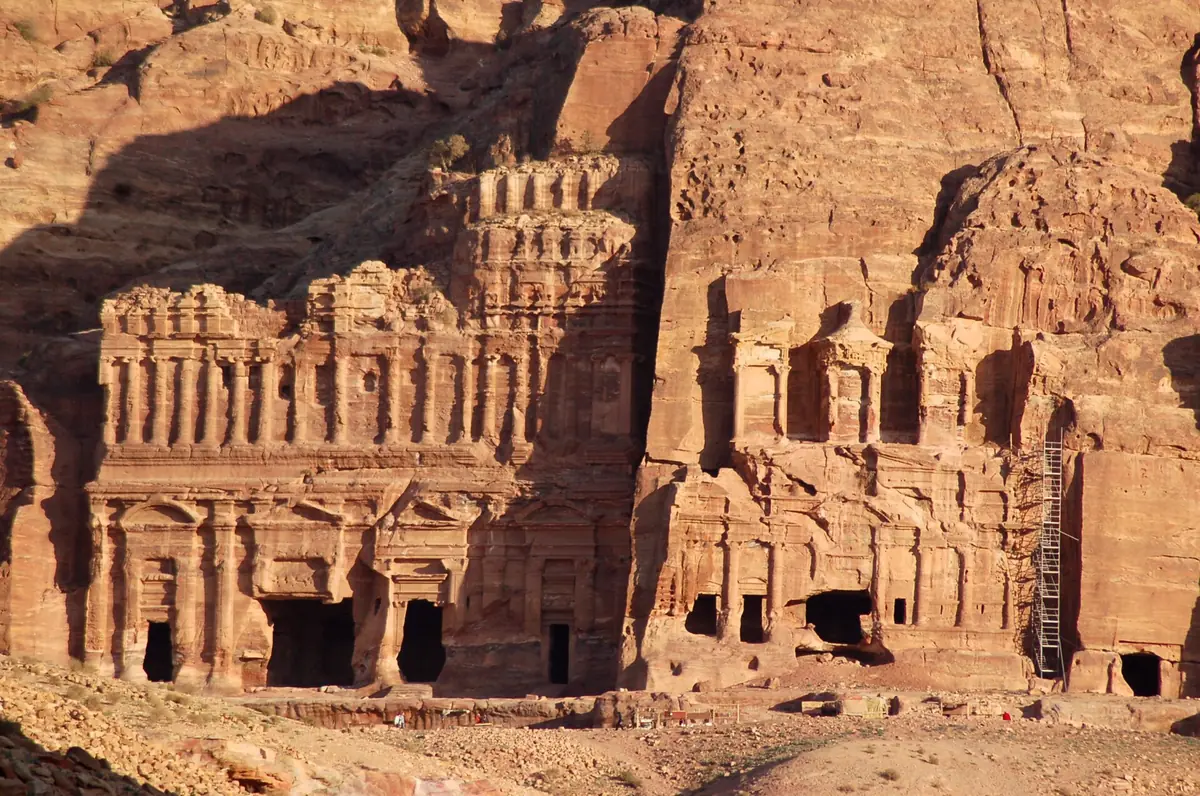
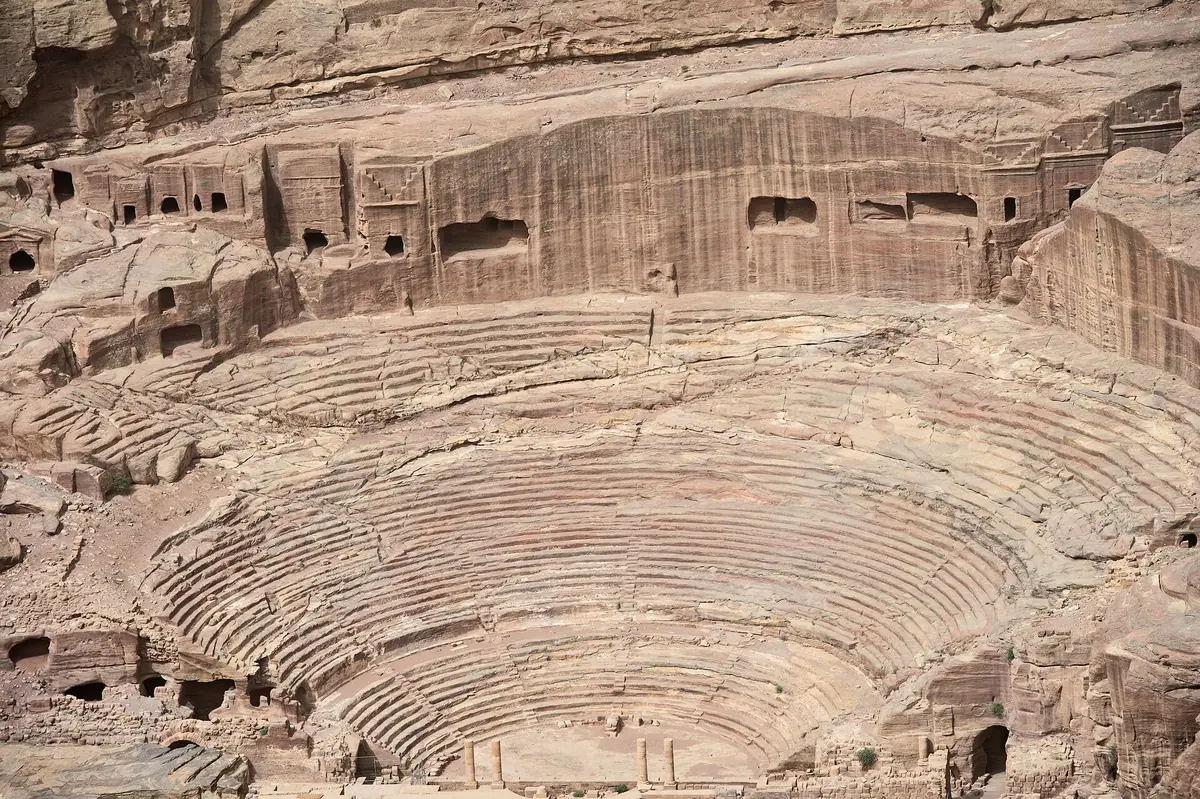
Past the Treasury the valley widens into the Outer Siq and the Street of Facades, rows of tombs cut into the cliffs, then the Theatre, carved out of the rock; it may date to the early 1st century AD, under Aretas IV. Opposite, on the western face of al-Khubtha, stand the four Royal Tombs: the Urn Tomb, the Silk Tomb with its streaked stone, the Corinthian Tomb and the three-storey Palace Tomb. The Urn Tomb was turned into a cathedral by Bishop Jason in the mid-5th century, and its terrace still gives the best view back over the city.
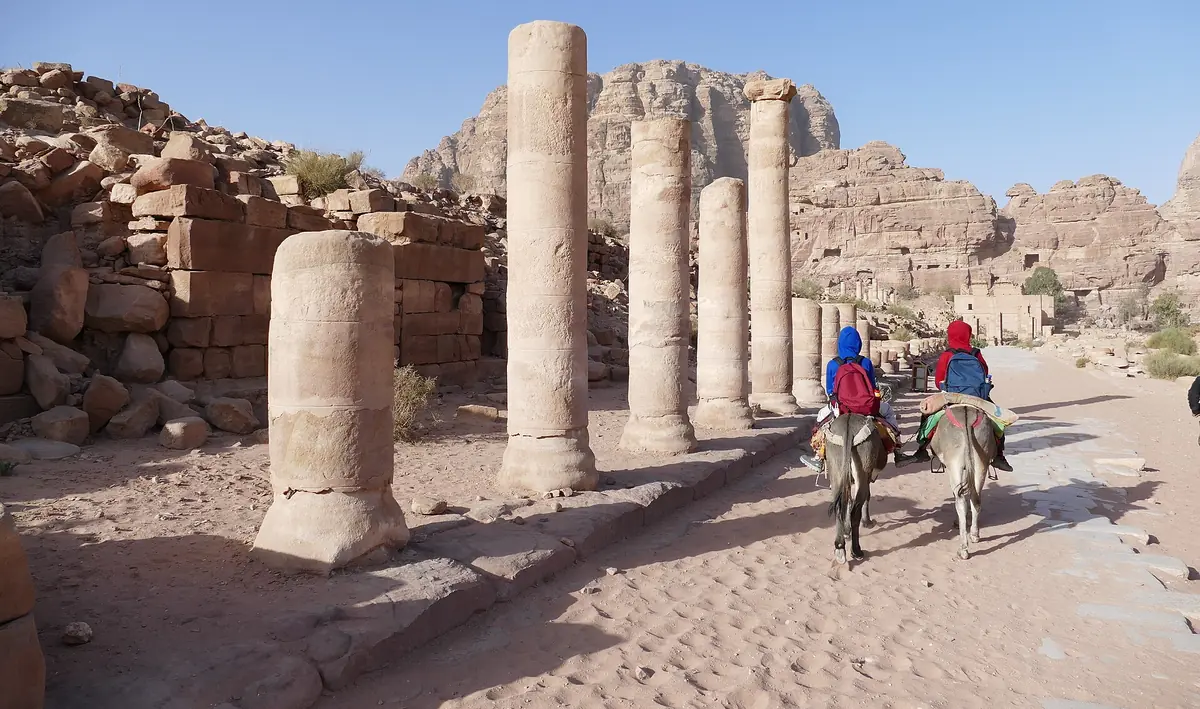
The Colonnaded Street was laid by the Romans in the 2nd century AD over an older Nabataean street that followed the course of the Wadi Musa stream. Beside it rises the Great Temple complex, which covers 7,560 square metres and is by far Petra's largest building. The street ends at the Temenos Gate and Qasr al-Bint, the oldest and most venerable temple of Petra, where two restaurants and the museums inside the park make a natural lunch stop. Walk back the same way through the Siq in the afternoon.
Day two: the Monastery and the High Place of Sacrifice
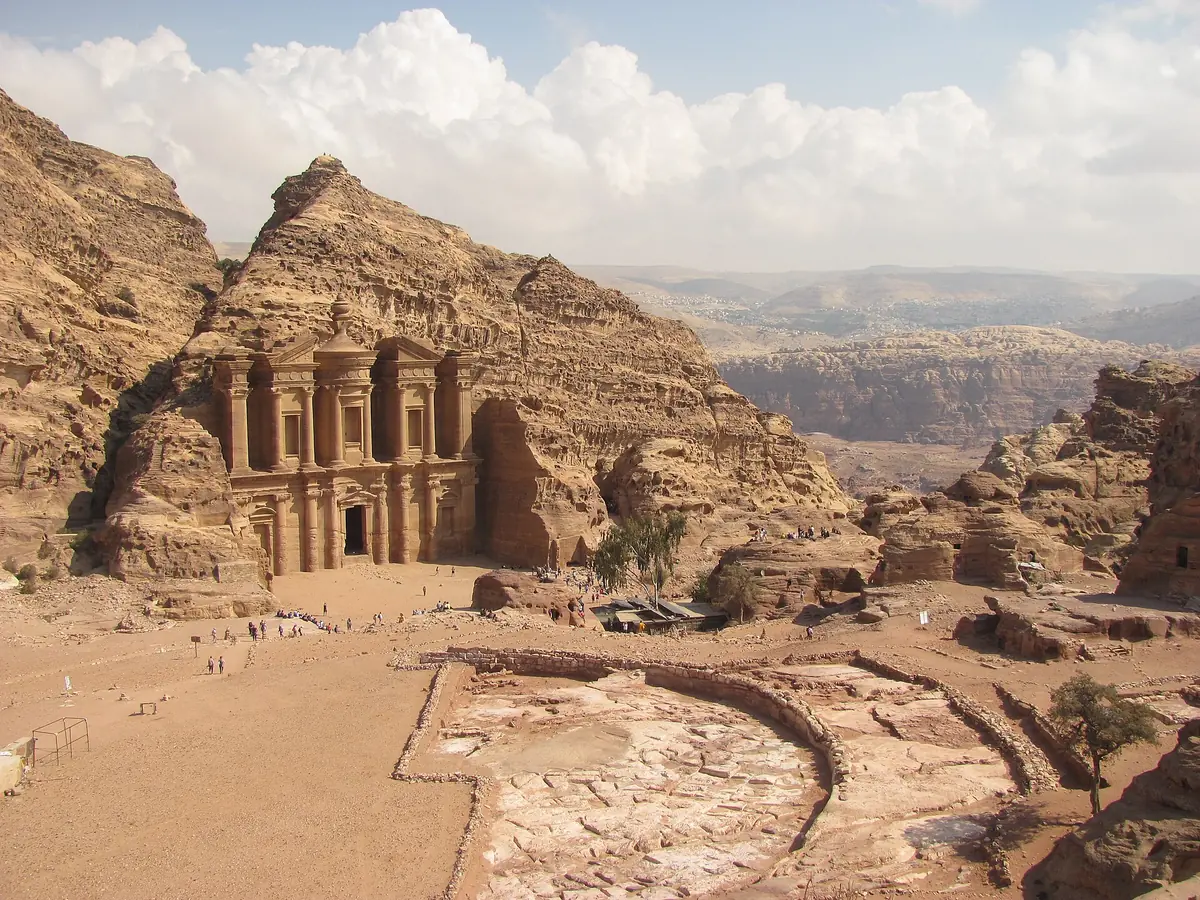
Start early on the main trail again and climb to the Monastery (ad-Dayr) from the stairway behind Qasr al-Bint: about 1.6 km and some 800 rock-cut steps, 1 hour 30 to 1 hour 45 minutes at a steady pace, past the Lion Triclinium. The trail is not dangerous but needs moderate fitness, sturdy shoes and water. The Monastery is one of the largest monuments in Petra, a facade carved deep into the cliff of Jabal ad-Dayr, and a few minutes beyond it a viewpoint looks west over dry mountains to Wadi Araba. The afternoon light is warmest on the facade, so a late climb also works if you come down well before closing.
The High Place of Sacrifice is the other climb. The Al Madras trail leaves the main trail after the Obelisk Tomb and climbs a Nabataean stairway about 3 metres wide to the summit, where an altar was cut for rituals and offerings, with views over the sandstone mountains around Petra. The trail then comes down through Wadi Farasa past the Lion Fountain, the Garden Hall, the Roman Soldier Tomb and the Renaissance Tomb: 4.8 km in all, 2 hours 45 minutes to 3 hours. On a two-day ticket, do the Monastery one day and the High Place on the other morning.
The Back Trail to the Monastery starts at Siq al-Barid, called Little Petra, a ten-minute drive north of Petra: 7 km through farmland and rough ground past the Neolithic village of al-Bayda, 3 hours 15 to 3 hours 30 minutes, ending with the Monastery stairs from above. PDTRA lists it among its public trails with no guide rule, but its safety tips ask visitors to keep to the main trails unless they have a guide, so a first-time walker is better off with a local guide, booked at the Visitor Centre. Jordan Pass holders who start this way show their pass at the Little Petra ticket office first, open 07:00 to 14:00 until 1 March 2027. Without the hike, PDTRA's shuttle runs from the Visitor Centre to the Nabataean Cultural Village in al-Bayda, where a 4×4 to Little Petra and on along the back road to the start of the Monastery trail costs JOD 5 one way, daily from 07:30 to 15:00.
Tickets, opening hours and Petra by Night
Visitors who spend at least one night in Jordan pay JOD 50 for one day, JOD 55 for two days and JOD 60 for three; two- and three-day tickets must be used on consecutive days. A visitor who does not stay overnight in Jordan pays JOD 90 for one day. Children under 12 enter free by day, and the ticket office asks for your passport. Pay in cash in Jordanian dinars or by Visa card at the Visitor Centre, or buy online through Petra Pass, the authority's ticket site. Holders of a JOD 50 ticket can extend their visit for JOD 5 at the Visitor Centre.
The Jordan Pass includes Petra: the Wanderer at JOD 70 gives one day, the Explorer at JOD 75 two consecutive days and the Expert at JOD 80 three, with free entry to over 40 attractions. The pass also waives the JOD 40 tourist visa fee if you buy it before arrival and stay at least three nights in Jordan, as the UK government advises (the pass site's own minimum is two nights, three days). If you leave sooner, immigration asks you to pay the fee as you depart. All Jordan Pass sales are final. For two days in Petra with a night in Wadi Rum, the Explorer at JOD 75 replaces the two-day ticket (JOD 55), the visa fee (JOD 40) and the Wadi Rum entry (JOD 5), which come to JOD 100. The entry guide explains the visa side.
Until 1 March 2027 the site and the Visitor Centre open from 06:30 to 17:00; check the summer hours from 2 March on visitpetra.jo (in summer 2026 they were 06:00 to 18:00). Leave the park before closing: the UK Foreign Office warns that visitors found inside outside opening hours risk arrest. The Petra Museum, a three-minute walk from the main gate, opens every day from 08:30 to 19:30; its five halls hold 280 objects on Nabataean life.
Petra by Night runs every Sunday, Monday, Tuesday, Wednesday and Thursday from 20:30 to about 22:30: a walk along a path of candles through the Siq to the Treasury, which is then lit with projections and narration. The show costs JOD 30 per person, and children under 10 go free. To buy a ticket you need a daytime Petra ticket or a Jordan Pass. The Petra by Night office in the Visitor Centre sells tickets on the day only, and each ticket is valid only on the day it is issued. Arrive ten minutes early.
Licensed guides are booked at the Visitor Centre: JOD 50 for the main trail, JOD 100 for the main trail with the High Place or with the Monastery. Golf carts wait at the Visitor Centre without booking and run daily from 07:00 to 18:00: JOD 15 one way between the Visitor Centre and the Treasury or JOD 25 return, and JOD 10 one way or JOD 15 return between the Theatre and Qasr al-Bint. From the viewpoints on the cliffs opposite the Treasury you look down onto its facade: PDTRA's activity page gives JOD 10 for those viewpoints and JOD 15 for all its viewpoints, daily from 06:30 to 17:00, but its fee list gives JOD 15 for the viewpoints opposite the Treasury. Check the price and which viewpoints it covers at the Visitor Centre. Use only licensed transport inside the park, and fly no drone without a permit.
Prices and times checked 29 November 2026
Getting to Petra, and on to Wadi Rum
Petra is about 235 km from Amman by the Desert Highway. JETT's coach leaves Amman's Abdali terminal at 06:30 and reaches Petra at 10:30; it costs JOD 10 a seat, JOD 11 per adult in total when booked online on jett.com.jo, and the return leaves Petra at 17:00. Public minibuses leave Amman's South station between 09:00 and 16:00 and come back from Petra between 06:00 and 13:00; no departure times are published for them. By car, allow about 3 hours on the Desert Highway or 4 hours on the slower King's Highway; follow the brown tourist signs from Amman's 7th Circle. Airport taxis at Queen Alia International Airport charge the fares fixed by the Land Transport Regulatory Commission, posted at the stand, and can take you straight to Wadi Musa. Plan the drive to end before dark. Our transport guide covers car hire and the rules of the road.
Wadi Rum is the usual next stop, about 107 km away, 1.5 to 2 hours by car; leave Wadi Musa in the morning and you reach the desert in time for an afternoon jeep tour. Without a car, Wadi Rum Nomads lists the daily Rum Bus, which picks up at Wadi Musa hotels between 06:00 and 06:30 and reaches Rum village around 09:00 for JOD 10 a person. A taxi from Wadi Musa costs JOD 40 per car and takes about 2 hours. Camps also arrange private transfers when you book the night. France advises against "the city of Aqaba and its surroundings" except for an imperative reason, because of missile and drone fire since 17 July 2026. Its advice does not say whether Wadi Rum, about 66 km from Aqaba, counts as Aqaba's surroundings, so French readers should check with France Diplomatie before booking. Germany advises against non-essential travel to the rest of Jordan, Petra included; health and safety compares each government's advice.
Little Petra (Siq al-Barid), a ten-minute drive north, was a resting place for caravans: a narrow cleft like a small Siq opens onto rock-cut tombs, temples, cisterns and dining halls, and one biclinium keeps a Nabataean fresco of grape vines.
Prices and times checked 28 November 2026
What two days in Petra cost
Petra's own costs for two days come to about JOD 135 per person if you take a guide for the main trail with the Monastery and see Petra by Night, and JOD 55 if you walk the trails yourself and skip the evening. Rooms are not included; the where-to-stay guide gives room rates.
| Item | Per person |
|---|---|
| Two-day ticket (staying in Jordan) | JOD 55 |
| Petra by Night | JOD 30 |
| Guide, main trail and Monastery (JOD 100 shared by two) | JOD 50 |
| Total with guide and Petra by Night | about JOD 135 |
A Jordan Explorer pass at JOD 75 replaces the JOD 55 ticket, waives the JOD 40 visa fee and covers Wadi Rum's JOD 5 entry and other sites on the route. A golf cart to the Treasury and back adds JOD 25, and the 4×4 to the Monastery trail JOD 5.
Prices and times checked 28 November 2026
What to eat and where to look
Mansaf
Jordan's national dish: lamb on rice with a broth of jameed, dried fermented yoghurt, served on one large platter and eaten with the right hand at weddings and family gatherings.
- Where to look
- Family restaurants on the main street of Wadi Musa, usually as a lunch dish.
- Fit it into your day
- Lunch after day two, once the climbs are done.
Zarb
The Bedouin way to roast: lamb or chicken cooked in a pit about one metre deep, sealed so the meat takes on a smoky taste.
- Where to look
- Bedouin camps around Little Petra and Wadi Musa restaurants that cook it in their own pit.
- Fit it into your day
- Dinner on the first evening.
Maqluba
"Upside down": rice cooked in layers with fried vegetables and chicken or meat, then turned out onto the plate.
- Where to look
- Petra Kitchen in Wadi Musa, whose evening classes cook a family menu with local chefs.
- Fit it into your day
- The evening between the two days, if you skip Petra by Night.
Taboun bread
The thicker Jordanian flatbread, baked fresh and eaten with soups and hot dishes, as against the thin Bedouin shrak.
- Where to look
- Loran's Kitchen, the "Disco Bakery" among PDTRA's listed experiences in Petra, where guests bake taboun bread and then eat it at a breakfast.
- Fit it into your day
- Breakfast on the morning you leave Petra.
Practical questions
How many days do you need in Petra?
Two days. One covers the Siq, the Treasury, the Royal Tombs and the colonnaded street; the second adds the Monastery and the High Place of Sacrifice. A two-day ticket costs JOD 55, only JOD 5 more than one day.
How much is the Petra ticket?
JOD 50 for one day, JOD 55 for two and JOD 60 for three consecutive days if you spend at least a night in Jordan; JOD 90 for a day visitor who does not. Children under 12 enter free by day.
Is Petra included in the Jordan Pass?
Yes: the Wanderer (JOD 70) includes one day, the Explorer (JOD 75) two and the Expert (JOD 80) three. Petra by Night is not included.
What are Petra's opening hours?
06:30 to 17:00 until 1 March 2027. Check the summer hours from 2 March on visitpetra.jo; in summer 2026 they were 06:00 to 18:00. Be out of the park by closing time.
When is Petra by Night?
Sunday to Thursday from 20:30 to about 22:30, for JOD 30. Buy the ticket at the Visitor Centre on the day; you need a daytime ticket or a Jordan Pass.
How long is the walk to the Monastery?
From Qasr al-Bint about 1.6 km and some 800 steps, 1 hour 30 to 1 hour 45 minutes up. Qasr al-Bint is itself 3.9 km from the Visitor Centre.
How do I get from Amman to Petra?
JETT's coach leaves Abdali at 06:30 and reaches Petra at 10:30, for JOD 11 per adult booked online, and returns at 17:00; minibuses leave the South station from 09:00 to 16:00. By car it is about 3 hours on the Desert Highway.
Keep planning your trip
Wadi Rum
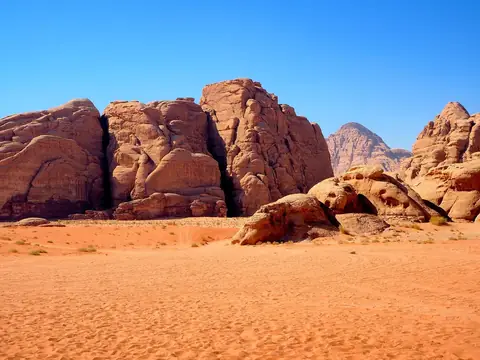
One night in a Wadi Rum camp after Petra: the jeep tour, Lawrence's Spring, Khazali Canyon and Burdah, with the entry fee, tour prices and the drive in daylight.
Read the guide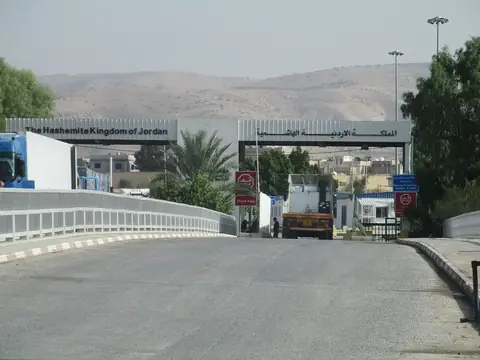
Entering Jordan
Who gets Jordan's JOD 40 visa on arrival, when the Jordan Pass waives it, the free Aqaba zone visa, which land borders issue visas, and what customs asks.
Read the guide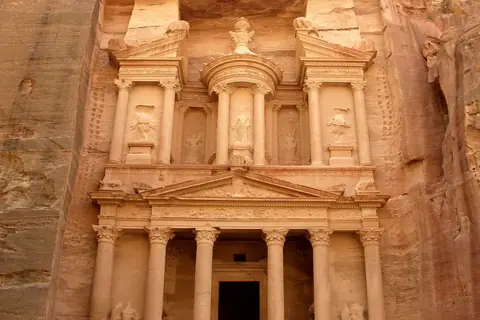
Transport in Jordan
Get around Jordan: the JETT bus to Petra, the Desert, King's and Dead Sea highways by hire car, airport buses and taxis, apps, and the places no bus reaches.
Read the guide
Jordan in seven days
Seven days by hire car from Amman airport: Amman and Jerash, the King's Highway to Petra, a Wadi Rum camp night and the Dead Sea, with the costs for two.
Read the guide
Best time to visit Jordan
Choose your Jordan dates: spring and autumn for Petra and Wadi Rum, the summer heat, winter rain, snow and flash floods, Ramadan 2027 and the Eids, month by month.
Read the guide
First trip to Jordan
How many days a first Jordan trip needs, the order of Amman, Petra, Wadi Rum and the Dead Sea, how to get between them, and what to book before you fly.
Read the guideSources and checks before you travel
(37)
- Visit Petra (PDTRA): Petra fees ↗ — opens in a new tab
- Visit Petra (PDTRA): opening hours ↗ — opens in a new tab
- Visit Petra (PDTRA): getting to Petra ↗ — opens in a new tab
- Visit Petra (PDTRA): the Main Trail ↗ — opens in a new tab
- Visit Petra (PDTRA): Al Dayr Trail 1 ↗ — opens in a new tab
- Visit Petra (PDTRA): Al Madras Trail ↗ — opens in a new tab
- Visit Petra (PDTRA): Back Trail / al Dayr Trail ↗ — opens in a new tab
- Visit Petra (PDTRA): Inside Petra ↗ — opens in a new tab
- Visit Petra (PDTRA): Argoob Jumay'an Trail ↗ — opens in a new tab
- Visit Petra (PDTRA): tips ↗ — opens in a new tab
- Visit Petra (PDTRA): FAQs ↗ — opens in a new tab
- Visit Petra (PDTRA): Petra Archaeological Park ↗ — opens in a new tab
- Petra by Night (official operator) ↗ — opens in a new tab
- Visit Petra (PDTRA): Petra by Night ↗ — opens in a new tab
- Jordan Pass (Ministry of Tourism and Antiquities): packages ↗ — opens in a new tab
- Jordan Tourism Board: Petra ↗ — opens in a new tab
- Jordan Tourism Board: entrance fees ↗ — opens in a new tab
- Jordan Tourism Board: feasting in Jordan ↗ — opens in a new tab
- Visit Aqaba (ASEZA): Petra ↗ — opens in a new tab
- Visit Aqaba (ASEZA): Wadi Rum ↗ — opens in a new tab
- Visit Aqaba (ASEZA): eat and drink ↗ — opens in a new tab
- Petra Kitchen ↗ — opens in a new tab
- Mövenpick Resort Petra ↗ — opens in a new tab
- UK Foreign Office: Jordan safety and security ↗ — opens in a new tab
- France Diplomatie: Jordanie, conseils aux voyageurs (full advice, PDF, French) ↗ — opens in a new tab
- Jordan Pass (Ministry of Tourism and Antiquities): FAQs ↗ — opens in a new tab
- Jordan Pass (Ministry of Tourism and Antiquities): cancellation policy ↗ — opens in a new tab
- Visit Petra (PDTRA): nearby attractions ↗ — opens in a new tab
- Germany, Auswärtiges Amt: Jordanien, Reise- und Sicherheitshinweise (German) ↗ — opens in a new tab
- JETT: live schedule and booking ↗ — opens in a new tab
- Queen Alia International Airport: to and from the airport ↗ — opens in a new tab
- Wadi Rum Nomads: how to get to Wadi Rum ↗ — opens in a new tab
- Jordan Tourism Board: Petra, how to get there ↗ — opens in a new tab
- Visit Petra (PDTRA): the view in front of the Treasury ↗ — opens in a new tab
- Visit Petra (PDTRA): Back Trail / tourist transport vehicles ↗ — opens in a new tab
- Visit Petra (PDTRA): Loran's Kitchen ↗ — opens in a new tab
- UK FCDO: Jordan entry requirements ↗ — opens in a new tab
Reference sources for the version dated 29 November 2026. Confirm opening times, access, transport and conditions for your travel dates.
Photo credits
(7)
The Treasury at the end of the Siq
Photograph: Vyacheslav Argenberg — opens in a new tab · CC BY 4.0 — opens in a new tab
Changes: Resized and converted to WebP; displayed with responsive crops. · Original photograph and licence details ↗ — opens in a new tab
The last bend of the Siq, with the Treasury beyond
Photograph: Vyacheslav Argenberg — opens in a new tab · CC BY 4.0 — opens in a new tab
Changes: Resized and converted to WebP; displayed with responsive crops. · Original photograph and licence details ↗ — opens in a new tab
The Monastery and the mountains to the west
Photograph: Trldp — opens in a new tab · CC BY-SA 4.0 — opens in a new tab
Changes: Resized and converted to WebP; displayed with responsive crops. · Original photograph and licence details ↗ — opens in a new tab
Two of the Royal Tombs on al-Khubtha
Photograph: twiga-swala — opens in a new tab · CC BY-SA 2.0 — opens in a new tab
Changes: Resized and converted to WebP; displayed with responsive crops. · Original photograph and licence details ↗ — opens in a new tab
The colonnaded street towards Qasr al-Bint
Photograph: Ankur P — opens in a new tab · CC BY 2.0 — opens in a new tab
Changes: Resized and converted to WebP; displayed with responsive crops. · Original photograph and licence details ↗ — opens in a new tab
The theatre cut into the rock
Photograph: Dosseman — opens in a new tab · CC BY-SA 4.0 — opens in a new tab
Changes: Resized and converted to WebP; displayed with responsive crops. · Original photograph and licence details ↗ — opens in a new tab
The Treasury at Petra in the morning, with a saddled camel standing in front of it
Photo: Yuki Ikemori